
By Dan Ninham
By day Shawna Grapentine works in the American Indian Education Department at Warroad Public Schools. Outside the day she has been an aspiring artist with a distinctive and unique art style that she expanded into a business. She has a website called “Moon and Back Custom Arts.” See https://moonandbackcustomarts.com/
The NHL Minnesota Wild not only hosted the Colorado Avalanche in a recent game. The organization also hosted the Native American Heritage Day at the Grand Casino Arena in St. Paul.
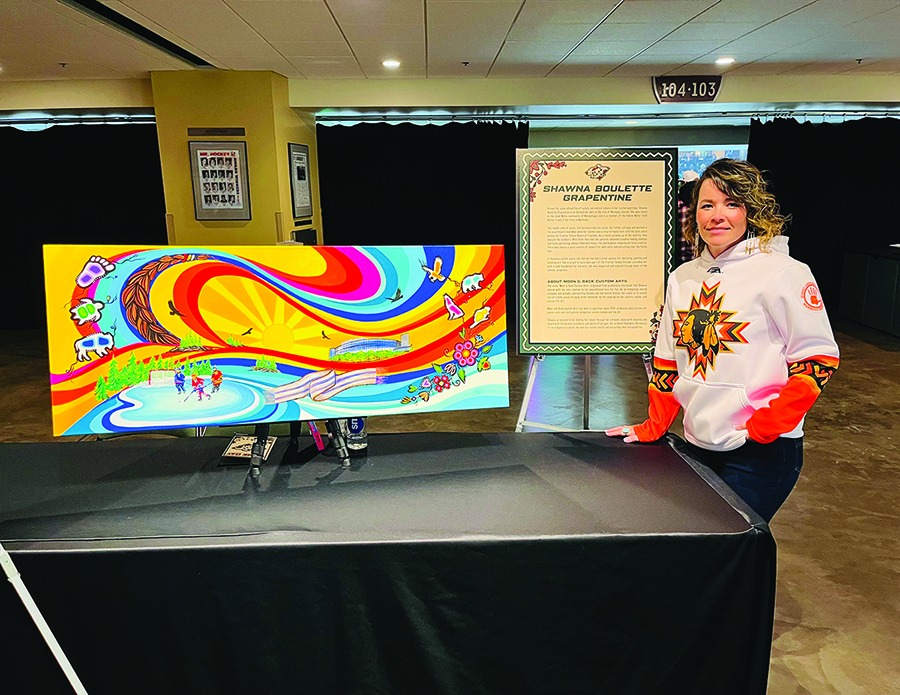
A small-scale mural for the upcoming International Ice Hockey Federation’s (IIHF) World Junior Championships was showcased during the Wild and Avalanche game and bridges the Native American and hockey communities. The artwork will be enlarged in the visitors village and throughout the venues.
Oji-Cree artist Shawna Grapentine is a member of the Hollow Water First Nation and she designed the artwork. The artwork is titled “Land of 10,000 Rinks.”
The 2026 IIHF World Junior Championship will be held at the end of December and early January in St. Paul. The event will host several world class level hockey teams for under 20 year olds. The local organizing committee with Minnesota Sports and Events is called Assist 26 and is in partnership with USA Hockey.
The Assist 26 initiative aims to build equity, access and across the state of Minnesota.
In a press statement by Minnesota Sports and Events, the mural “brings together Indigenous teachings, Minnesota’s hockey heritage, and the natural beauty of the State of Hockey.”
Grapentine has a past connection with the IIHF. In April of 2023 she was one of four Indigenous artist’s chosen from across Canada to design the “Player of the Game” Hockey sticks for the IIHF Womens World Championships.
Interview:
DN: How and when did you develop your current artistic styles?
SG: My artwork style has evolved over the years. As a young girl, I always had a strong interest in the arts and being creative. The middle child of seven siblings, growing up in a large family, there were times when we had to go without certain things because my parents simply couldn’t afford the extras. While it wasn’t always easy, those experiences taught us to appreciate what we had and to be grateful for the little things.
My artistic style consists of bold, bright colours simply because I feel that the sight of bright colours is cheerful and brings me joy. It makes me happy, and this is what I hope others feel when they look at my artwork.
DN: Describe the processes of you being involved with the Wild’s Native American Heritage Day with the art mural and hoodie design and the artwork of the 2026 IIHF World Junior Hockey Championship.
SG: The “Land of 10,000 Rinks” mural project interested me because of the challenge in connecting the Native American culture and what hockey means in the state of Minnesota. To create an art piece that complements the meaningful connection between my Anishinaabe culture and the strong rooted heritage of hockey and what it means to me and many others intrigued me.
I was truly proud to be a part of this art project because it allowed me to shine a spotlight on the beauty of my Anishinaabe culture and to share what hockey has meant to me over the years. The many men in my life have always loved the sport of hockey; my brothers played, as did my brother-in-law, my husband, and now my son and nephew. Hockey has truly become a family tradition; it’s what we love to watch and what we live for.
DN: How does your Indigenous background influence your art?
SG: Much of my artwork is inspired by childhood memories: growing up by the lake, family traditions, and the simple joys of nature. Nothing resets me quite like being outdoors; nature has always been my greatest source of renewal. I feel a natural connection to the land; it’s an integral part of who I am. Being surrounded by nature brings me a sense of renewal and belonging that’s hard to describe. I believe that as Anishinaabe people, it’s simply a part of who we are.
DN: How do you think about keeping indigenous traditions alive while also exploring contemporary forms and imagery?
SG: I strive to keep my Indigenous culture alive through my artwork, using it as a way to educate and inspire others. Each piece is an opportunity to share the beauty and traditions of my heritage, and to encourage understanding and appreciation.
The artwork
The sun at the center of the artwork is a symbol that everyone can relate to, it’s a symbol of life, energy, balance and warmth. It’s a sacred connection to all of creation.
The seven grandfather teachings are the core values that guide each of us towards living a good life in harmony with others. The braid is a symbol of strength, unity and a sacred symbol of connection and identity, family, community and Mother Earth. Also, a single strand of hair is fragile, but when braided with all the other strands of hair is strong, a symbol that we are much stronger together and united rather than standing alone.
The Wampum Belt is a huge symbol throughout the course of history. The Wampum Belt was the first peace agreement between nations. It was used to record the great laws of peace between the Indigenous peoples and the Europeans.
The good old-fashioned pond hockey is what all hockey lovers can relate to growing up. It’s deeply rooted in our hockey heritage; it’s a part of who we are.
The Grand Casino Arena is a childhood dream for any kid playing organized hockey in the state of Minnesota. The goal is to compete in the Minnesota high school hockey tournament.
By creating this artwork piece, I hoped to draw the audience in and shine a light on the beauty of my Indigenous culture, along with the sport of hockey, which has brought so much joy to many families.
This mural not only serves as a visual celebration but also as a bridge between generations, encouraging conversations about shared values and traditions. Through each element, from the vibrant sun to the iconic pond hockey scene, I aimed to honour both the past and present, inviting viewers to reflect on their own connections to culture and sport.
====
Info on the 2026 IIHF World Junior Championship can be found at; https://www.iihf.com/en/events/2026/wm20