

By Lee Egerstrom
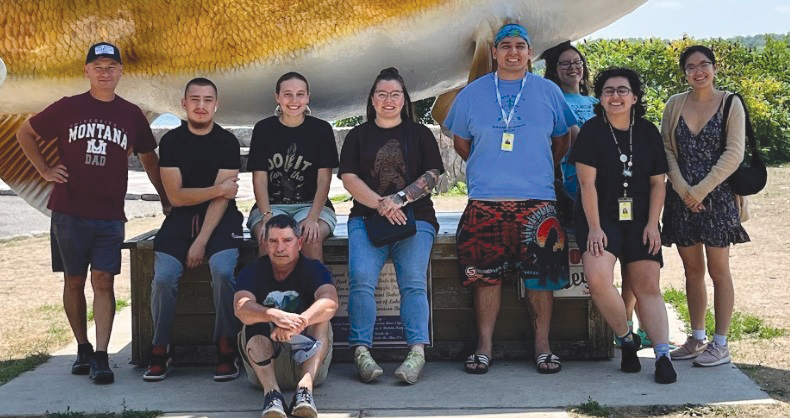
The task of compiling research, recovery and recognition materials on Native people, environments and cultures is well underway for six recent undergraduate students who have completed a Native American Museum Fellowship program at the Minnesota Historical Society.
These six, all with direct or distant ties to Minnesota’s tribal nations, now join an alumni of 98 fellows who have gone through the historical society’s training program, said Regan Kluver, program director for the society’s Native American Initiatives Department (NAI).
Undergraduate college students from 53 tribal nations, attending colleges and universities stretching from the Washington, D.C. area to University of California, Berkeley, have availed themselves to the society’s unique program, Kluver said.
A lot of them take on museum positions, become tribal curators or become tribal historical preservation officers, she said. They work in positions to preserve histories predating the creation of state boundaries, more recent tribal histories, with language revitalization, at art galleries, and a various museums and historic centers.
Kluver, who has White Earth and Red Lake ties, said restoring historical information can be complicated. Citing Minnesota examples, she said people and history can be confused by references to people being Anishinaabe, Chippewa and Ojibwe.
Add to that confusion with Dakota, Lakota and Nakota people and language variations, and uses of the Sioux name.
The Native American Undergraduate Museum Fellowship is a 10-week, paid internship involving three weeks of workshops and seminars and seven weeks of internship work on projects. Or, as MNHS describes it, it is “designed to engage and expose undergraduates to the professional opportunities within the museum, cultural resource, public history, and tribal historic preservation fields.”
It is one of several programs of the Native American Initiatives Department. Others include the Our Home: Native Minnesota exhibit at the Minnesota History Center in St. Paul, the Native American Artist-in-Residence program, the Reconnecting Our Roots program for teenagers, and providing Educational Resources for educators and partner groups.
This extensive NAI programs in Minnesota isn’t surprising. Minnesota Historical Society is the second largest such state association after New York, and programs reflect Minnesota’s growing commitment to undoing damage from past national and state assimilation programs that were dubbed “kill the Indian, save the child.”
Putting that in perspective, Kluver and Amber Annis, director of the Native American Initiatives, said in a joint statement NAI and other Native organizations are a direct results of past harmful public policies.
“The damage during the boarding school era, and the larger assimilation era, created devastating issues today that resulted in a larger absence of our voices in the dominant narrative. Our department seeks to repair those harms caused through the work we do. We advocate for, and celebrate, Native nations and Native people,” they said.
Internships are funded by a grant from the Mellon Foundation.
This year’s fellows included:
Eileen Bass, an enrolled member of the Sac & Fox Nation of Oklahoma (with Standing Rock and Muscogee ties), is a student pursuing a double major in Anthropology and English with a minor in creative writing at the University of Minnesota Twin Cities.
Her project involves digitalizing tribal newspapers from the 1980s and 1990s to make them available in Dakota and Anishinaabe languages for online research.
Taylor Fairbanks, from the White Earth and Ho-Chunk nations, is a Sociology and American Indian Studies major at the University of Minnesota-Twin Cities. She is also studying her Ojibwe language.
She has been working with Rita Walaszek Arndt, program and outreach manager for MHS’s Native American Initiatives department and curator of the Our Home: Native Minnesota, an exhibit at the Minnesota History Center in St. Paul.
Kluver said Fairbanks has been “pulling together” materials and data for a research and outreach guide to help people at the White Earth Nation, and for others doing research across Anishinaabe communities.
Some interns’ projects can be tied to areas far off reservation lands.
Jose Garcia, for example, has ties to both the Lower Sioux Indian Community and to White Earth Nation and is a student at St. Paul College. His internship project involves community engagement and worked with A’nia-Nicole Rae, a community engagement manager for the museum, on a St. Paul neighborhood project.
Garcia’s commitment to community started early. He and a brother started a youth-run nonprofit, Isaac’s Blessings Bags, when he was 15 to help feed and care for homeless during the COVID-19 pandemic in St. Paul. This included unsheltered relatives. (Program details can be found at: https://isaacsblessingbags.com.)
Raymond George Growingthunder, simply know as George, is working with the historical society’s exhibits department on developing skills for putting together community and other historical exhibits.
He is an enrolled member of the Fort Peck Assiniboine and Sioux Tribes in Montana and a student at the Institute of American Indian Art at Santa Fe, N.M. He has relatives at Cass Lake. Growingthunder works with aluminum, titanium, steel, brass, copper and acrylic materials for use in exhibits and installation. During his internship, he also worked on preparations for a traveling exhibit from the Smithsonian Institution called “Girlhood (It’s Complicated)”. It is scheduled to visit the Minnesota History Center from Aug. 31, 2024 to March 16, 2025.
Another museum intern, well-grounded in Minnesota, is Jim Kunesh, a Standing Rock Lakota descendant. He already has a bachelor’s degree in Anthropology from St. Cloud State University and is completing a degree in Geology and Human Services at the University of Minnesota, Morris.
Kunesh worked with MHS’ Jim Rankin, director of archeology, in inspecting Native historical sites, including soil testing. Museums, caring people and tribal leaders want information about sacred locations, Kluver said.
This work used drones to get aerial views of sites at Lower Sioux Indian Community and at Jeffers Petroglyphs, the 7,000 to 9,000-year-old historic and sacred site for Dakota people in southwestern Minnesota.
Gavin Zempel is the final intern from this year’s museum cohort. Also known as Wambdi Waste, or Good Eagle, he is Bdewakantunwan Dakota and a member of the Lower Sioux Indian Community.
Zempel is a Native American Studies and Psychology student at the University of Minnesota, Morris, with a minor degree in English. His internship research is in Indigenous language revitalization.
Also working with MNHS’ Walaszek Arndt, his work focused on creating a new research guide for the Lower Sioux community, and especially about the Battle of Birch Coulee that was a fierce battle site in the U.S.-Dakota War of 1862.
He also researched and wrote about the Pipestone Indian Boarding School that was of personal importance. His Lower Sioux ancestors were among young people taken there during its operating years (1892-1953).
“History matters,” Kluver said. “It keeps communities … so we don’t feel isolated.” The Minnesota Historical Society programs provide the connections.
Information about programs, historical sites, exhibits and goals of the Minnesota Historical Society can be found online at https://www.mnhs.org.
Information about the museum fellowship program is available at https://www.mnhs.org/internships/fellows/native-american.