

By Dan Ninham
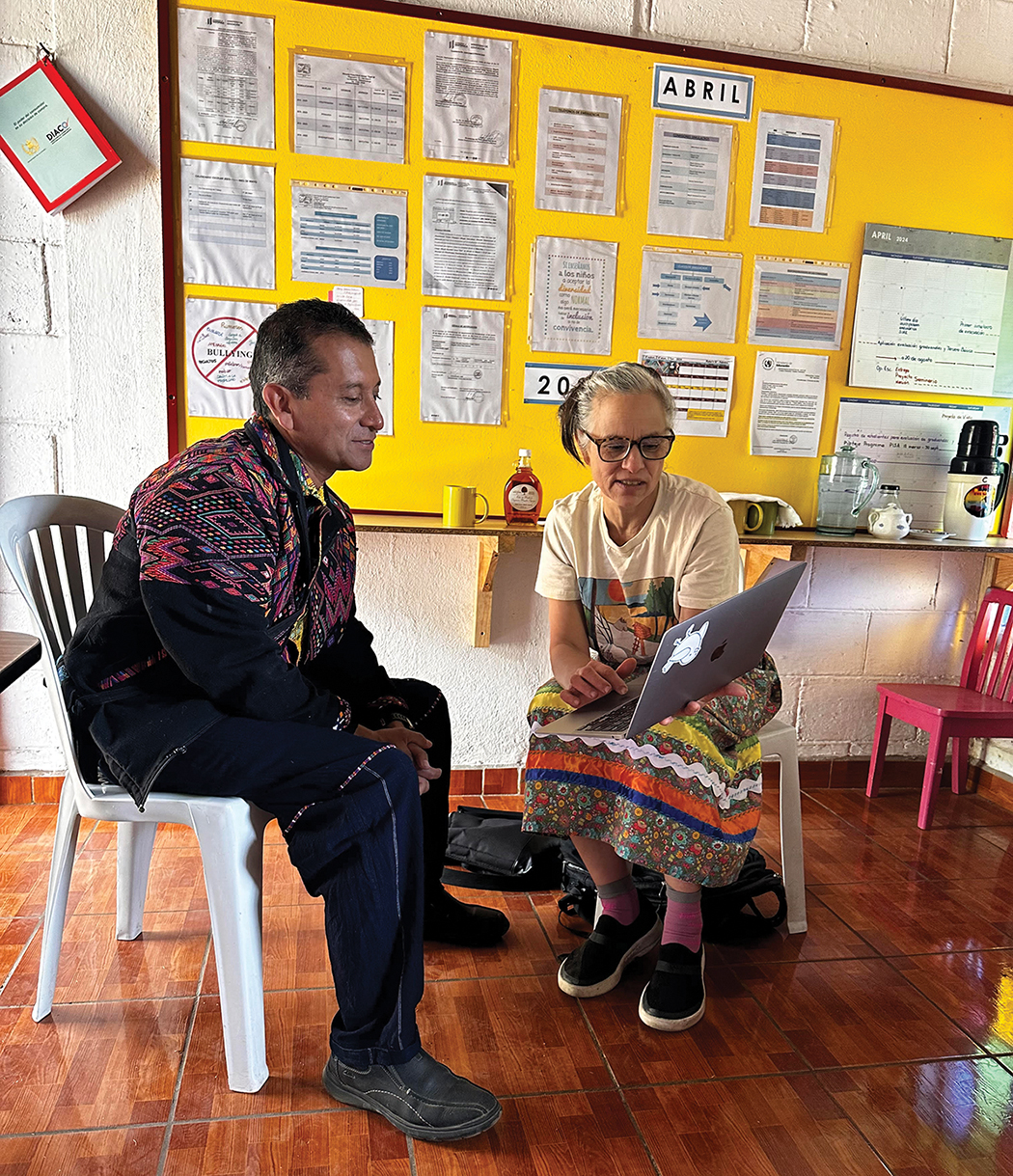
As part of their ongoing efforts to promote and preserve indigenous languages, Dr. Mary “Fong” Hermes, a University of Minnesota professor, and others, including Govinda Budrow and Biidaabanikwe (Kim Anderson), traveled to Guatemala in April.
The group visited Nimaläj Kaqchikel Amaq, a Kaqhikel medium school located within the Maya Kaqchikel community in Chimaltenango. In just eight short days, they aimed to absorb as many language teaching/learning experiences as possible, focusing on bringing their newfound knowledge back to their own communities. They learned about the incredible work being done by Igor Xoyon, the school’s principal. In a region where racism and prejudice towards Mayan people are still prevalent, Xoyon has dedicated himself to preserving the Kaqhikel language.
Dr. Hermes is of mixed heritage including Irish American, Chinese American, Dakota, and Lac Courte Oreilles Ojibwe community member. She is a Professor in Curriculum and Instruction at the University of Minnesota – Twin Cities. Hermes spent ten years as an Associate /Assistant Professor at the University of Minnesota, Duluth from 2001 to 2011. She also co-founded the Waadooko-daading Ojibwe Immersion School.
“To be in an environment where an indigenous language is the norm with Mayan spoken by 800,000 people was amazing,” said Dr. Hermes. “The school we visited, Nimaläj Kaqchikel Amaq, is a Kaqhikel medium school, situated in the Maya Kaqchikel community in Chimaltenango, Guatemala.”
“We contacted Igor Xoyon, principal of the school. We had only read about the school in an article but he opened his heart and his school to us. In his particular community there was a genocide of 200,000 indigenous people there a few decades ago so despite the large numbers, Chimaltenanog has no Kaqukikel first speakers,” added Dr. Hermes.
“The racism and prejudice to the Mayan people is palpable, and Igor and his school are doing a brave thing. He feels somewhat isolated, as all indigenous language folks do at times, so he was happy to spend the entire day with us – we felt very akin and inspired by him as well. Then he fed us the most beautiful Mayan foods, and gave us a lesson on sucking a mango,” added Dr. Hermes.

Govinda Budrow, direct descendent of White Earth Nation, is an Education Faculty Member at Fond Du Lac Tribal and Community College. She is a consultant with the Minnesota Department of Education on the Dream Catcher Project and Native Voices, and a PhD candidate at the University of Minnesota – Twin Cities, Curriculum and Instruction Department with an emphasis on Culture and Learning.
“The most profound experience visiting the immersion school in Guatemala was to observe the teaching strategies,” said Budrow. “The teachers were all first language speakers so it seemed to place an ease into their teaching that they could focus on their pedagogy. They were comfortable allowing the children to connect to their instruction through their home languages and seamlessly bridging the gap between understanding without breaking from the immersion instruction.”
“It made me think about the state we are in with Ojibwemowin, where most of our teachers are language learners and attempting to reclaim language as well as centering in a pedagogy of love for caregiving and teaching. It is a big stressor attempting to bring these worlds back together that had been intentionally separated through government policy with religious crimes codes and boarding schools,” added Budrow.
Budrow continued to talk about her profound experience being connected to her educational journey. She said, “My hope is to focus my PhD research on bringing and reclaiming these pieces of ourselves back together. Even a small movement of mending education and caregiving back together with our language and cultural ways of life is meaningful and worthwhile.”
Biidaabanikwe (Kim Anderson) is from the White Earth Reservation. She is the language director for a non-profit called the Niibi Center. She also contracts with various entities including OOG – Ojibwemotaadidaa Omaa, an Ojibwe Immersion Academy for adult language learners who seek to improve their proficiency and pass the language on to others.”
“The most profound experience was witnessing the immersion school in action with very little materials and little to no technology, which really put into perspective to me that immersion can be done no matter what,” said Biidaabanikwe. “Often, we in America, let material things limit us in our practice. I also really respected the effort and promotion to bring their traditional clothing back to everyday life.”
The article on the school in Guatemala: https://folklife.si.edu/magazine/stream-of-voices-guatemala-maya-kaqchikel-language.