
By SOLVEJG WASTVEDT/MPR NEWS
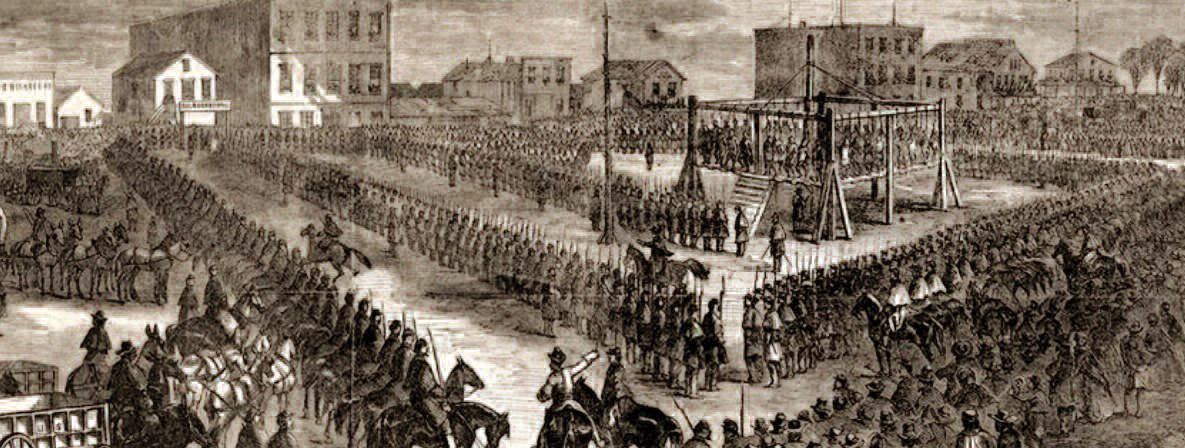
It’s a troubling piece of Minnesota’s past: Thirty-eight Dakota men hanged from a Mankato gallows in December 1862. Their deaths scarred generations of Native people and cemented Minnesota as home to the largest mass execution in U.S. history.
Despite that infamy, if you’re a Minnesotan in your 30s or older, it’s likely you were never taught about the hangings – or the prairie war between the United States and the Dakota that led to them. Minnesota didn’t require students to study that tragic chapter in the state’s history.
That past, and how it’s taught, surfaced again recently with installation of “Scaffold,” a Walker Art Center sculpture built in the shape of a gallows with a reference to the Mankato hangings. It led to an outcry from Dakota community members. While “Scaffold” has been torn down, the controversy has called into question how much Minnesotans know about what happened at Mankato.
Historians say younger Minnesotans get more teaching on the topic than their parents or grandparents ever did, but that the executions, and the whole Dakota story, still don’t receive the treatment in school they deserve.
“I think it’s getting better than it used to be, but there’s a long way to go,” said Kate Beane (Flandreau Santee Sioux), outreach and program manager for the Minnesota Historical Society.
Beane also teaches about Dakota culture and history at Minneapolis Community and Technical College. She said every year she asks her students if they know about the U.S.-Dakota War.
“Seven years ago when I started teaching that class maybe one or two hands would be raised. Now I’m seeing more hands being raised,” Beane said.
Still, Beane said very few recall learning the content in school.
The war has been part of Minnesota’s grade school social studies standards for more than a decade. After a 2011 revision, the content is now taught in sixth grade.
The updated standards don’t mention the hangings at Mankato specifically. They do say students must learn “reasons for the [war]; compare and contrast the perspectives of settlers and Dakota people before, during and after the war.”
A widely used sixth grade social studies textbook published by the Minnesota Historical Society describes how U.S. Army officers “rushed through” trials of the Dakota men who “had no lawyers to present their case” and calls it “the largest mass execution in U.S. history, before or since.”
But while it’s made it into textbooks, responsibility for teaching everything in the standards rests with individual school districts.
State law requires inclusion of American Indian history and culture across subject areas. Beane and others said it’s important to teach that broader context. The state Education Department said it isn’t able to police how schools and districts teach the standards, although it does follow up with districts if there’s a complaint.
There’s no state social studies test, as there is for reading, math and science. And the U.S.-Dakota War itself isn’t required in social studies outside of sixth grade.
That lack prompted Mankato West High School teacher Matt Moore to build his own lesson for his Advanced Placement U.S. History class.
“For a Mankato student, I don’t think it’s right for the last time for them to go in-depth and learn about the U.S.-Dakota war to occur in sixth grade. I just think that’s kind of an injustice to the local history,” Moore said.
Moore said his students come into the eleventh-grade class with a range of knowledge about the war and the hangings at Mankato. “Likely the same will result in my class,” he admitted.
Still, Moore said students need to revisit a history that’s too complex for sixth graders to grasp fully.
It’s also a traumatic history. “We have to make sure that in presenting this material to children that we remember that there can be Dakota children in that classroom. How do you teach this history in a way that helps protect their spirit as well?” Beane said.
Beane and others said it’s a matter of how to teach it, not whether to present the story.
“We all learn how to teach what we’re teaching … We learn how to teach chemistry. We learn how to teach rocket science. We have to learn how to teach Minnesota Indian history,” said Osseo Area school district secondary Indian education director Ramona Kitto Stately (Santee Sioux).
Stately said her great, great grandmother was one of a group of mostly women and children force-marched to a prison camp at Fort Snelling following the end of the U.S.-Dakota War.
“I have teachers who ask me, ‘When is it appropriate to tell kids this story?’” she said. “My answer is always the same: ‘When is it appropriate to lie to them?’”
Minnesota Public Radio News can be heard on MPR’s statewide radio network or online.