

By Dan Ninham
The dream of Dakota tribal member Waziyatawin and her non-profit Makoce Ikikcupi, meaning land recovery in Dakota, came to reality three summers ago: To secure a homeland base indigenous to her people where seven earthlodges will be built for Oceti Skowin families of Dakota, Lakota, and Nakota of the Seven Council Fires to live in the village.
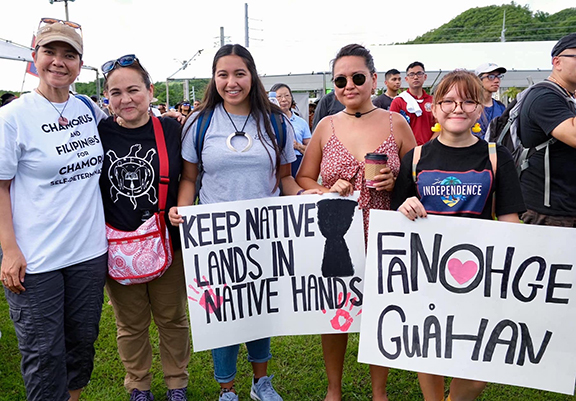
Gabriela Ines DeLisle Diaz is CHamoru and her clans are Familian Liberatu/Kabesa, Familian Nungi-Assan, and Filipino/Pohnpeian from Guam. She has a Bachelor of Arts degree in American Indian Studies with a minor in Environmental Geosciences from the University of Minnesota–Twin Cities and graduated in the spring of 2021. She lives in Minneapolis, Minnesota.
DeLisle Diaz shared her recent work. She said, “Supporting Dakota Land Justice is an original creative project that I put together for Makoce Ikikcupi. Makoce Ikikcupi is a non-profit organization in Minnesota that works to recover and restore Dakota lands throughout the state with the help of settler ally contributions.”
“Through restoring these lands, Makoce Ikikcupi is developing sustainable, off-grid and culturally-oriented community sites for their formerly exiled Dakota relatives to return to and reconnect with their lands, traditional ways and relatives as forms of reparative justice for their people and their land,” added DeLisle Diaz.
DeLisle Diaz developed a zine that “highlights their work and tells their story as a Dakota land recovery project from (my) perspective as a Native Pacific Islander living on Dakota homelands,” DeLisle Diaz said.
“In addition to providing a general overview of their efforts, the zine includes historical context behind their work and highlights their recent struggles to build traditional Dakota earthlodges at their first village site, Zani Otunwe,” said DeLisle Diaz. “It ends with a call to action for settlers and visitors on Dakota homelands to critically contend with what it means to live on Dakota homelands, often as beneficiaries of Dakota genocide, exile and dispossession, and just as importantly, to support Makoce Ikikcupi’s work and other efforts to restore Dakota and Indigenous lands and life.”
“Learning how to navigate my place at the University of Minnesota and within ongoing Indigenous struggles for sovereignty back home on Guam or on Dakota homelands in Minnesota while being away from home remain heavily grounded in my understandings of my relationships and obligations to the Dakota people and their lands,” added DeLisle Diaz.
“Supporting Dakota Land Justice for me really came together because I felt it was a way through which I could be a better relative to the Dakota and the land,” added DeLisle Diaz.
“Though the zine was inspired as a whole by Indigenous activism and robust Dakota and global Indigenous sovereignty movements and political struggles, the project began as a creative final project that I put together for a Gender & Women’s Studies course I took as a senior taught by Dr. Sima Shakhsari at the University of Minnesota–Twin Cities,” said DeLisle Diaz. “I decided I wanted to promote Makoce Ikikcupi’s work and highlight their struggle at the time to build their earthlodges at Zani Otunwe.”
Dr. Sima Shakhsari talked about her student who was mutually inspiring. She said, “I remember Gabriela very well, even though the class, Politics of Sex, is a relatively large class in our department. She was a brilliant student who contributed greatly to discussions and critically engaged with the material. Gabriela’s zine on settler colonialism and the criminalization of earth lodges in Minnesota was so amazing that I use it in my classes as an example of what a brilliant zine looks like.”
“I actually learned something from her zine, which is not something that happens very often in introductory 1xxx level courses. If the university grading system would allow A+, Gabriela would certainly earn that grade. My teaching assistant was also impressed with Gabriela during discussion sessions,” added Shakhsari.
“I ended up sharing this project with my Aunty Roxanne Biidabinokwe Gould, a Makoce Ikikcupi Governing Council member, after I graduated and she suggested that I share it with the organization’s Executive Director Waziyatawin. After sharing it with her, Waziyatawin reached out to me and asked if I would be interested at all in reworking the project for Makoce Ikikcupi to use,” added DeLisle Diaz.
The zine will be available on the website of Makoce Ikicupi: The zine is also available on the Makoce Ikicupi FaceBook page on the August 10, 2022 post. Printed copies will be distributed to Oceti Sakowin families who might be interested in living at Zani Otunwe.
“Global Indigenous sovereignty struggles and activist movements, particularly Dakota sovereignty/decolonization efforts and CHamoru sovereignty/decolonization efforts on Guam inspired me in many ways to create the zine,” said DeLisle Diaz. “My experiences serving and voicing American Indian and Indigenous student needs through undergraduate student programming and finding a community for myself with Indigenous student organizations at the University of Minnesota – Twin Cities have similarly shaped the zine content.”
“Supporting Dakota Land Justice in many ways was an extension of my guinaiya (love) and respetu (respect) for Makoce Ikikcupi’s work from a place of inafa’maolek/chenchule’,” added DeLisle Diaz.
For more information, see: https://makoceikikcupi.com/2022/08/22/supporting-dakota-land-justice-zine.