

By Dan Gunderson/MPR News
Denise Lajimodiere’s interest in the Indian boarding school experience began with the stories of her parents.
“Mama was made to kneel on a broomstick for not speaking English, locked in closets for not speaking English,” she said. “They would pee their pants and then the nuns would take them out [of the closet] and beat them for peeing their pants.”
Lajimodiere is Ojibwe, and a member of the Turtle Mountain Band of Chippewa in North Dakota. She was an educator for 44 years, working as an elementary school teacher and principal before ending her career recently as as an associate professor of educational leadership at North Dakota State University in Fargo.
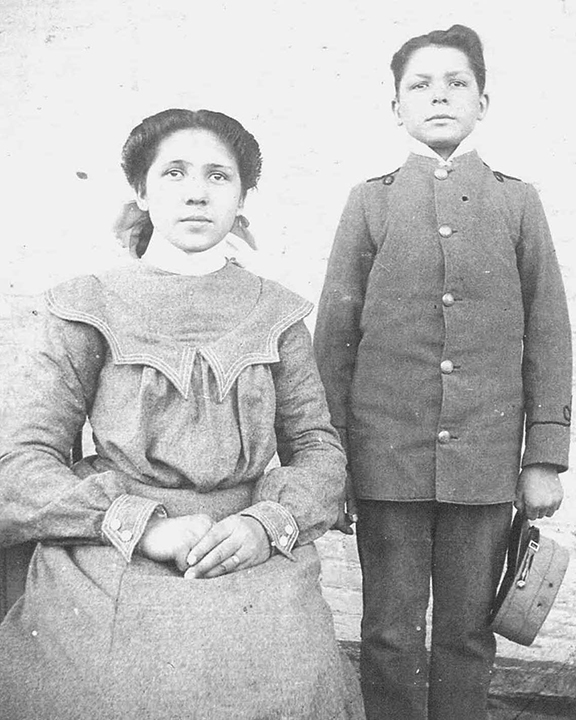
Her parents were separated from their families and sent to federal government-run boarding schools as children. Thousands of Native children met the same fate during the boarding school era, which scholars estimate lasted from the late 1800s to well into the middle of the 20th century.
The children were sent to the schools to be purged of their Native cultures, languages and spiritual practices – forced to learn English, and often abused.
The experiences of those children, now with children and grandchildren of their own, have left a deep scar on many in the generations that came after them.
“Papa was beaten with a belt. He saw one of his fellow students die from a beating at the school,” she said.
Her parents rarely talked about their boarding school experience. She only was able to coax stories from her father in the last years of his life.
“Papa said, ‘I just couldn’t learn that language,;” she said, “so they put lye soap in his mouth and the kids would get blisters.”
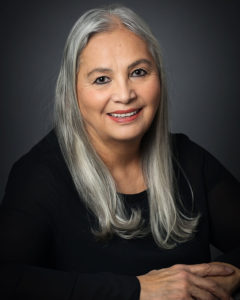
a Contemporary Voices of Indigenous Peoples series,
published by the North Dakota State University Press in June, 2019. (Photo by Amber Mattson/Courtesy of Dreamcatcher Photography.)
Lajimodiere believed her parents’ boarding school abuse was a reason for the family dysfunction she grew up with, so she began a decade-long quest to understand it, interviewing people who went through the experience.
“It’s a journey I had to go on to forgive my dad for the way we were raised, for his temper, his verbal abuse and for the beatings,” she said. “So, it was a long journey to understand why my father was the way he was.”
What she found was a trove of stories closely guarded for decades by those who lived them. She tells those stories in their own words in her new book, “Stringing Rosaries.” She collected the stories using strict academic research protocols, but the listening was intensely personal.
Many of the former boarding school residents she interviewed prefaced their stories by telling Lajimodiere, “I’ve never told anybody my story. I’ve never told my kids. I’ve never told my grandkids. I had to think about these stories all my life about what happened to me. I don’t want my kids to have to think about it or know about it,” she said.
For most people, Lajimodiere promised anonymity before they would share with her the stories.
She recalls one elderly woman who refused to even let family know she was being interviewed for the book.
“She became very quiet, even though it was a huge house, and no one was in the house,” recalled Lajimodiere. “She started whispering about being sexually abused and she said, ‘I don’t know why I’m telling you. I have not told anybody.’ Almost every survivor in the book experienced sexual abuse, or they witnessed it.”
Lajimodiere found that, while the stories people told her were often infused with painful and traumatic memories, that pain was not universal. Some people recalled their time at a boarding school fondly. But Lajimodiere says even those people – who said they preferred the school experience to alcoholism, abuse or hunger they experienced at home – shared stories of abuse in the boarding schools.
As she traveled the country doing research on boarding schools and collecting stories, Lajimodiere said she would often find herself sitting in her car, sobbing, after an interview.
She realizes now that she was experiencing the collective intergenerational trauma of losing language, culture and identity. Her parents both spoke their native languages, Ojibwe and Cree, before they went to boarding school.
“My father never spoke Cree again; that was completely beaten out of him,” said Lajimodiere. “So, now, at my age, I’m trying to relearn Ojibwe. Ojibwe is the language of our ceremonies – and our ceremonies have come back very strong.”
Lajimodiere thinks connecting with traditional ceremony and culture is helping Native Americans across the country recover from the generational impact of the boarding school era.
She asked people she interviewed what it would take to heal from the trauma they experienced.
“Some of the people in the book say an apology would be a recognition of what the government did to us. Others have said, ‘Boarding schools destroyed my childhood; I’ll never get that back, so an apology would mean nothing,’” she said.
“Many of them said [what would be healing would be] a return to tribal spirituality and to the languages, our traditions and our ceremonies,” she said.
Lajimodiere felt compelled to share the stories because many who attended boarding schools in the first half of the 1900s are now elderly and dying.
She’s clear that she doesn’t want the stories to elicit pity. She wants understanding.
“I want the world to know that part of why we are the way we are,” she said, “with high alcoholism, high diabetes and a lot of other health issues, one of the overarching reasons is the boarding school era.”
==================
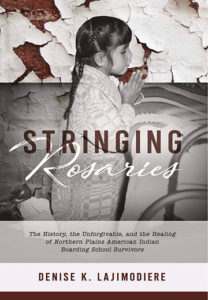 Contemporary Voices of Indigenous Peoples
By Denise Lajimodiere
Hardcover: 320 pages
Publisher: North Dakota State University Press, June 20, 2019