By Albert Bender/People’s World
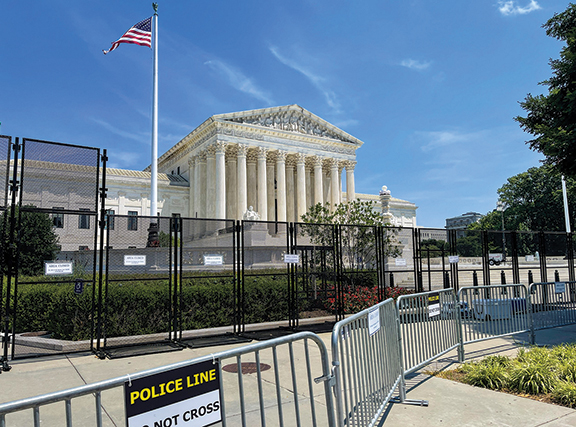
As the retrograde Supreme Court has taken steps back in time on abortion rights, blurring the time-enshrined separation between church and state, limiting the authority of the EPA to control carbon emissions, lowering restrictions on the carrying of firearms, and restricting Miranda rights, it has now also struck a reactionary blow against the tribal sovereignty of this land’s Indigenous nations.
The court is imposing Trump’s vision, through his appointees, on the U.S. which is out of touch with the vast majority of the nation’s people. This is the rule of right-wing tyranny.
On Wednesday, June 29, the rogue court ruled in Oklahoma v. Castro-Huerta that states have concurrent jurisdiction, with the federal government, in cases of non-Indians committing crimes against Indians on Native American reservations.
This granting of states’ rights to intrude onto Native lands reverses over 200 years of one of the most enshrined tenets of federal Indian law, beginning with the Indian Trade and Intercourse Act of 1790 and proclaimed in the decision of Worcester v. Georgia issued by the John Marshall court in 1832.
The Worcester decision defined the relationship between Native nations, the federal government, and the states. Marshall stated as follows in laying the parameters of the relationship:
“The Cherokee Nation, then, is a distinct community occupying its own territory…in which the laws of Georgia can have no force, and which the citizens of Georgia have no right to enter but with the assent of the Cherokees themselves, or in conformity with treaties and with the acts of Congress.”
The ruling in Worcester established the principle that the relationship of Native nations to the federal government is that of nation-to-nation in which the individual states have no jurisdiction. Under this long-established principle, the states have no authority on Native American lands. The federal government has the sole authority to deal with Indian nations.
The ruling in Castro-Huerta gives the states a foothold of jurisdiction in Indian Country. This is the first time in American history that states have concurrent jurisdiction with the federal government in Indian Country. Under previous law, as a general rule, jurisdiction in Indian Country was limited to tribal governments and the United States government.
The court’s ruling reverses, for the time being, the long-established federal Indian law principle which held that only tribal and federal courts had the authority to prosecute crimes committed against Indian people on Tribal lands.
The ruling of the court could not be more ominous, outrageous, and foreboding, especially in light of some of its specific wording. The decision, written by Justice Brett Kavanaugh, a Trump appointee, in some of its most chilling parts, states as follows:
“To begin with, the Constitution allows a state to exercise jurisdiction in Indian Country. Indian Country is part of the state, not separate from the state.”
The astonishing decision continues: “…as a matter of sovereignty, a state has jurisdiction over all of its territory, including Indian Country.”
This is incredible in light of enshrined, established, and settled federal Indian law and precedent. Worcester said the complete opposite. Either Kavanaugh has never even read Worcester, does not understand Worcester, or totally rejects Worcester. At the very least, it is abundantly clear that Kavanaugh has not even the slightest smidgen of understanding of federal Indian law. He is completely out of his field.
With the absurd, preposterous, and states’ rights wording of the ruling, it does not take a genius to see where this could lead in the foreseeable future.
In the case at hand, the defendant, Castro-Huerta, a non-Indian, criminally neglected his Cherokee stepdaughter, who is a member of the Eastern Band of Cherokee Indians. This occurred on the Cherokee Nation Reservation in eastern Oklahoma. Initially, he was convicted in state court of a state crime.
But after the Supreme Court’s 2020 McGirt decision, the Oklahoma Court of Criminal Appeals held that Castro-Huerta’s conviction was invalid because only tribal or federal officials had the authority to prosecute crimes by or against Native Americans on tribal lands.
In McGirt, the Court returned three million acres of eastern Oklahoma to the Muscogee Creek Nation (MCN). This is the area comprised of the original boundaries of the Nation under the Treaty of 1866. It was seen as a gigantic legal step forward for Indigenous people not just in Oklahoma but nationwide.
The statehood of Oklahoma in 1907 dashed the dreams and aspirations of generations of Indigenous on the unrelenting rocks of racism when the state was admitted to the Union with the dismantling of the governments of the Five Southern Tribal Nations: Muscogee Creek, Cherokee, Choctaw, Chickasaw, and Seminole.
The substance of the McGirt case focused on the question of what government has sovereignty – the state of Oklahoma or the federal government – over serious criminal matters in the area of eastern Oklahoma. Jimcy McGirt, a Seminole man, was convicted of sex crimes by the state of Oklahoma, but in his appeal, McGirt’s lawyers claimed that because past Muscogee treaty rights had never been disestablished by Congress, only the federal government could try his case. The state of Oklahoma argued that Muscogee sovereignty had been effectively extinguished in practice if not in legislation.
In cases involving tribal citizens, the Supreme Court definitively stated that those treaty rights remain in force, giving the federal government authority over prosecuting serious crimes on reservation land, of which eastern Oklahoma is a part.
But in the Castro-Huerta case, the offender was a non-Indian. After McGirt led to Castro-Huerta’s conviction being overturned, federal authorities re-indicted him, and he was again convicted. The state of Oklahoma sought to have the ruling reversed, however, and reasserted jurisdiction over Castro-Huerta and have him transferred from a federal prison to state incarceration to finish his state sentence.
This was just a shoddy attempt by Oklahoma to gain a foothold to exercise some jurisdiction over crimes involving Indians on tribal lands.
Justice Neil Gorsuch filed a powerful dissent in this case, arguing, “Where this Court once stood firm, today it wilts. After the Cherokees’ exile to what became Oklahoma, the federal government promised the Tribe that it would remain forever free from interference by state authorities. Only the Tribe or the federal government could punish crimes by or against tribal members on tribal lands.”
Gorsuch, in his dissent, more than amply illustrates his expertise in the field of federal Indian law. At one point, he describes the court’s decision as “especially bewildering.” At another, Gorsuch writes that “The Court may choose to disregard our precedents…. As a result, today’s decision surely marks an embarrassing new entry into the anti-canon of Indian law. But its mistakes need not – and should not – be repeated.”
This decision, like so many recent rulings, shows the Supreme Court is out of sync with public opinion and is an outlier in U.S. society. It has become an anachronism dragging down the political future of the country. The court has become the flagship institution on the road to fascism. It is little wonder that public confidence in the Supreme Court has sunk to an all-time low of 25%.
Its decisions are out of line with modern, progressive thought and sentiment.
The Supreme Court must be stopped!
Albert Bender is a Cherokee activist, historian, political columnist, and freelance reporter for Native and Non-Native publications. He is a consulting attorney on Indigenous sovereignty, land restoration, and Indian Child Welfare Act (ICWA) issues and a former staff attorney with Legal Services of Eastern Oklahoma (LSEO) in Muskogee, Oklahoma. This article originally appeared on People’s World at https://peoplesworld.org/article/rogue-supreme-courts-latest-indian-law-decision-a-huge-step-back-in-time. It is published under a Creative Commons license.