
By Brad Hagen
With the ever-growing presence of Natives on social media, it’s likely that you’ve come across Maggie Thompon’s work at least once or twice while scrolling through your feed. Thompson (Fond Du Lac Ojibwe) is a textile artist and designer, as well as the owner of Makwa Studio, where she crafts a variety of beanies, cowls, and scarves that are available for purchase through her website. In addition, she’s exhibited her work at places such as All My Relations Gallery, Minneapolis Institute of Art, and the Plains Art Museum.
For Thompson, art has always been part of her life. “Both of my parents were artists. My mom’s a painter and photographer, and my dad was a graphic designer, so I just kind of grew up with it.” After beginning to explore fine art in high school, Thompson earned her BFA in Textiles at the Rhode Island School of Design in 2013.
When she returned from college, Thompson worked part-time at a coffee shop while taking care of her father who had just been diagnosed with pancreatic cancer. At the same time, she was looking for ways to use her skills. “I was looking for textile jobs, but everything was at [places like] Target. I just needed something more flexible. So [Makwa Studio] started very small and on the side. I was living on a half-time coffee wage and bought small balls of yarn to knit my first hat.”
Now Thompson’s audience is growing, with people like Lieutenant Governor Peggy Flanagan appearing on Makwa Studio’s Instagram page wearing an “I Voted” beanie, one of Thompson’s latest projects.
For many, fine art is surrounded by an aura of aristocracy, which can act as a means of gatekeeping and often prevents many people from seeking it out or engaging with it. Because of this, Thompson wanted to create art that would actually reach people.
“I came from more of a fine arts background and after school, I was thinking about how to make artwork more accessible to other folks. So I thought I could make wearable art that would reach more people.”
The creation of Makwa Studio has allowed Thompson to follow this credo, especially in regard to the aid she’s offered during the pandemic.
With mask shortages occurring around the country in the early days of the pandemic, Thompson was inclined to use her abilities to help and ultimately created the Ribbon Mask Project, an initiative that aimed to provide as many masks as possible.
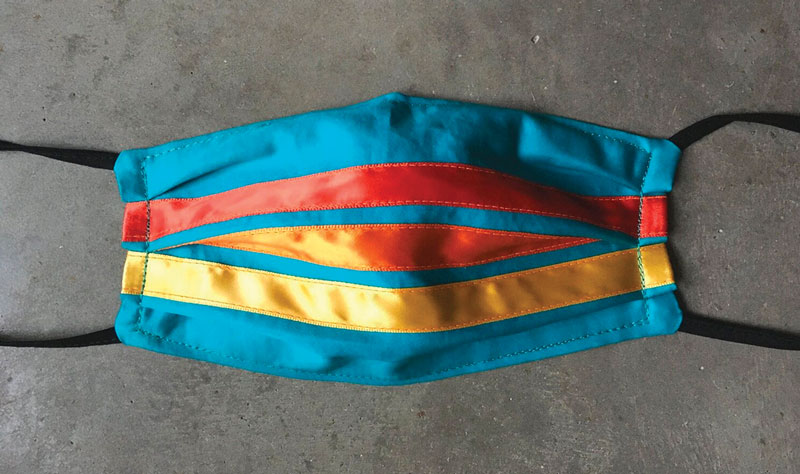
“I started making masks pretty early on because folks in New York were talking about their shortage, so I started sewing and trying different patterns for masks. I was donating a lot for hospitals here, and then I started having individuals ask for them and then I made this one mask for a woman’s mother who was going through chemo. So then I was really thinking about protecting the vulnerable. I just wanted to keep making something that felt more special to people and thought of using ribbon.”
Hearing “ribbon mask” and seeing the mask’s design may lead many Native people to think of ribbon skirts, an article of clothing particular to Native women. For Thompson, this was intentional. “I think of ribbon as a symbol of adaptation and survival. For me, it speaks to indigenous communities and how we’ve experienced the traumas of the past, and how we’re still here. Everyone in the world is experiencing this together, though I feel it’s different for indigenous peoples. There’s a familiarity to it.”
Thompson also cites a desire to create a sense of community by using ribbon in her masks. “When you see another Native person wearing beads or wearing something that we see as being Native, there’s this instant connection, whether you know them or not. In a time of isolation, I felt like that was really important to translate.”
Thompson’s Ojibwe identity plays a central role in her artwork. On Makwa Studio’s website, it’s stated that “she derives her inspiration from the history of her Ojibwe heritage, exploring family history as well as themes and subject matter of the broader Native American experience.” This exploration of identity through art also played a large role in the creation of Makwa Studio. “My identity was obviously showing through my work, and it didn’t feel like something I could give up to a larger company- it felt more personal.”
However, this doesn’t stop Thompson from collaborating with other companies. Her most recent joint venture was with Askov Finlayson, the Minneapolis-based fashion company owned by the sons of Minnesota Governor Mark Dayton. Her idea was to put an Ojibwe spin on an already popular product. “I don’t speak the language a lot, but I know a few words here and there, and they [Askov Finlayson] have these iconic North hats, so I was like, what if we did the North hats in Ojibwe?” The result was a hat that replaced “North” with Giiwedin, the Ojibwe equivalent of the word. Her motive was based in “the idea of bringing culture to the forefront and also teaching people. So art as education.” Through this collaboration, Thompson was able to maintain the integrity of her work, while allowing it to reach a wide audience.
When asked about the role of art during the pandemic, Thompson had some wise words to share. “It’s a way to process and communicate. And it’s a way to tell stories. When people are going through all these intense emotions and seeing things happening from all around the world, art can tell the personal narratives that aren’t in the headlines.” She went on to say that artists tend to navigate through the world in a unique way and, because of this, they’re important during this time when many are struggling to see the path forward.
For information Thompson’s work:
http://makwastudio.com
https://www.facebook.com/makwastudio
https://www.askovfinlayson.com/collection/makwa-studio-x-askov-finlayson