
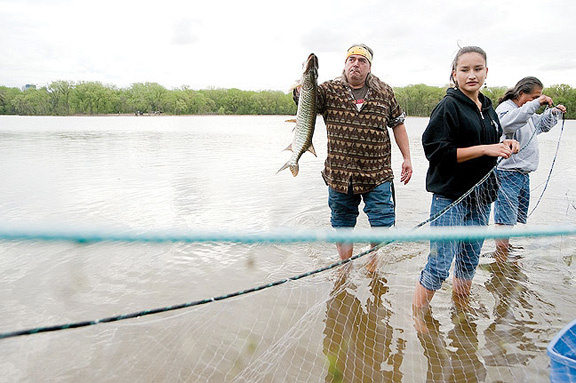
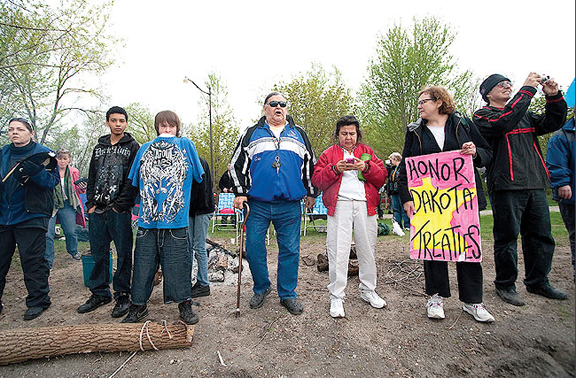
 Cedar Lake, long famous for its skinny-dipping beach, was the site of an unusual treaty rights demonstration on May 13. Local Dakota activists put a net into the south Minneapolis lake and caught several dozen fish, which were confiscated, along with the gill net, by Department of Natural Resources officers.
The Dakota are asserting their rights under the 1805 Treaty between the United States of America and the "Sioux Nation of Indians." As I recall, there is a bronze marker on a large rock by Lake of the Isles that shows a map of the treaty area, which extends from Ft. Snelling across the scenic lakes in south Minneapolis. The treaty describes the Sioux land cession, about 100,000 acres, as "from below the confluence of the Mississippi and St. Peters [Minnesota], up the Mississippi, to include the falls of St. Anthony [in downtown Minneapolis], extending nine miles on each side of the river."
Many Americans misunderstand the nature of treaty rights, and think that hunting and fishing rights are something given by the U.S. to the Indians. Rather, in 19th century land cession treaties, the Indian nations (which often had military supremacy over U.S. forces) gave up land and retained their rights to hunt, fish and gather in their traditional way.
 In fact, Indian treaty rights are recognized under the U.S. Constitution, and the federal courts continue to uphold these supreme legal rights. In the case of the 1837 Treaty between the U.S. and the Mille Lacs Band of Chippewa Indians, the U.S. Supreme Court, in 1999, upheld hunting, fishing and gathering rights over a vast tract of land in central Minnesota, including Mille Lacs Lake, the premier walleye fishery in the state.
Getting back to Cedar Lake and the 1805 Treaty, negotiated for the U.S. by Lt. Zebulon M. Pike, the Indian signatories (Le Petit Carbeau and Way Aga Enogee) agreed to take $2,000 in compensation for the ceded lands. Article 3 of the treaty states: "The United States promise on their part to permit the Sioux to pass, repass, hunt or make other uses of the said districts, as they have formerly done, without any other exception, but those specified in article first," which refers to U.S. control of military posts.
The legal standing of the 1805 Treaty were not resolved on May 13 at Cedar Lake, as the DNR officers reportedly took down names and referred the matter to the Hennepin County attorney’s office. Before the treaty rights fishing exercise, Jim Anderson, chairman of the Mendota Mdewakanton Dakota Community, told Minnesota Public Radio: "If they let us do it, that’s what we want. If they don’t let us do it and ticket us and arrest us, that’s what we want to so we can get it into court…. [W]hen and if we go to court over this, we’ll win our rights back."
And Chris Mato Nunpa, a retired Southwest Minnesota State University professor and Dakota activist, vowed to continued fishing and said, "We’ll be organizing a hunting party in Ft. Snelling State Park, because we can also hunt," under the terms of the 1805 Treaty.