
The Anishinaabe Cultural Center and other Native organizations and businesses in Callaway, Minnesota have partnered with the new eco-tourism service Journeys with First Nations (JWFN), which was created to develop green tourism destinations in Indian Country.
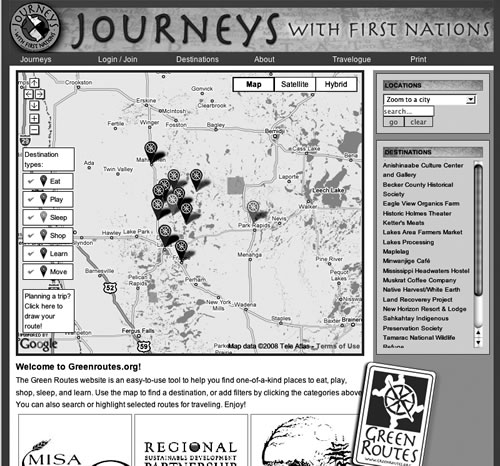
JWFN, part of Greenroutes, the tourism arm of Renewing the Countryside, worked with Tribal Chair Erma Visenor and other programs at the White Earth Reservation to undertake the pilot project. Deborah McLaren, who works for JWRN, says they were initially invited to White Earth by author and activist Winona LaDuke, who had already done a tourism survey at White Earth. McLaren said start up grants from the Minneapolis Foundation and Otto Bremer were used to create Journeys with First Nations.
McLaren said the numerous small businesses and organizations were identified through public outreach, presentations, and informal visits to local businesses that want to go “green.” She said Greenroute and JWFN’s goal is to help small businesses and organizations bring tourism to their communities, with the emphasis on sustainable, environmental tourism.
JWFN is focusing specifically on tribal communities in Minnesota.
According to their website, their focus is to help promote “small,
unique businesses that are rooted in their communities” and “places to
have fun while helping to ensure that our natural and cultural
resources will be around for many generations to come.”
Instead of staying at a chain hotel and eating at a fast food
restaurant, travels can stay on a local farm, visit an organic
Minnesota winery, or stay at a cabin or a resort on reservation lands.
JWFN helps visitors find one-of-a-kind places to eat, play, shop, sleep
and learn. Destinations include transit options, restaurants, hiking
trails, accommodations, wildlife refuges, food distribution and
processing facilities, organic farms and even an energy renewable
project. JWFN is also consulting with local Native elders and other
leaders to make sure that places where tourists should not go are
omitted from tourism marketing materials.
Some businesses that are going the ecotourism route include Ketter’s
Butcher Shop and Meat Market in Frazee, which offers meat processing
and trapped meat, including turtle soup for anyone fond of it. And in
Detroit Lakes, Dallas Flynn, an enrolled member at White Earth, sells
his homegrown mushrooms and other local foods at the summer Farmers
Market.
JWFN’s focus is on businesses that may not be a part of the mainstream
tourism economy. They plan to make that information available to
travelers and tourists who want to visit Indian country, but don’t know
where to start. McLaren says they look for “quality tourists” – people
who support coops, and they advertise at places like living green
expos and eco living conventions.
Businesses and other entities pay on a sliding fee scale, based on the
number of employees. The fees range from $40 to $200 a year. About 20
Native businesses and organizations have signed up since its inception.
The Anishinaabe Culture Center and Gallery, Minwanjige Café, Muskrat
Coffee Company, Native Harvest/White Earth Land Recovery Project,
Sahkahtay Indigenous Preservation Society, and the White Earth Tribal
and Community College are some that have signed on.
McLaren said they also plan to do “volun-tours” where small groups of
people come to a community to do volunteer work for a short period of
time. Global Citizens Network is assisting in the development of the
volun-tours.
The first volun-tour will take place during the official Journeys with First Nations launch at White Earth on September 6.
For more information contact Deborah McLaren at 651-983-9880, or email:
Deborah@rtcinfo.org. Their website is: http://journeys.greenroutes.org.