

By Jiwon Choi/MPR
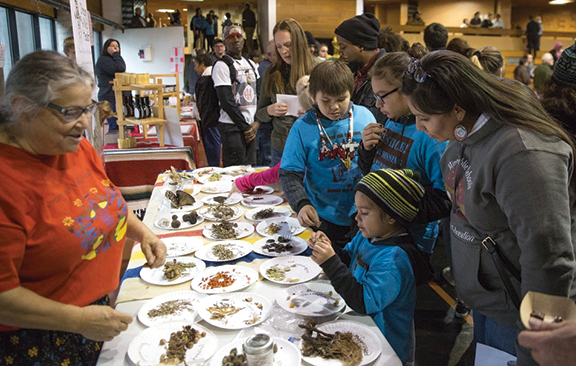
Mysti Babineau, a Red Lake Ojibwe tribal member, along with her two young children and 12-year-old niece, waited in line for an hour on October 8th for the opportunity to get back to their roots.
They were among the hundreds of people, mostly Native American, who came to celebrate Indigenous Peoples’ Day at the Minneapolis American Indian Center – by eating their native foods.
“This is something that’s really amazing,” said Babineau. “There’s that disconnect between generations where we’re losing [indigenous foods.]”
From wild rice pudding to buffalo meat jerky, the venue was full of food from the indigenous community that have become more difficult to find in conventional markets, said Diane Wilson, executive director of Dream of Wild Health, the organizer of the event.
“Communities being moved down to reservations, the diet is being shifted to commodity foods. So a lot of this really incredible knowledge about plants and foods was displaced,” she said.
Most of the vegetables at the tasting were directly delivered from a 10-acre organic farm in Hugo, Minn., where the indigenous community grow their native plants and learn how to raise and cook the food.
Austin Bartold was one of the five Native American chefs at the event. He said it took him the whole weekend to prepare the foods – walleye cakes and bison soup.
“Here, this is the collards that came from the farm, collard greens, buffalo and turkey stock, Indian corn, and some wild rice in here,” Bartold said as he mixed ingredients for a traditional Native American salad.
By returning to a diet that is closer to what their ancestors ate, indigenous communities in Minnesota are trying to curb a rising health crisis.
According to government figures, American Indians and Alaska Natives are at least twice as likely as whites to have Type 2 diabetes, and they have 1 1/2 times the rate of obesity as non-Hispanic whites. Meanwhile, due to chronic lack of proper health care and financial difficulties, the life expectancy of Native Americans is 5.5 years shorter than the national average, according to a study by the Indian Health Service.
Ernie Whiteman, cultural director at Dream of Wild Health, was diagnosed with diabetes four years ago. He said he has been able to manage it by turning back to a native diet and healthier lifestyle.
“I said I’m going to get back to where I originally was. So I started a rigorous cleansing, a diet and exercise. Within three days, I was off the insulin; within three more days, I was off the hormone,” said Whiteman.
“I attribute that to the way I live and the way I eat.”
Minnesota Public Radio can be heard at www.mpr.org.