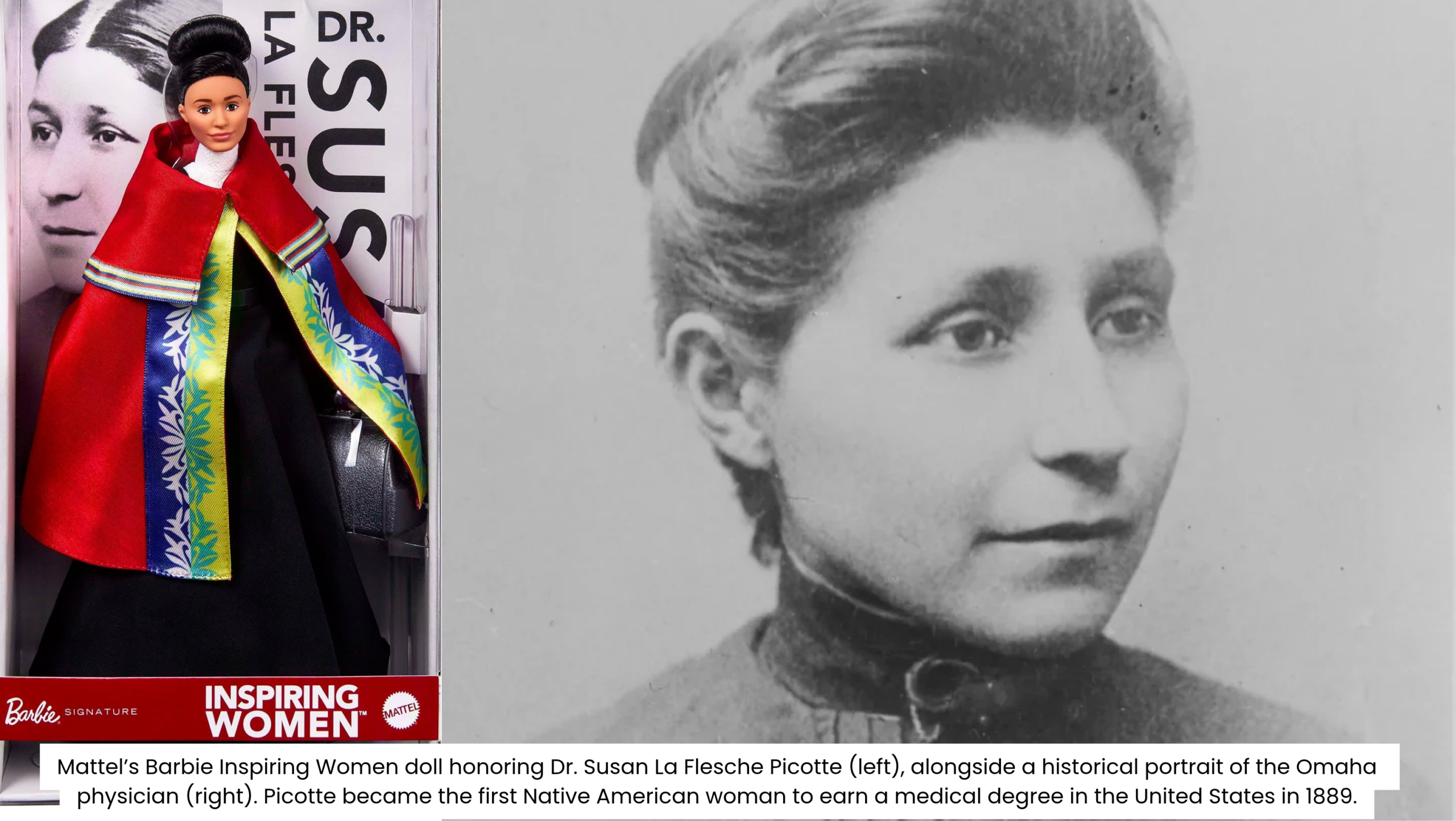
Mattel is honoring Dr. Susan La Flesche Picotte, the first Native American woman to earn a medical degree in the United States, with a Barbie doll recognizing her dedication to health care and the Omaha community.
Part of Barbie’s Inspiring Women series, the doll wears a dress inspired by Picotte’s era, an Omaha-inspired shawl, and carries a medical bag. Designed by Carlyle Nuera, the doll is listed for $38 through Mattel Creations.
The tribute brings attention to an Omaha woman whose work expanded access to medical care at a time when Native people faced discrimination, and women had limited opportunities to enter medicine.
Born in 1865, Picotte grew up on the Omaha Reservation in Nebraska. According to the Dr. Susan La Flesche Picotte Center, a childhood experience helped shape her decision to become a physician: She witnessed an elderly Native woman die after a local doctor refused to provide care because the woman was Native.
Picotte pursued a medical education so she could return home and care for her people. In 1889, she graduated at the top of her class from the Woman’s Medical College of Pennsylvania.
Returning to the Omaha community, she cared for more than 1,200 patients, traveling across the reservation by horseback and horse-drawn buggy. Her responsibilities extended beyond medical treatment. The Picotte Center describes how she brought food to families, prepared meals, and stayed overnight with critically ill patients.
She also worked to prevent illness through public health education. Her efforts included promoting hygiene and food sanitation, treating tuberculosis, and discouraging the sharing of drinking cups. She advocated for window screens to help keep disease-carrying flies out of homes.
A central goal was establishing a hospital closer to the people she served. Otherwise, patients needing surgery had to travel to Omaha or Sioux City.
Her efforts helped make that vision a reality with a hospital in Walthill, Nebraska, which opened in 1913. The facility served both Native and non-Native patients and included general wards, private rooms, a maternity ward, and an operating room.
Although declining health limited her ability to work in the hospital, Picotte lived to see it serve her community. She died on Sept. 18, 1915.
The doll recognizes a legacy rooted in service to the Omaha people. Picotte’s achievements went beyond breaking barriers in medical education: She brought care directly to families and worked toward a future where her community could receive treatment closer to home.
Sources