
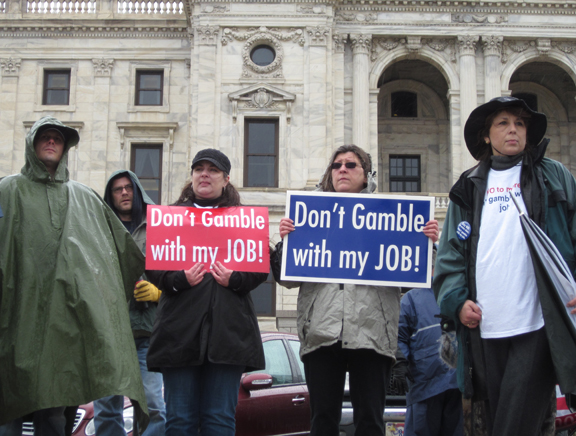
 Over 3,000 workers gathered on the lawn of the Capitol in St. Paul on April 26 to protest legislation that would expand gambling within the state of Minnesota.
"We need to look for solutions to move Minnesota's economy forward, and this isn't one of them," Former House Representative Frank Moe said to protesters who had travelled from across the state for the event. Protesters stood in the rain holding up signs that read "Don't Gamble With My Job!"
The legislation in question proposes allowing racing tracks to carry slot machines, known as racinos, into the state. With a gambling economy that is already considered saturated, rural casinos are worried such tracks would take business away from the small-town communities across the state that rely on jobs local casinos provide.
The Secretary Treasurer of the Mille Lac band of Ojibwe, Curt Kalk, took the podium to express his concerns, "The number of jobs created by Minnesota's Job Creation Programs is a drop in the bucket compared to the employment opportunities Casinos in the state of Minnesota have generated. In Mille Lac's alone, we've created over 3,000 jobs for tribal members and non-members alike. These are decent paying jobs that give benefits to everyone."
"Racinos would permit full-blown casinos for privately owned north Metro and south Metro businesses. Especially for the Mille Lac's band, the economic consequences would be devastating," Kalk said.
There were many prominent political figures at the rally, including Bios Forte Tribal Chairman Kevin Leecy, Upper Sioux Community Chairman Kevin Jensvold, and Chairman Stanley Crooks from the Shakopee Mdewakanton Sioux Community, as well as Legislators from both the Republican and Democratic-Farm-Labor parties. National Indian Gaming Association Chairman And Ernie Stevens, Jr., who came from Washington, D.C. show his support.
"Looking out at this great crowd, I see Indian and non-Indian people standing side by side, fighting for their jobs," Stevens said. "We thank you for being here, and for supporting the great work that these tribes are doing for their own communities and for their neighbors. We're all in this together."
The benefits Tribal Gaming has provided to remote reservations and rural areas has positively affected both Native and non-Native residents. 78% of Minnesota Indian Gaming enterprise employees are non-Native American, with a direct annual payroll of $249.5 million.
In addition, Tribes build roads, water, waste treatment, health care, community centers, retirement facilities, law enforcement facilities, museums, and libraries with gaming revenues.
"How many more [Natives] go to college? How many more have health-care? How many jobs do casinos create? We're on a higher standing in this debate. Good jobs, good education, good health-care; we're going to win this fight if we can!" said Representative Tim Mahoney (D – 67A).
John McCarthy, Executive Director of the Minnesota Indian Gaming Association (MIGA), spoke on behalf of the company that sponsored the event. "This event was designed to highlight the fears of thousands of tribal employees who could lose their jobs if the legislature adopts any of the gambling expansion proposals now on the table. Any significant decrease in revenue [for tribal casinos] would likely result in layoffs and reduced purchasing of goods and services."
The rally ended with the personal testimony of employees from Prairie Edge and Grand Casino, telling the audience about how much their jobs have helped change their lives for the better.
"Say no to Racinos!" Chanted the crowd as the rally-goers departed for the day. "Rural Jobs count too!"
Hearings on the bill were set for the day of the rally, but postponed due to the illness of the committee chair.
Legislators have yet to decide on whether they will allow racinos in the State of Minnesota. Debate in the house and Senate is expected in the coming weeks, with Tribal leaders expected to offer testimonial evidence.
"Racinos would permit full-blown casinos for privately owned north Metro and south Metro businesses. Especially for the Mille Lac's band, the economic consequences would be devastating," Kalk said.
There were many prominent political figures at the rally, including Bios Forte Tribal Chairman Kevin Leecy, Upper Sioux Community Chairman Kevin Jensvold, and Chairman Stanley Crooks from the Shakopee Mdewakanton Sioux Community, as well as Legislators from both the Republican and Democratic-Farm-Labor parties. National Indian Gaming Association Chairman And Ernie Stevens, Jr., who came from Washington, D.C. show his support.
"Looking out at this great crowd, I see Indian and non-Indian people standing side by side, fighting for their jobs," Stevens said. "We thank you for being here, and for supporting the great work that these tribes are doing for their own communities and for their neighbors. We're all in this together."
The benefits Tribal Gaming has provided to remote reservations and rural areas has positively affected both Native and non-Native residents. 78% of Minnesota Indian Gaming enterprise employees are non-Native American, with a direct annual payroll of $249.5 million.
In addition, Tribes build roads, water, waste treatment, health care, community centers, retirement facilities, law enforcement facilities, museums, and libraries with gaming revenues.
"How many more [Natives] go to college? How many more have health-care? How many jobs do casinos create? We're on a higher standing in this debate. Good jobs, good education, good health-care; we're going to win this fight if we can!" said Representative Tim Mahoney (D – 67A).
John McCarthy, Executive Director of the Minnesota Indian Gaming Association (MIGA), spoke on behalf of the company that sponsored the event. "This event was designed to highlight the fears of thousands of tribal employees who could lose their jobs if the legislature adopts any of the gambling expansion proposals now on the table. Any significant decrease in revenue [for tribal casinos] would likely result in layoffs and reduced purchasing of goods and services."
The rally ended with the personal testimony of employees from Prairie Edge and Grand Casino, telling the audience about how much their jobs have helped change their lives for the better.
"Say no to Racinos!" Chanted the crowd as the rally-goers departed for the day. "Rural Jobs count too!"
Hearings on the bill were set for the day of the rally, but postponed due to the illness of the committee chair.
Legislators have yet to decide on whether they will allow racinos in the State of Minnesota. Debate in the house and Senate is expected in the coming weeks, with Tribal leaders expected to offer testimonial evidence.