
Work has been underway to select photographs of the American Indian Movement (AIM), along with documents and objects, for a special first exhibit to open May 10th at the All My Relations Gallery in Minneapolis, at 1414 East Franklin Avenue, just a stone’s throw from AIM’s original offices.
The challenge was to winnow thousands of pieces down to a tiny fraction of what is being archived by AIM’s Interpretive Center, on Franklin Avenue, also near the site of the original offices.
The exhibit is titled, “I’m Not Your Indian Anymore,” in memory of Floyd Westerman, whose music filled the hearts of all who heard him sing such songs as, “Custer Died for Your Sins.”
National writers, filmmakers, and many people think of the AIM in the past tense if they consider it at all. In Minneapolis, this national organization is considered local because several AIM founded organizations are active and activities are seen close to home.
But for those who are even closer to it as AIM members, the “Movement” is anything but in the past tense. Busy organizations, like American Indian OIC (AIOIC), located where the Phillips neighborhood divides into other parts of the city, and marking the beginning of the American Indian Cultural Corridor, has one of the largest operating budgets of nonprofits in the Indian sector. Started by Clyde Bellecourt and his friend, businessman John Bolger, the organization focused on one of AIM’s longtime goals of providing job training to raise up the Indian community. AIOIC is recognized by the U.S. Dept of Labor as one of the premier workforce development programs in the country: moving 45,000 people off of welfare roles and putting them to work.
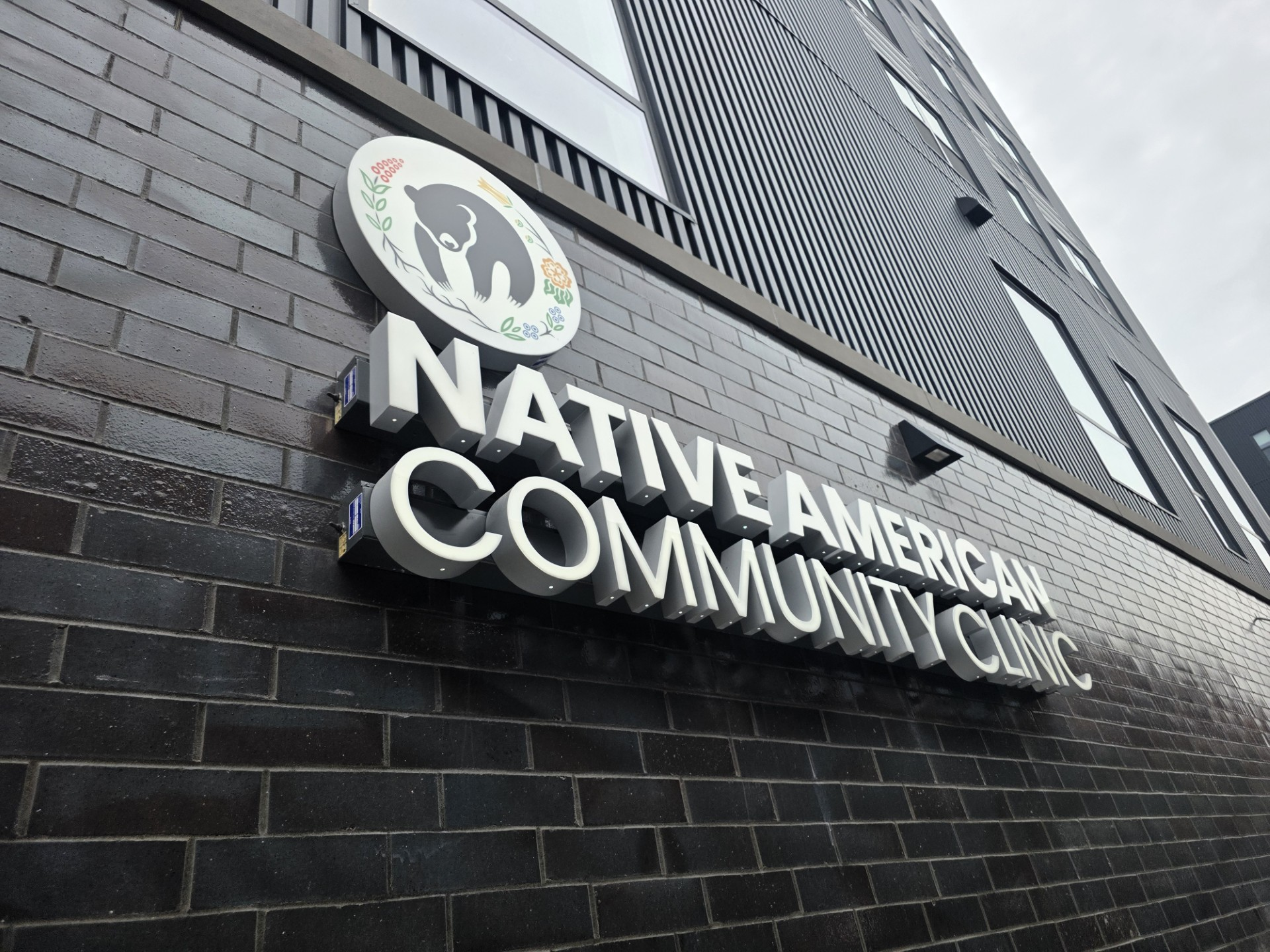
AIM has touched other areas in Indian lives: health, education, and legal representation. The Minneapolis Indian Health Board was founded by AIM member Charles Deegan, Jr. and the Native American Community Clinic was started through the efforts of Clyde Bellecourt and three physicians.
Young supporters of AIM founded MIGIZI Communications: it has served thousands of college age and secondary students in media-related education.
The Legal Rights Center began by representing Indians who could not afford legal counsel and through the activism and support of AIM, and progressive attorneys, tackled the overrepresentation of Indian youth, adults, and people of color in Minnesota’s correctional system. To date, the Center has provided legal representation to nearly 30,000 people and outreach and services to an additional 4,000 people each year.
AIM urged the fledgling National Indian Education Association at its meeting in Minneapolis to put education of Indian children at the top of its work plan. Thousands of Indian children were being abused in BIA schools, pushed out of public education and onto city streets, and culture and language continued to be ignored or suppressed.
Making good on its own words, AIM started two schools in Minnesota: Red School House in St. Paul and Heart of the Earth Survival School in Minneapolis. AIM founder George Mitchell was already holding classes for pushed out secondary students but schools were needed as formal organizations. Both schools have closed, but in their histories, they served nearly 50,000 students in innovative programs that focused on culture and language. They were models for the many programs and schools to come that now serve Indian students throughout the country.
But back in 1968, there were no models to follow. It was all new work, accomplished by people who were not deemed to be “scholars” by the Indian elite of the time. Deep divisions were growing between reservation leaders and their own members who had been relocated to the cities. Deemed “urban Indians,” an artificial tag that disregarded continuing reservation family ties and land still owned by the relocated, those in cities and towns were cut off and ignored.
AIM was a brand new idea, formally organized to receive government funds to serve those in need, but also informal enough to offer membership to anyone to wanted to join the Movement, and thousands did. The little red membership cards were distributed in cities and on reservations, as well as by institutions such as the Haskell College AIM Chapter in Kansas.
The cities that had been points where relocated Indians were sent became sites of Indian Centers that provided help through various social service programs and places where AIM flourished. The children of those who were relocated, Baby Boomers, flocked to join AIM and they began to focus their discontent on the place that had so much to do with the division of Indian lives: the Bureau of Indian Affairs (BIA).
Perhaps because it was an image well known around the world, Wounded Knee in 1973 is most associated with AIM. For 71 days AIM responded to pleas for help from reservation residents. AIM?and its supporters either held down their occupied area, or brought in food and medical supplies to sustain those inside who were pinned down by U.S. government fire. In a subsequent 9-month trial of AIM leaders, the Federal Bureau of Investigation was found to be untrustworthy on the stand and in evidence presented. The charges were dismissed on grounds of governmental misconduct.
“I’m Not Your Indian Anymore,” runs May 10 to June 30. Reception is May 10, from 6 pm to 10 pm. Traditional Native food will be served. Dick Bancroft and Laura Waterman Wittstock will be signing their book We Are Still Here: A Photographic History of AIM on May 25 and June 1. Lectures on AIM history will be held June 8, June 15, June 22, and June 29. For more information, call Susan Bellecourt at 612-886-2107.