

By Lee Egerstrom
Migizi Communications is celebrating 40 years of service to the American Indian community in the Twin Cities but is looking far ahead through training Native youth for leadership, education preparation and careers in emerging environmental, technical and renewable energy occupations.
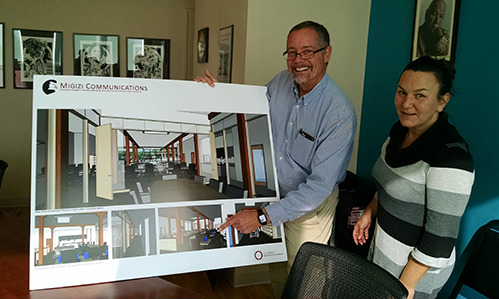
To aid its plans for the future, the nonprofit organization purchased a vacant building at 3017 27th Ave. S. in Minneapolis and recently completed design work and planning for the new building.
When remodeling is completed, the new site will allow Migizi to almost double the number of students and others it serves with its programs, said Kelly Drummer, the transition coordinator. Migizi is currently housed in rented space at 1516 East Lake St., also in south Minneapolis.
Drummer, who is overseeing operations during the transition to new leadership and the new building, said fundraising is now 70 percent complete for the $1.6 million acquisition and buildout project. Grants from Northwest Area Foundation, the Otto Bremer Foundation and Shakopee Mdewakanton Sioux Community got the project started.
With the move, space for programs will increase from 3,400 square feet to 7,400 square feet. That opens the way for additional students and program interns, said Graham Hartley, director of programs.
At the same time, Migizi is expanding its education and training programs to St. Paul and with high school programs in suburban Farmington and Fridley. Those programs are in planning stages.
Migizi (the “bald eagle” in Ojibwe) will celebrate 40 years of service at a special reception Nov. 8 at the Northwest Area Foundation in St. Paul. That program will be a special salute to Laura Waterman Wittstock, who founded Migizi in 1977, and Elaine Salinas, who was Migizi president from 2004 until retiring in April.
“MIGIZI is constantly evolving in its response to community needs based on past experience and new learning, while remaining true to its original mission to inform and educate,” Salinas said.
It started in 1977 as a targeted program to train young journalists to counter misrepresentations of Native Americans in media. From that it evolved into a variety of career advancement and training programs in more recent years.
Migizi programs
Four main categories for its programs include: Native Academy, a middle school and high school program that focuses on STEM, or science technology and math education; Native Youth Futures, an internship program and financial literacy track; First Person Productions, a media training program that teaches students how to produce videos and film for new media; and Green Jobs Pathway, which helps Native students complete high school, succeed in post-secondary education and training programs, and become qualified for jobs in the evolving “Green Economy”.
These four areas are interconnected and all prepare students for future employment and financial success. For those reasons, Drummer said a future growth area will be the Green Jobs Pathway.
“These jobs pay $18.50 to $24 an hour,” she said. “Those are living wages and they represent the jobs of the future.”
The median hourly wage for available jobs statewide in October was $12.40, according to data assembled by the Jobs Now Coalition. The median is the point where half of all jobs pay more and half pay less than that wage.
Four low-paying occupations – food preparation and serving, sales, personal care and office support – accounted for 46 percent of Minnesota’s 142,000 job openings heading into October.
Kevin Ristau, analyst for the jobs group, said only 45 percent of Minnesota’s job openings offered health care benefits and more than half of the jobs were part-time.
In contrast, the Minnesota Department of Employment and Economic Development (DEED) has a “Cost of Living Calculator” showing a Minnesota family of three must have both parents working full time and both earning at least $15.80 an hour to meet basic family needs.
Getting people prepared for living wage careers isn’t easy. Recognizing that, the U.S. Department of Health and Human Services awarded Migizi two three-year contracts, totaling $2.1 million, to support its programs. That funding will be used on two projects that connect the four Migizi training and education categories, Drummer said.
The Indigenous Pathways to Economic Independence project includes specific career training, internships and apprenticeships leading to industry recognized certification in technology and new media fields and in renewable energy. Part of this will help build youth social enterprises, such as the First Person Productions unit that is seeking to become self-sustaining by producing videos and training materials for nonprofits and other groups.
The second project is called the 21st Century Warrior’s Society. It uses Migizi’s programs to work with 200 American Indian youth to develop leadership skills, deepen their cultural identity and community connections and prepare for high school and postsecondary success.
In a statement from Hartley explaining the grants, the latter effort for student preparedness was described as improving “their educational trajectory so that their futures will be defined by choices, rather than circumstances.”
Partnering with Migizi on these programs for the current year are the Minnesota Department of Public Safety, Minnesota Office of Higher Education, Minneapolis Public Schools, Youthprise and the STEP-UP youth employment program of AchieveMpls and City of Minneapolis.
Other partners cited for making these programs work included the All Nations Program at Minneapolis South High School and Minneapolis Public Schools’ District Indian Education Department, the NaWayEe Center School, Minneapolis College, Century College and Phillips Indian Educators.
Wilder Foundation research shows the programs do have success although Drummer said much work remains to be done.
In an evaluation of Migizi’s Native Academy programs this past year, Wilder researchers found 53 percent of Native Academy program participants were on track for on-time graduation in the 2016-2017 school year. The overall American Indian graduation rate in Minneapolis schools that year was only 30 percent.
Of those Native Academy students, 79 percent had plans for postsecondary education. Twenty percent would seek an associate’s degree, 60 percent were planning on bachelor’s degree programs and another 20 percent planned to pursue education to the doctorate level.
For info on Migizi Communications, see: https://migizi.org.