

By Hannah Broadbent
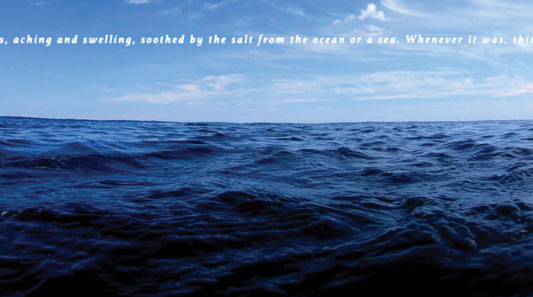
It’s a special experience to see a work of art that stays in your head for days after. I can still see an endless horizon above choppy waves, the waves move by at eye level while the sun is at its highest point in the sky. Words from Seminole Chieftain Coachoochee’s memoirs appear on screen – a video projection that takes most of the space on a black wall in a dark room inside the Minneapolis Institute of Art.
This video is playing directly to the right of another video. Together the two make one film, “Cloudless Blue Egress of Summer”. It’s one of two films in Sky Hopinka’s (Ho-Chunk/Pechanga Band of Luiseño) latest body of work, “Disfluencies”. The artist was a fellow at Harvard’s Radcliffe Institute for Advanced Study and at the Sundance Institute. His work has been featured in festivals and exhibitions at the ImagineNATIVE Media + Arts Festival, Ann Arbor Film Festival, Sundance, LACE, the Whitney Biennial, and the Front Triennial.
The filmmaker tells me when I watch the film I have to choose between the right and the left videos. Will I choose to look to the left – moving pictures of Fort Marion and what it looks today as a tourist destination? Complete with ropes and coach buses accompanied by tourists in cargo shorts. Or will I look to the right? This side shows the journey the prisoners made to be free and the drawings they made while imprisoned.
“Cloudless Blue Egress of Summer” tells the story of Fort Marion, Florida and Coachoochee’s escape from the prison in 1837. The film starts with silence. The only sound being that of the waves, familiar and comforting, relaxing even. As the words slowly drift across the screen Hopinka’s voice reads them to us in a lower, slightly modified delivery over music that starts to play.
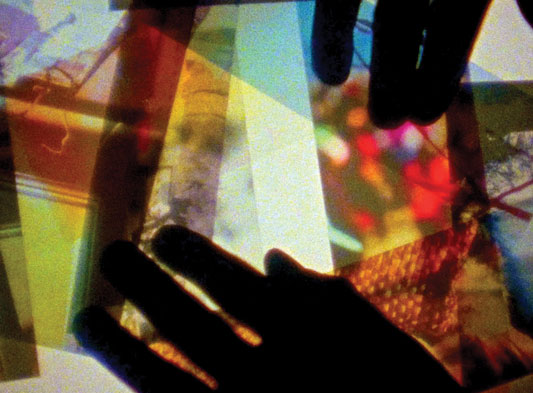
On the right, we see the ledger drawings from the prisoners that were held at the Fort (also known as, Castillo de San Marco). We see Hopinka’s hands go in and out of the frame as he moves the drawings throughout the screen. Seeing his hands and the physical movement of someone moving the images makes it personal.
On the left, the story of Choachoochee’s escape from his own account scrolls vertically across the screen in an hourglass shape over images of today’s Fort.
“I would rather die by a white man in Florida than die in Arkansas,” passes by.
He and several other prisoners chose the darkest night of the month to make their escape because that’s when it was safest for them – whatever safe means for a group of Indians risking their lives to get back to their people – anything to not die at the hand of white men who captured them for no reason. They brought stolen medicine with them for the sick and hurt prisoners and crawled through a small hole that was carved from a brick in the wall. They landed in the ocean and from there finished their journey back to their people.
“I told them of my escape and assured them I would not betray them.” Coachoochee said to his tribe when he returned to them.
The videos end in silence – just the way they started.
The juxtaposition of the two films side by side still has my mind reeling. The images play in my head over and over again and each time I try to remember something new, an image, a word, a sound, that I didn’t see in my last memory. All of these elements Hopinka perfectly blended together to tell Coachochee’s story.
“Disfluencies” features two films, a collection of pictures as well as poems. The pictures are from his second film, “Lore”, which plays directly across the atrium from “Cloudless Blue Egress of Summer”.
Watching “Lore” as the second film felt like walking into another set of emotions. Leaving the first film (not that there’s an order) left me with questions, a flurry of feelings, and the internal struggle that we share with our ancestors.
The first impression of “Lore” makes me think the two videos are in complete contrast to each other, but on further reflection I understand the balance and companionship they have with each other. They’re both symbols of rebellion and evolution.
“Lore” sits in a small white room. The old, audible projector sits about 5 ft. from the wall it projects onto. It shows the video in a perfect square. Hopinka tells me the video is square shaped and not in landscape because landscape images were not for our people, we didn’t need to have pictures of the land, because we were a part of it.
Hopinka’s calming voice plays. He is narrating his own thoughts as his hands move around camera film. The somewhat distorted images but incredibly clear and bright colors of the undeveloped pictures are the perfect complement to Hopinka’s poetry, which start with stories about land and spirits.
He continues to ask questions while he’s telling stories, making me think harder and harder with each one while the pictures are making me smile at the same time. He talks about what was and what could have been – honestly the best summary of what I was feeling through the whole experience.
“Rivers and shapes will never change, this is the old way.”
A video of Hopinka’s musical band appears on screen. The film ends with his band’s performance and their friends taking part in it, leaving me with feelings of laughter and the love of community.
The whole exhibit plays with images, shapes, music and words. It appeals to every sense, giving every part of our mind something to do – and something to think about. If you’re like me you’ll be playing scenes and sentences in your head over and over again. You’ll be thinking about ways to translate and adapt our culture to modern art, and you’ll be eager to go back.
Sky Hopinka: Disfluencies will be on display through July 19th at the Minneapolis Institute of Art. (Mia is currently closed due to Covid-19. Please check their status before going there.)