

 On March 11th The Walker Art
Center hosted the Twin Cities premiere of Chloe Zhao’s debut feature,
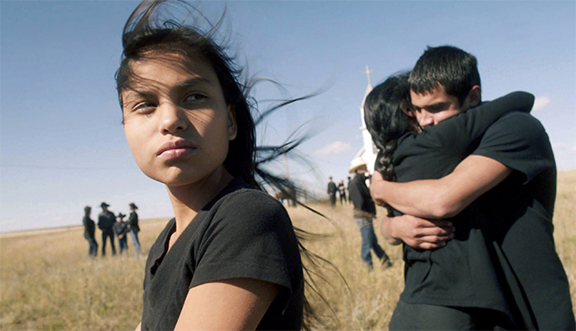
“Songs My Brothers Taught Me,” a quiet story set against the
backdrop of Pine Ridge Reservation in South Dakota. The film tightly
follows the tender relationship of eleven-year-old Jashaun Winters
(Jashaun St. John) and her older brother Johnny (John Reddy). In the
wake of the death of their estranged, bull-riding father, Johnny’s
secret plan to leave the reservation for Los Angeles with his
girlfriend becomes more attainable. He buys his late father’s truck
and his situation becomes more violent as his side-job of bootlegging
alcohol reaches an impasse. For all of the reasons he needs to leave,
leaving Jashaun looms as an increasingly cruel intent.
“Songs My Brothers Taught Me” is
subtile storytelling told through portraiture. Although the story
opens and ends with Johnny’s first-person voice over, the story is
demonstrative and shown, not told. There are no overt explanation
that alcohol is illegal on Pine Ridge, Johnny is warned about “the
protests” and Johnny is beaten, but Zhao isn’t interceding and
offering up a textbook history lesson for her characters’ situation.
The story doesn’t take on the responsibility of educating white
people. This is an important and surprising nuance of the film. So
many films that focus a lens on reservation life are in the business
of offering up explanations and elucidating Natives for an outsider’s
eye. That is because many films about Native people are usually made
for a non-Native market.
In 2002 director Chris Eyre pointed out
a big problem with Natives on film. Native people rented movies but
often didn’t have access to theaters on many reservations. He
premiered his film “Skins” at Pine Ridge from a mobile theater
that sat one hundred people in a semi-truck as part of the film’s
“Rolling Rez Tour.” Eyre had filmed “Skins” entirely on Pine
Ridge and wanted to make sure the people could see his film
first… for free. Although many films have been made on or about
Pine Ridge, the Lakota community there had no theater until 2012 when
the Nunpa Theatre (nunpa means two in Lakota) was
opened. A small victory resides in the fact that “Song My Brothers
Taught Me” is showing at Nunpa Theatre in the community where it
was produced.
The film also features some very
insightful, nuanced perspectives that no-doubt reflect on Zhao’s
capacity for quickly adapting to communities. Her work has been
compared to Terrence Malick for its pacing, quietness and beauty.
But, unlike Malick, who directed The New World (2005) a film
about John Smith and Pocahontas, Zhao created a contemporary
portrait, a deeply thoughtful film that doesn’t perpetuate the idea
that Native people belong to a romantic, idealized past, but that we
belong, create and thrive today.
Much of the story relies on characters
teetering on the edged of two states. Irene Bedard, the voice of
Disney’s Pocahontas who also played Pocahontas’ mother in Malick’s
The New World, plays the role of Lisa Winters, the repentant
alcoholic mother of Johnny and Jashaun. Lisa seeks redemption in
church looking for a heavenly father for her fatherless children,
while Johnny and Jashaun walk the cathedrals of the Black Hills. The
landscape is a character in this film, the tight framing of on the
characters faces in interior spaces is opened up in the instances
where the landscape floods in. This also seems Malick-esque.
Another angle to the inside/outside
community element of this film’s production is that the director,
Chloé Zhao is Chinese-American filmmaker who immigrated to the
United States by herself when she was fourteen years old. She spent
four years making Songs My Brothers Taught Me and
adapting to the community. Many directors hop from community to
community seeing places as slates for films, yet not being fully
vested in any one community. Zhao’s next film may be telling as to
what themes and patterns she establishes over her career, and I look
forward to seeing where she goes from here.