

By Natasha Rausch/Inforum
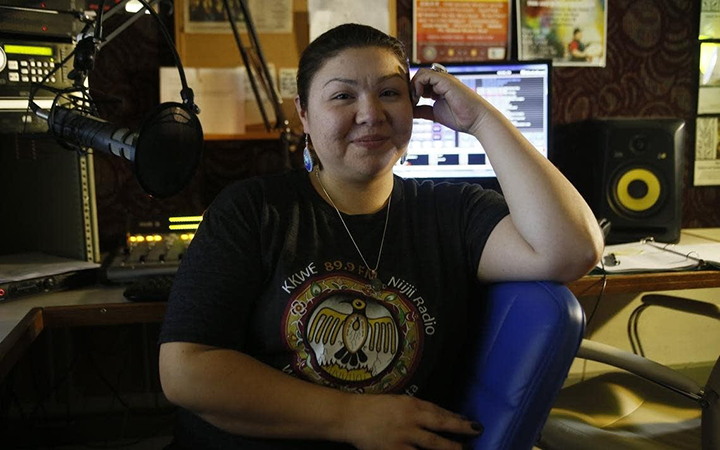
A brick building off State Highway 59 that used to serve as the Callaway School is now home to the White Earth Nation’s sole independent radio station.
Niijii Radio, on KKWE 89.9FM, ran its first show on Nov. 11, 2011, at 11:11 a.m. The time was intentional, a good luck charm. For the first three days, the station ran on a 24-hour loop of songs and station IDs, just to test out the new airwaves. Then people started going on the air.
Since then, the nonprofit station, its hosts and volunteers served to “keep our people connected, informed,” said general manager Margaret Rousu, 51.
The reach goes beyond White Earth, though. The station’s name, “Niijii,” is the Ojibwe word meaning “friends,” representing the hope to reach out to non-Native people in order to “build a positive perception of the Native American people in non-Native communities, said Rousau.
Each morning, Terry Goodsky, of the Bois Forte Band of Chippewa, starts the day on the air. He has “good music, bad jokes, news, weather,” said assistant station manager and program director Faith Ahlgreen. “He’s very real.”
Rousu, a member of White Earth, runs “minwaajimo,” which roughly translates to “he or she tells good news.” She tells stories of people in the community, like tribal council members and Indian Child Welfare social workers, to help shed light on services provided in the area.
College student Jacob Woody runs “Play it by Ear” every Saturday. He started with the station in high school, but now he sends in his segment from college, where he’s a broadcast major.
Interspersed between shows is often a show known as “Beautifully Random Music,” a name given by listeners early on in the radio station’s existence to describe the diverse mix of Native and non-Native tunes.
Grace Roberts, 32, of the Mille Lacs Band of Ojibwe, runs the “Reviving with Grace Show” three days each week. She described the segment as a “reviving of culture, a reviving of language, a reviving of self.”
She’s run the show since 2013, though it’s changed as she has. She’s learned the Ojibwe language — though she said she’s not quite fluent yet — and she speaks in the language on the show in an effort to teach listeners new words. She’s interviewed Ojibwe elders and Native American bands like War Bonnet. And now she’s learning more about the Minnesota Chippewa Tribe Constitution to produce a new series on it.
“I came to White Earth for healing,” she said. “Through culture, community, language and Niijii Radio, I was able to overcome the struggle and share that with listeners.”
Interviewing elders, she said, helped with much of her healing.
“I just admired their resiliency,” she said. “A lot of their strength has passed on to me.”
She titled the elder interviews “Gichi-Aya’aag Bizindaw Ya,” meaning “these are our elders, listen to them.” One elder even gave her a Native name, “Waawaate-Ikew” meaning “Northern Lights Woman.”
Listeners have reached out to Roberts to tell her the impact her show had on them, too. “They tell me things like that I help brighten their day, that I help lift themselves up.”
In the beginning, Niijii Radio’s logo was a microphone. But after two setbacks — a lightning strike to the station and then a break-in — the station went off-air for several months to recover. Afterward, Niijii changed its logo to a thunderbird rising up from flames.
“We rose up out of the ashes,” Rousu said. “It’s that constant reminder that we’re going to continue to rise.”
The White Earth Land Recovery Project owns the license to the station, and sponsors such as Honor the Earth, the White Earth Tribal Council, the Mille Lacs Band of Ojibwe and others help keep Niijii Radio on the air. The station also relies on grant funding and donations. Renting their one radio tower with a 50-mile radius costs $3,000 a month, Rousu said.
Rousu initially came to the station to have an impact on the community and the next seven generations, she said.
“When we go on-air, we have a healing ability to affect historical trauma,” Rousu said. “With the radio station, we can bring a light to the disparities we suffer in order to help those who are suffering.”