

By Sarah Mearhoff and Dana Ferguson
Editor’s note: This is the 2nd installment of a three-part series on the crisis of missing and murdered Indigenous women in the upper Plains.
Zahannez Stands was having recurring dreams that he and his loved ones were going missing – pursued by a green Camaro and abducted into the car, never to be seen again.
The nightmares were inspired by the real-life horrors he heard growing up on the Pine Ridge Reservation in southwestern South Dakota, where everyone knows a story of a daughter, sister or mother who seemingly vanished.
Stands was 13 years old when he sat before 13 legislators in the South Dakota Capitol’s largest hearing room on a bitterly cold February night in Pierre, pleading them to greenlight a bill that would collect data on cases of missing and murdered Indigenous people. He said his nightmares only stopped after he began home-schooling in fifth grade.
“It makes you feel scared to walk out of your house,” he said in the full hearing room. “You know you could never return.”
Legislators unanimously passed the bill in March, and it was signed into law by Republican Gov. Kristi Noem weeks later.
About a mile away from where Stands sat, Corinne Faye White Thunder’s body was submerged in the Missouri River. Though she was last seen in December 2017, her body wouldn’t be discovered until June, when Game, Fish and Parks officials accidentally encountered her submerged car off of Pierre’s Downs Marina. She had never been reported missing.
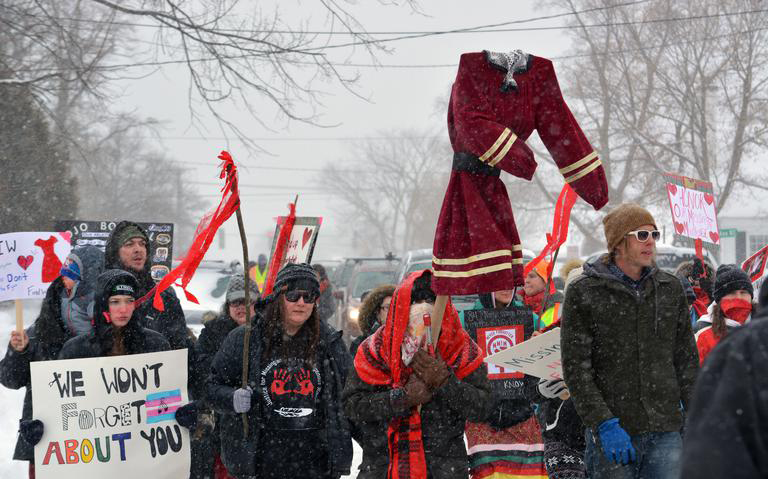
The push for legislative action like South Dakota’s comes after years of grassroots efforts, which have fueled conversations about Native women and girls’ safety in hearing rooms and Facebook groups. A search for #MMIW on Twitter will reveal tweets from activists begging to be seen and lawmakers calling for reform.
And a wave of Native elected officials entering state and federal offices has shone a spotlight on the issue, though Native representation in legislative bodies remains disproportionate.

victim of a brutal murder that rocked Fargo and North Dakota in 2017.
What are lawmakers doing?
In South Dakota, Senate Bill 164 in 2019 tasked the state with establishing uniform reporting and investigating protocols for missing persons cases and required training for law enforcement officers on cases of missing Native women and children. It also passed missing persons guidelines in 2019.
This year, South Dakota lawmakers are considering a bill written that would establish a statewide universal database of missing persons cases, accessible by local, state, tribal and federal law enforcement.
Lawmakers in Minnesota last year formed a state task force to investigate the prevalence of violence against Indigenous women and girls in the state, as well as the gaps that allow these cases to fall through the cracks. The 11-member task force, comprised of advocates and state officials, has a year to study the issue and give recommendations to state lawmakers for legislative action.
In Washington, D.C., members of Congress have pushed for federal action. Savanna’s Act, championed by former U.S. Sen. Heidi Heitkamp, D-N.D., has yet to be passed more than two years after the brutal murder of the bill’s namesake Savanna LaFontaine-Greywind, a Spirit Lake Nation woman who disappeared from Fargo in 2017. The Not Invisible Act, introduced by four Native lawmakers in May 2019, has completely stalled.
And Congress’ reauthorization of the Violence Against Women Act, which contains provisions geared toward protecting Native women and reaffirming tribal criminal jurisdiction over non-Native perpetrators, remains unpassed, embroiled in Washington politics.
The Trump Administration in November announced its own task force named Operation Lady Justice, which aims to better understanding what Trump called “a tremendous problem” that’s “been going on for a long time – many, many decades, beyond that.”
Pushing for answers
Minnesota state Rep. Mary Kunesh-Podein, D-New Brighton, said she authored the bill to create a state task force amid increased national awareness of the issue, which grew thanks to grassroots activism and high-profile cases like LaFontaine-Greywind’s.
“People finally started talking about it,” Kunesh-Podein said, but the stories that were already well-known among Indigenous communities weren’t as familiar at the Capitol.
“Very few people had any idea that this was even happening,” Kunesh-Podein said. “So our first hearing (in 2018), there were legislators and people in the audience that were in tears, that were incredibly moved by the testimony of the women that came in to tell the stories.”
Democratic Lt. Gov. Peggy Flanagan, a member of the White Earth Nation, said part of the credit for getting the proposal in Minnesota off the ground goes to the Native women, including a coalition of Indigenous state lawmakers, who pushed to get Minnesota’s bill passed.
“I’m grateful that we didn’t have to convince people that our women were worth protecting this session,” Flanagan said. “The groundwork had been laid. The advocates were a constant presence here, and reminding us of our role and responsibility, and we got it done.”
In South Dakota, proponents of SB 164 asked for even less than a task force: They simply proposed that law enforcement keep track of cases of missing and murdered Indigenous women and girls (MMIWG) in their records. Without proper documentation, Native women’s cases remain invisible to the state.
Annita Lucchesi, a Cheyenne woman, at February’s hearing in Pierre said that as a survivor of domestic violence and trafficking herself, she was frustrated “that these stories weren’t being cared for and this data weren’t being collected in any meaningful way.”
She single-handedly – literally, with one hand broken by her former abuser – founded the Sovereign Bodies Institute, which houses one of the most comprehensive databases on MMIWG cases in the continent. Lucchesi, who is pursuing her Ph.D. in geography from the University of Arizona, began collecting the data herself with no funding or institutional backing.
“If that’s something that little ol’ me can do at a coffee shop table, that’s something our state agencies and law enforcement can commit to, as well,” she told legislators.
According to Sovereign Bodies, at least 158 Native women and girls have gone missing or murdered from South Dakota, and 35 from North Dakota, since 1900.
Lucchesi read off the names of the women and girls missing from South Dakota at February’s hearing: “Delphine, Tessa, Desiree, Darla….” Twelve Jane Does. It took her two-and-a-half minutes to get through the list, reading only the first names.
Is legislation enough?
Setting up state and federal task forces is a step, many involved in creating them said. But there’s more work to be done.
“This isn’t the victory,” Flanagan said. “The victory comes when we implement the recommendations and then see that we are experiencing a decrease in the number of women and girls that go missing or are murdered who experience violence.”
Heitkamp said as the prime author of Savanna’s Act, she’ll be proud when it finally reaches the president’s desk. But she cautioned that solving the crisis is “going to take more than just these one-offs.”
“It’s not about, ‘Boy, we got something done because we passed Savanna’s Act,’” she said. “(Savanna’s Act) is only a first step to overcome historic disparities in the treatment of Native Americans as crime victims.”
She said the lack of resources starts at the very beginning of every MMIWG case, from the moment a Native person goes missing. Tribal law enforcement agencies are notoriously strapped for resources, and Heitkamp said precious time is “wasted” because protocols aren’t in place and federal agencies may not respond right away.
Heitkamp said public safety on reservations “has never been equal” to the rest of America. It wasn’t until 2018 that Amber Alerts could be issued in Indian Country when children went missing, thanks to a bill Heitkamp cosponsored.
“What are the things that happen in white America when someone goes missing and why are we failing to do these exact same things in Native America?” she asked.
“They’ve been second-class citizens as it relates to public safety for a lot of years.”
Lucchesi said the law’s lack of a response is part of a larger problem: a “culture of violence against Indigenous women and girls.”
“The law enforcement and justice systems are complicit in maintaining a culture of violence against Indigenous women and girls, where perpetrators, especially white men, are repeatedly taught by law enforcement that there are no consequences for harming an Indigenous woman or girl,” she wrote in Sovereign Bodies’ November report.
But there’s a beacon of hope, Heitkamp said, in the advocates for change.
“They aren’t going to go quietly into the night,” she said. “They’re not going to say, ‘Well, that’s just the way it is.’ There is now a whole movement.’”
“Those are the kinds of things that will, in fact, spark additional protections.”