

Review by Deborah Locke
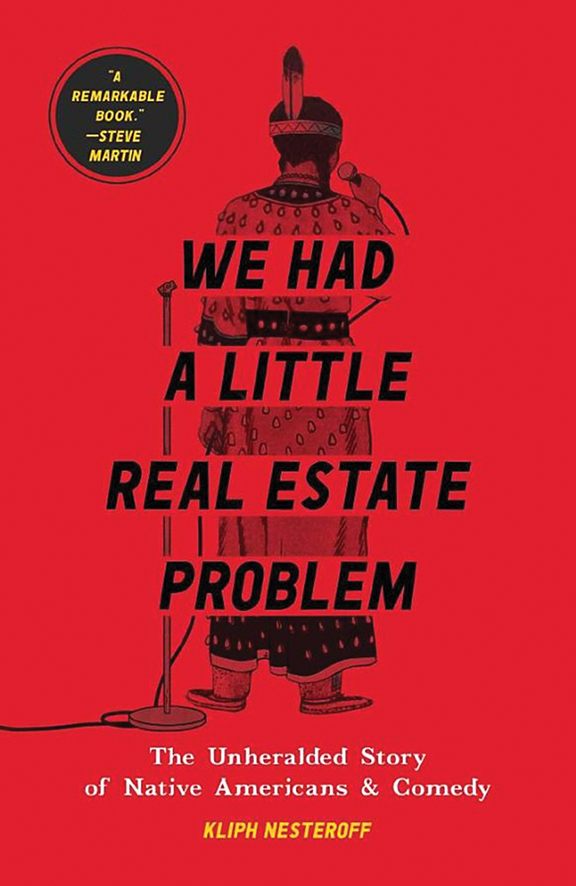
We Had a Little Real Estate Problem by Kliph Nesteroff (Simon & Schuster, 2021) examines the evolution of American Indian comedy, the many obstacles in its way, and its influence on popular culture.
Nesteroff does this by weaving first person stories of contemporary comics (including a few from Minnesota) with the country’s earliest examples of comic performance, the traveling vaudeville shows.
Standout comics Will Rogers (Cherokee, 1879-1935) and Charlie Hill (Oneida, 1951-2013) are featured prominently, as well as the 1491 comedy troupe, Jonny Roberts (Ojibwe, Red Lake), the Williams and Ree comedy act, and Kiowa-Apache comic Adrianne Chalepah.
This compelling, thorough story of Indians in comedy is told in non-linear fashion about the way American Indians tore away obstacles in their quest to do standup comedy, destroy stereotypes, and forge a path for new talent.
Many of the most harmful stereotypes held by North Americans about Indians got a foothold in the film and television industry. Film producers hired non-Indian actors who then dunked their faces into buckets of red clay and water to achieve the desired look.
The terms “redskin,” and “squaw” were common in movie plots that presented Indians as ignorant, grammar-challenged savages.
Early television portrayals weren’t much better. Nesteroff reported that during tv’s early years, stations needed content and turned to B westerns for vacant time slots. The movies were popular, so Hollywood started to crank out tv westerns by the dozen. “Hopalong Cassidy,” “The Cisco Kid”, “The Lone Ranger,” and “Davy Crockett,” entertained a generation of Baby Boomers who believed that feathers grew out of the heads of Indians. Television-watching children “hoarded coonskin hats as they enthusiastically re-created genocide during recess.”
Indian parents weren’t indifferent to these false and harmful stereotypes. In 1961, a Dakota mom told a reporter that she had a son, 3, who loved animated cartoons about Indians. She said that when the cartoons end, he “runs through the house pointing his cap gun and shouting, ‘Bang-bang! I’m killing Indians.’ It can be very embarrassing when we have visitors.”
Charlie Hill, who grew up in Detroit, watched the television stereotypes with his dad, who yelled at the screen. “Those aren’t Indians! Look how dumb they are! Indians – they’re not like this.”
Hill became critical of Native stereotypes on tv, and later of comedy teams like Allen and Rossi who were on “The Ed Sullivan Show.” He decided if they could be on tv, so could he. Hill arrived in Los Angeles in 1974, performed a set with the Garden Theater Festival, joining other fledgling performers like Minnesota’s Al Franken. He thought that comedy was just getting up on a stage and talking.
“But I found out right away why they call it an act,” he said. “It was frightening – staring at the microphone and seeing all those strange people drinking and staring at me.”
No one laughed at Hill that day. He bombed. Nesteroff shows how bombing is just a part of comic training. No one is born knowing comedy, and the road to success was not lucrative.
He wrote that new comedians paid dues in “roughshod bars, trying to entertain chain-smoking degenerates, most of whom had just lost it all at the tables. In these venues it didn’t matter how well-polished your jokes, how perfect your tuxedo, how wide your grin – inevitably some devasted soul would throw a shot glass at your head.”
The book shows Hill’s climb to the top as the first American Indian stand-up comedian, starting with an appearance on “The Richard Prior Show.” One of his signature jokes became: “I’m Charlie Hill. My people are from Wisconsin. We used to be from New York. We had a little real estate problem.” Hence, the book title.
Nesteroff starts and ends the book with Jonny Roberts, a Red Lake Nation member and father of 10 children who drives five hours to Minneapolis to perform a seven minute set each month. Roberts, a former social worker on the reservation, knows he needs more experience, but he takes what he can get.
He performs at the Laugh Factory in Hollywood on a night featuring all American Indians including Will Spottedbear, Lakota. The two men walk a few blocks to the Comedy Store, where they perform. When the evening ends, they see a signed photograph of Charlie Hill on the way, the guy who forged the path they now walk. Seeing that photo was magic.
Reading this rich, powerful book casts a kind of magic spell of its own. Nesteroff does a superb job of blending comedic voices with historical record, and the result will change the way you consume popular culture.