

By Lee Egerstrom
The COVID-19 pandemic is taking a toll on Native students, their teachers and programs within Minneapolis Public Schools and threatens to upend steady progress toward improving education and graduation rates over recent years.
This is not unique to Native American students and programs in Minneapolis, as schools across the state and nation shift to online teaching, called remote or distance learning. It is especially noteworthy in Minneapolis, however, where from 1,500 to 1,700 Native students are enrolled each school year.
That may be understating the actual numbers, said David (“Bezh”) Butler, the All Nations program coordinator at South High School in Minneapolis. Many Native students at South and throughout Minneapolis’ 75 schools simply get identified as “white” or other ethnicities, or come from families that keep their own cultural identities close within their circles of families and friends, he said.
“We are always trying to reach these students and families to make them more engaged within the Indian community,” he said.
Jennifer Simon, director of Indian Education for Minneapolis Public Schools (MPS), said the key challenge for educators and families this year is keeping students attending classes and connected to teachers, and with other classmates while using online tools at home and not in classroom settings.
Minneapolis school officials, like counterparts elsewhere across the country, are finding this difficult with distance learning in Minnesota.
Data from the Minnesota Department of Education show that 43 percent of Minneapolis American Indian students in grades 9 through 12 failed at least one core class of math, English, social studies or science in the first, or Fall quarter, of this school year. That is up from 38 percent from Fall quarter a year ago.
Comparable disappointing results were noted for middle school Native students – grades 6-8, by MPS officials in a statement on American Indian education in the district released Oct. 12, Indigenous Peoples’ Day.
State and district officials are still collecting data, Simon said. Early findings are disappointing given that Minneapolis schools were seeing improvement in connecting with Native students, their families, and improving graduation rates. The percentage of Native students graduating in four years increased from 36 percent in 2018 to 45 percent in 2019 before the COVID-19 pandemic hit.
While that was progress, Simon said, it shouldn’t leave educators “satisfied. Four in ten graduating on time isn’t what anyone should see as a great accomplishment.”
Similar looks at student progress being impacted by the pandemic is troubling for educators all across the nation where classes are restricted to avoid the virus.
Across the river in St. Paul Public Schools, for instance, officials found 39 percent of all students were failing at least one core course during the first quarter of this school year. The St. Paul Pioneer Press reported Nov. 11 that district wide failure rate was only 19 percent at the same time the year before.
Around the same time, NBC News reported Fairfax County Public Schools in affluent Virginia suburbs of Washington D.C. struggled with online learning results as well. While some students are thriving under the current remote learning system, students who were already having difficulty with academic progress have fallen farther behind.
The Fairfax schools said the number of students failing two or more grades increased 83 percent in the first quarter this year. Failing grades for English language learners jumped up 106 percent; students in special education with failing grades increased 111 percent.
News reports on the COVID-19 pandemic often remind us that the only comparable health crisis to today’s contagion was the Spanish flu a century ago. There were no computers, comparable telephone services and handheld devices back then to even contemplate out of the classroom, distance learning approaches to education.
Schools and education officials are coping and changing education approaches all across the country to keep students, teachers and school staffs healthy.
Despite these challenges, Minneapolis schools do have strengths and community support in reaching out to Native students and their families.
Several ongoing programs district wide and at various schools, conducted in coordination and with support from Native community groups, have been in existence for a decade or more, said Indian Education director Simon and Louise Mattson, executive director of Division of Indian Work (DIW). These deserve future media attention for greater public awareness and to help the schools and their programs connect with Native families and students.
A more recent development, however, is especially timely in that it addresses many of the challenges educators now face with teaching students under distance learning from COVID-19 restrictions. It stresses attendance and keeping students in contact with their teachers.
This program was established before the virus began affecting students, their families, and shutting down in-person classes.
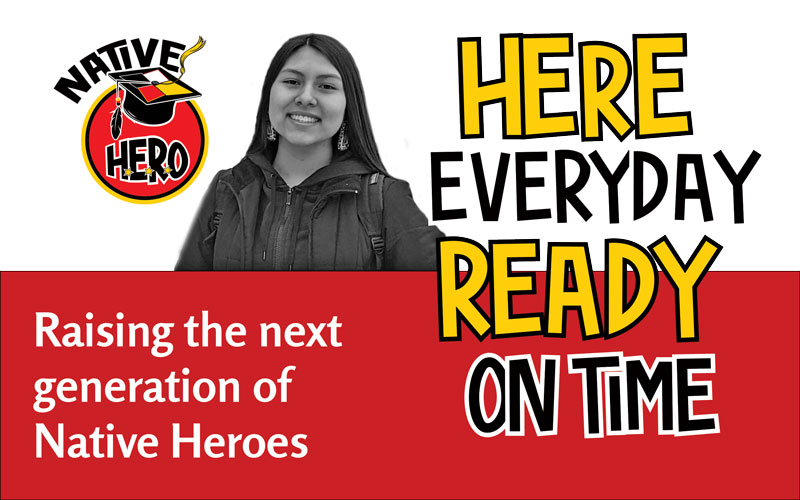
Called Here Today Ready On Time (HERO), it rewards students who have 95 percent and better class attendance records, said Braden Canfield, a social worker assigned to the Indian Education Department who works with schools in South Minneapolis.
This is done with community support from partner organizations that include DIW, Migizi Communications, Minneapolis American Indian Center (MAIC), Native American Community Clinic (NAAC) and the Indian Health Board (IHB). Awards are provided to students who became the program’s HEROs. The shutting down of in-person gatherings now make such ceremonies difficult.
“I’m really hopeful that we can hold a community celebration to honor these kids in May,” DIW’s Mattson said. “But, that isn’t easy to predict right now.”
South teacher Butler isn’t making predictions, either. “I know what some of our kids are going through,” he said. He lost his grandmother to COVID and other family members have had the virus.
“It is difficult when you can’t visit your sick relatives in the hospital and when you can’t get together for family gatherings and funerals. That’s not how our culture works.
“A lot of our kids are going through the same thing right now,” he said.
Teaching some students online can create other challenges. Students can mute the sound on online devices and remove cameras from Zoom teleconferences. “You don’t really know if they are there. Just knowing attendance is difficult.”
These challenges often engulf entire families, he added. With sick parents or guardians, Butler said, students may drift away from classes while others opt out to take jobs to pay family expenses and buy food.
Underlying these new challenges is the inherent problem many Native families have with institutionalized education. That comes from education being a “Europeanized” institution that remains foreign to many Native families and their student children.
This is why, they said, that American Indian education in the schools encourage class attendance, culturally appropriate activities, and interaction among people within communities with faculties and families. This helps make all pieces and people fit into a culturally recognized community.
Information on what Minneapolis Public Schools are doing to cope with COVId-19 is available at https://b2s.mpls.k12.mn.us/Phases_to_Safe_Learning
Data from Minnesota Department of Health on COVID-19 impacts on schools can be found at https://www.health.state.mn.us/diseases/coronavirus/stats/wschool.pdf
and https://www.health.state.mn.us/diseases/coronavirus/schools/index.html