

By Dan Ninham
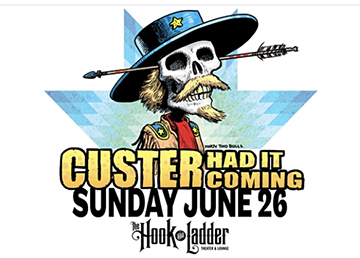
The Hook and Ladder theater and lounge venue in Minneapolis, MN was the location of the “Custer Had it Coming!” event on June 26th. It was held on the anniversary of “Custer’s Last Stand” on June 25-26, 1876. The theme of the event was to encourage an audience “to celebrate Native Nations resistance and resilience with Poets, Writers and Hip Hop Artists.”
The Battle of the Little Bighorn, known to the Lakota and other Plains tribes as the Battle of the Greasy Grass, was also known as Custer’s Last Stand. It happened along the Little Bighorn River in southeastern Montana Territory. This was the defeat of General George Armstrong Custer and five of the 12 companies of the 7th Cavalry Regiment of the United States Army. It was an overwhelming victory for the Lakota, Northern Cheyenne, and Arapaho, led by Crazy Horse and Chief Gall and was inspired by the visions of Sitting Bull.
The Master of Ceremony and event initiator was Zibiquah Denny, Potawatomi/Ho-Chunk tribal member and poet/writer.
In one of Denny’s Facebook posts, she thanked the talented writers, poets and hip hop artists that came to the “Custer Had it Coming!” event “to share their visions, words, and artistry.” A few of the performers shared their current and future work as a part of the gathering as well as how the event went.
Austin Owen
Austin Owen (Prairie Island Dakota) lives in St. Paul, MN . His Dakota name is Tasia popo dowan and means Meadowlark Singer. For this event he was asked to showcase his music as a writer in hip hop. “I’ve been in the entertainment industry over twenty years working events of all kinds, especially concerts and community events,” said Owen. “Fortunate to have opened up for the likes of Nelly, Wiz Khalifa, Bizzy Bone, Ghostface Killah, and DMX.”
“Most of my music I write and speak consciously about who I am, what I embody as an artist, while integrating aspects of culture into the hip hop elements,” said Owen.
“The event went well, it was great to see the different aspects of writing between all the performances,” said Owen. “Poetry, spoken word, and book reading showcased our similarities on how we create environments with our words.”
“My future plans are to continue DJ’ing which I’m most committed to in my career at this moment,” said Owen. “As a hip hop artist, I will continue to make music that represents who I am, what I stand for, and combining native and hip hop culture to prove we have a space in the art.”
Utuhu Can Cistinna Teresa Peterson
Utuhu Can Cistinna (Little Oak) Teresa Peterson (Sisitunwan Wahpetunwan Dakota) is a citizen of the Upper Sioux Community. She works as a Program Manager for the Collective Abundance Fund in the Foundation at NDN Collective.
“I shared excerpts from me and my Uncle’s recent book, Voices from Pejuhutazizi: Dakota Stories and Storytellers, published by the Minnesota Historical Society Press, some poetry that was published in the Racism issue of the Yellow Medicine Review, and two short stories from a draft manuscript I am working on.
“Creative writing for me really started when I was doing research on sense of belonging and the potential role and impact storytelling has,” said Peterson. “I experimented with story and wrote a historical fiction piece that ended up being published as a children’s story, Grasshopper Girl, published by Black Bears & Blueberries Publishing in 2018.”
Peterson continued, “It is one of the unktomi (trickster) stories my mom heard growing up nestled within a story that lifts up the tradition and role of storytelling. The experience provided me an opportunity to explore writing outside of academia and reporting.”
The last two years Peterson was involved in a Native women writers group facilitated by writer and author Diane Wilson. It gave her the support and space to finish a 20+ year project that resulted in Voices from Pejuhutazizi: Dakota Stories and Storytellers. She said, “It was a lengthy process because it was basically a big healing journey. You have to read the book to understand how stories can have such a profound role in healing.”
Peterson talked about the “Custer Had it Coming!” event. She said, “The event was a wonderful opportunity for Natives to share our work coming from all different kinds of genres, ages, tribes yet some common themes were present and gave honor to the historic victory – the Battle of the Little Bighorn.”
“Many of us are familiar with the generational traumas our people have endured yet we are still here – telling our stories, amplifying our voices, speaking truth,” said Peterson. “It is an opportunity to further our individual and collective healing.”
Bay Quaderer
Bay Quaderer (Lac Courte Oreilles Ojibwe) is a poet and writer. “My greatest life accomplishment putting it together as a whole is really plain and simple,” said Quaderer. “Surviving life as it came and went thus far.” “Thanking the Creator every day that I’ve survived my choices in life.”
Quaderer is a former wildfire fighter that followed being in the military service. “I have no formal education other than the boots on the ground type of life and the experience that it has shown me,” said Quaderer. “I have no big letters behind my name.”
“My family and I survived my father’s service in Vietnam, and with this also became a higher learning ground for me as an adolescent. My own knowledge has come later. I started writing after my own discharge, vowing never to be silent after falling ill to that which made me ill,” added Quaderer.
Quaderer continued, “Writing poetry has been my champion and allows me to reach out to others that struggle every day to find beauty in all that is ugly in our world and its many struggles. I write on a broad range of topics that we all inherit from our surroundings and upbringing with mine being here at Lac Courte Oreilles Ojibwe.”
The “Custer Had it Coming!” event effectively shared the words and voices of talented native poets, writers, and hip hop artists.
See some of Austin Owens’ work at: https://youtu.be/Lf9pM2fXHmY