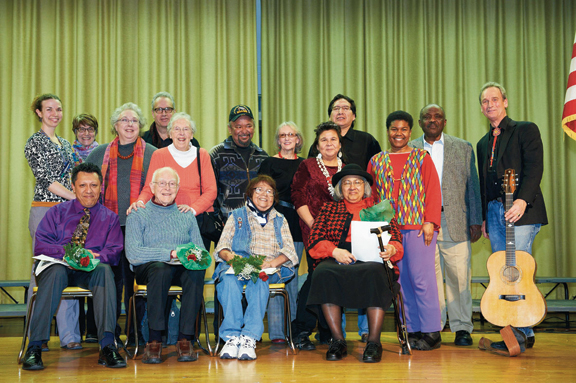
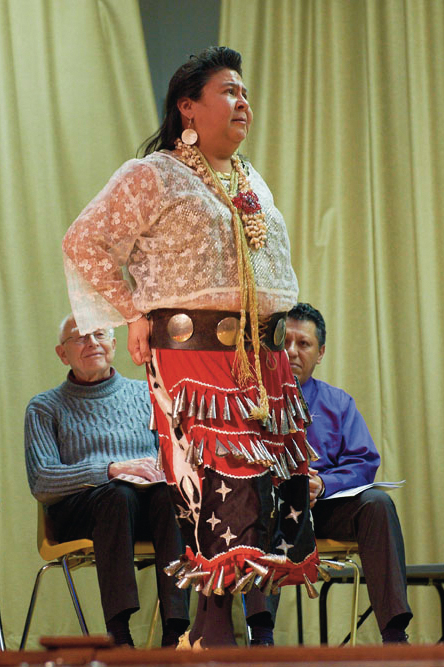
The Elders’ Wisdom Children’s Song (EWCS) program honored Anishinabe Ojibwe elder Pat Bellanger on February 12th at a celebration at Sanford Middle School in Minneapolis. EWCS blends elders’ oral narratives with youth engagement, music, and performances to affirm diverse backgrounds and experiences in communities throughout North America.
Bellanger, a founding member of the American Indian Movement and a delegate to the International Treaty Council for the United Nations, is the most recent member of the Twin Cities’ Native community to be honored through EWCS. Bellanger’s personal narrative focused on her role as a traditional Medewiwin woman. Because of this, EWCS founder Larry Long and the students chose to emphasize her Medewiwin responsibilities and her Anishinabe name Awaanakwe, which means Water Woman. The chorus reads: Awaanakwe, Awaanakwe/ Water Woman is my name/ Awaanakwe, Awaanakwe/ Anishinabe Ojibwa/ To care for Mother Earth/ From the moment of our birth/ Awaanakwe, Awaanakwe, Awaanakwe.
Long worked with Mavis Mantila’s 7th grade classrooms to bring Elders’ Wisdom, Children’s Song to Sanford Middle School. Mantila is one of the few certified First Nation Ojibwe teacher’s in Minneapolis Public Schools and a friend of Pat Bellanger.
"It fits right in with the Medewiwin belief that women are the keepers of the water, so we ended up writing a song that affirmed the spiritual and cultural core of who she really is," said Long.
Long, a Smithsonian Folkways recording artist, activist, and Executive Director of the nonprofit Community Celebration of Place, started EWCS over 20 years ago. The vision for the program was inspired by Long’s relationship with Dakota elder Amos Owen. Owen and Long first met in the 1980s, when Long and other activists organized the Mississippi River Revival.
"His philosophy, his particular calling, was that he would make his sweat lodge open to all people. He welcomed me in as one of his relations," said Long of Owen. "All of this came out of a shared vision with Amos Owen."
Since then, Long has worked through EWCS to recognize elders from the Dakota, Lakota, Ojibwe, Choctaw, Cherokee, Ho-Chunk, Dine, and Paiute tribes, the Brothertown Indian community in Wisconsin, and First Nations people in Canada. To date, the program has honored over 1,000 elders by turning their oral narratives into songs and performing these songs at large community celebrations.
Long feels that EWCS creates an opportunity for youth and elders to engage in inter-generational learning and relationship building.
 "That’s what elder wisdom does – it builds relationships," said Long. "It helps children realize that they too make history everyday, that their actions too have consequences for the future of generations to come."
The process begins when schools who are interested in EWCS select elders to honor. The term elder does not necessarily mark someone as a senior citizen, but is an expression of respect for wisdom and life experience.
"The word elder is an earned title," said Long. "It’s somebody who gives back to the community who’s given to them."
Elders are often connected directly to the schools who honor them, whether they are retired school employees, volunteers, or family members of students and staff.
"If I walk in and the elders are two white men, I just don’t let it happen," Long said of the selection process. "When you select elders, you need to cross lines of complexion, class, culture, gender, and even sexual orientation."
After the selections are approved by Long, each elder is paired with a single class of students ranging from grades 3-12. First, the elders speak to their assigned classes for about 30 minutes. These conversations are transcribed and converted into one-page personal narratives. Long works with the classes to identify four main themes in these narratives, which eventually become the lyrics of the honoring songs.
Once the song lyrics and melodies are composed, schools or other community organizations host an honoring celebration where the classes perform their songs for the elders, their families, and other community members. All the lyrics are sung in the first person, which Long believes helps students make connections between their lives and the lives of a diverse group of elders.
"If you start owning the story of another, you begin to identify with them, and you begin to get offended when you hear people say offensive words to them," said Long.
Long records and archives all the materials used to create the songs, as well as the performances themselves, and distributes them to participating classes and elders. These materials are also used to create a curriculum that schools can use to introduce students to a wider range of historical experiences. Part of the EWCS curriculum has been adopted by Regina Public Schools in Saskatchewan, Canada, specifically to build a Native American Studies program.
"What’s really wonderful about doing these books is that you don’t have to talk about equity and inclusion – you turn the pages and just look at the faces," said Long of the curriculum. "You turn the pages and you see the whole world."
In addition to Pat Bellanger, EWCS honored Medewiwin women Lisa Bellanger, the Dean of Students at the Multicultural Indigenous Academy, and Sharon Day, the Executive Director of the Twin Cities Indigenous Peoples Task Force in 2005 and 2006, respectively.
The Community Celebration of Place receives funding for EWCS from Minneapolis Public Schools, the McKnight Foundation, the West Metro Education Program, and the Metropolitan Regional Arts Center.
To bring EWCS to your school or find out more about workshops or conferences offered through the Community Celebration of Place, visit www.community celebration.org or email Long at: larrylong@communitycelebration.org.