
 NASA, on one of it’s final return flights, has brought back experiments aboard the International Space Station that used Native heirloom seeds. The landing on June 22nd marked the completion of the nearly year-long Indigenous Star Seeds experiment involving indigenous tobacco. Scientists have wondered what effects microgravity plays on the growth of plants in space, and for years has researched the viability of crop growth for long term voyages.
"The seeds that were to germinate in zero gravity were 800 year old tobacco seeds," said Roxanne Gould (Odawan Ojibwe), a Science Museum of MN-American Indian Advisory Committee member. The Science Museum of MN donated the seeds for the project.
"The experiment came about because my husband [Jim Rock] works with the Minnesota Planetary Society. They had done a presentation at a climate change conference in Shakopee and a representative of NASA was interested in the experiment Jim was proposing."
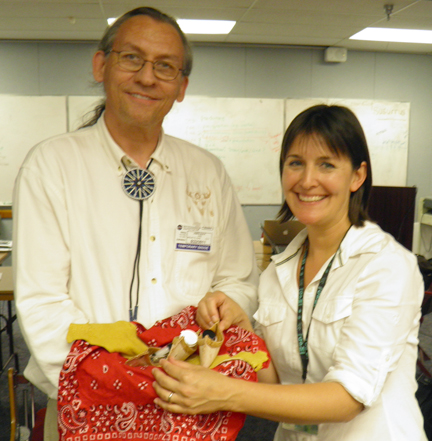
 Gould’s husband, Jim Rock (Dakota), was the principal investigators for the project that sent the seeds into space.
"I helped draft the initial hypothesis, and though the paper carried a lot of technical language, it was also important to me to explain the Native precedent for scientific study," Rock said. "To what extent will indigenous heirloom seed germinate in a microgravity environment? What that really means when you unpack the language is that these seeds will be teaching us, because so far we have not had an indigenous experiment aboard the ISS."
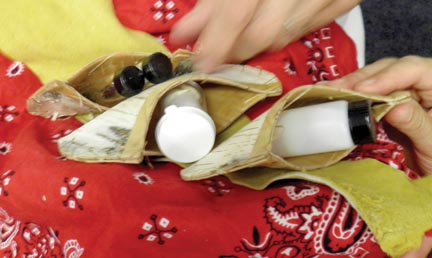
The experiment was arranged according to Rock’s specifications, and Rock personally delivered the seeds to be sent into space at the Kennedy Flight Center. Rock currently teaches for St. Thomas University- Native Teacher cohort.
The experiment itself is part of the Beautiful Earth project. It incorporates education, science, and art into visual and musical experiences. Combining music, science, and cultural perspectives together, the project provides a framework for middle and high school students to learn about the value of space experiments and exploration.
Travelling into space August 9th of last year, the seeds returned to Earth this June aboard the Space Shuttle Atlantis. Rock is eager to study the results of the plant’s eleven months in space. "These seeds will teach us as we take our first steps into the sacred realms above," Rock said.
Previous experiments in plant life aboard the ISS have studied the effects of gravity on the internal structure of plant cells. The research scientists are able to bring back information about how plants react to growing in a Zero-G, or microgravity environment. This has helped shed light on the evolution of cells, as well as collected data for extended space travel where it is predicted astronauts will have to grow their own crops and food.
Originally, it was planned that corn, beans, and squash (also known as the three sisters in Iroquois legend) would accompany the tobacco seeds into space, but ultimately, because of space and time issues, it was decided tobacco should go into space ahead of the others. "If you’re planting your crop, the tobacco always goes down first," Gould said.
This is the first Native American microgravity experiment in space, according to Rock. "Space is very important to Dakota cosmology," said Rock. "One of the best parts about this project is we can connect with indigenous groups across the planet. This project is a step forward in representing Native Americans in science."
Both Gould and Rock said that NASA was very thoughtful throughout the whole process, from loading to landing, concerning the Native seeds they were carrying. "The people who worked with us were incredibly respectful," said Gould. "The tobacco was loaded first into the shuttle before it lifted off."
The experiment was a cooperative effort with the Science Museum of Minnesota, as well as students from American Indian Opportunities Industrialization Center (AIOIC). AIOIC students who were involved in the experiment (through their internship at the Science Museum of MN) were Miriah Scarborough (Nakota, Lakota) and Dahjiae Williams (Blackfoot), along with their supervisor Scott Shoemaker (Miami).
Rock dedicated the experiment to his father. "His name was Tabdoka Sapa Itokab Najin Sni, which translates to Do Not Stand In Front of the Black Buffalo." His passing in December was a loss to the Dakota nation, as he was one of only seven full-blood enrolled members of the tribe living in Minnesota.
"In Dakota legend, we are children of the sky. We will go back to the sky," Rock said. "After all of the events of [my father’s] life, the experiments that NASA conducted honor him."