By Brad Hagen
At this point, most of us are familiar with the fact that our Native languages are endangered, some having gone completely dormant due to the assimilative policies enacted by the U.S. government, like the creation of boarding schools and the outlawing of our languages and cultural practices. According to Anton Treuer, there were an estimated 1000 first language speakers of Ojibwemowin left in the U.S. in 2020, the number having presumably dropped since then. If nothing changes, our languages are sure to disappear.
Luckily, things are changing. Ojibwemowin classes are spreading to universities and public schools across the state, language tables continue to be offered both virtually and in person, and online language learning resources like Rosetta Stone are gaining traction so that people can learn our language, our sound, gidinwewininaan, anywhere in the world. There is a battle being fought so that future generations can speak a language that is their birthright, and although we’ve celebrated some victories, there is still work to be done.
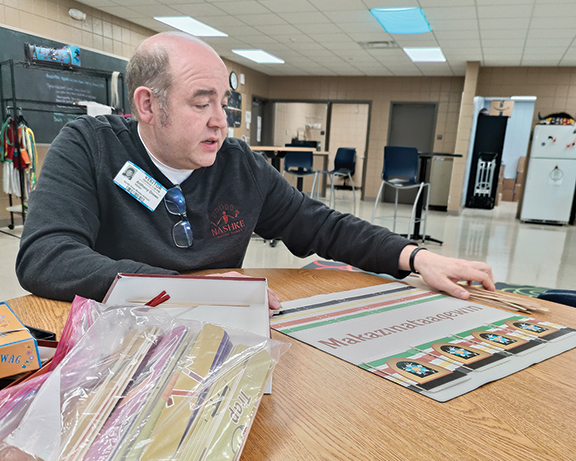
Nashke Games is one of the newest organizations to lend its skills and resources to this cause. Founded by Leech Lake descendant Tony Drews, Nashke Games offers traditional Ojibwe games that can be played either in Ojibwemowin or English, like Makizinataagewin (Moccasin Game), Bagesewin (Dish Game), and Ginebigataagewin (Snake Game). Additionally, Nashke Games provides puzzles, memory games, and a trading game called Mii Gwech that all center Ojibwe culture, history, and worldview.
Drews has worked in the Native community for several years and has held positions at Ain Dah Yung, Circle of Life Anishinaabe, Anoka-Hennepin Indian Education, and the Tiwahe Foundation. It was during his time working with youth in Indian Education, though, that inspired him to create Nashke Games.
“People always talk about how we’re losing our language,” he began, “but I haven’t heard many people talk about how many of us are losing our culture. There’s so much knowledge that isn’t available to people because they don’t know what questions to ask. So many of my old students at Anoka [High School] weren’t familiar with even the basics, which was no fault of their own, so I knew I had to do something.
“Take Wenabozho, for example,” he said, pointing at a card from one of his games. “So many people don’t even know who he is, but how can students ask if they don’t even know he exists? If these games can do anything, they can make people ask ‘Who’s he?’ and for those who want to learn, there are avenues to do so.”
Drews has already been active in spreading awareness about what Nashke Games has to offer. So far, he’s presented at the Minnesota Indian Education Association Conference where a room full of educators got to play early versions of the games, he’s gone to several school and community powwows and will continue on the powwow trail this summer, and he will be attending the National Indian Education conference in October in Albuquerque, NM.
To learn more about Nashke Games, visit their website at: https://www.nashke.com