

By Lee Egerstrom
Founders’ Day at the American Indian OIC schools in Minneapolis was a day to celebrate achievements, how it has rebounded from the COVID-19 pandemic, and where it now appears to be going.
The early May celebration at 1845 E. Franklin Ave. became a south Minneapolis community celebration as well as an institutional gathering with a community lunch and program.
Tied in with that, more than 50 Minnesota nonprofit organizations, governmental agencies, businesses and other colleges and universities participated in a Careers Fair to recruit AIOIC students, their friends and neighbors.
Internally, the education and training organization renamed its board room for Clyde Bellecourt, a founder of the OIC programs and of several other Minneapolis, Minnesota and Native organizations.
“As we planned our annual Founders’ Day event this year, we felt it was important to honor Clyde for his many contributions to American Indian OIC as a founder and longtime board member,” said Joe Hobot, president and chief executive.
AIOIC renamed the board room and installed words of inspiration from Bellecourt in several places in the building. “We are grateful that his son, Crow, and daughter Susie, were also able to join us for this special day,” Hobot said.
The celebration was scheduled to coincide with Bellecourt’s birthday, May 8. A White Earth Nation member also known by his Ojibwe name “Neegonnwayweedun” (Thunder Before the Storm), Bellecourt died Jan. 11, 2022. He was 85.
American Indian Opportunities Industrialization Center, or AIOIC as it is usually called, was formed in 1979 to meet education and employment shortcomings for Native Americans in and around Minneapolis.
Formed by Bellecourt and other early members of the American Indian Movement (AIM), that was started 11 years earlier in south Minneapolis, it follows an education and training model created in Philadelphia. There are now 31 OIC affiliated programs in 19 states.
Over the years, AIOIC has built a workforce of more than 25,000 people from the Twin Cities and tribal nations across the country. While started to assist Minnesota’s Native communities, its programs are available for all regardless of race, creed, age, gender or sexual orientation, it declares on its website.
Ann Merrill, director of External Relations, said AIOIC is now back to serving about 800 people annually seeking education and training support services. “That’s about right where we were pre-pandemic,” she said.
Its Takoda (Dakota word for “Friend to All”) programs help enrollees in four ways. The Takoda Institute provides certificate programs for technical and industrial jobs; Takoda Works offers career coaching help, Takoda GED and Basic Education programs help students finish basic education programs, and Takoda Prep Alternative High School is what the name implies. Eight students will graduate from the high school program in June.
The AIOIC website offers glances of success stories from past years. Soon to go up online is a story about a Fond du Lac student who is completing her GED degree and is now considering college for a medical career.
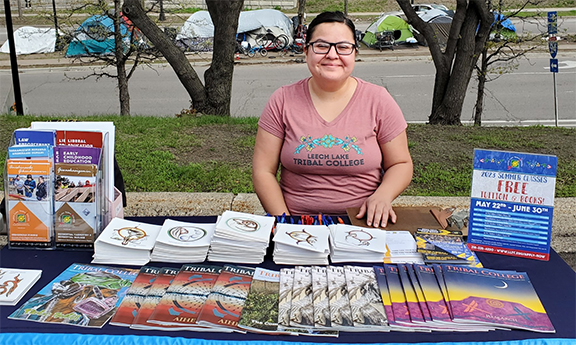
Career Fair exhibitors showed that just isn’t wishful thinking. Samantha Fairbanks, admissions coordinator and outreach recruiter for Leech Lake Tribal College, staffed a booth providing prospective students with brochures and information sheets about the college’s programs.
A summer school was coming up that might appeal to AIOIC students and other Indigenous people from the Franklin area, she said. And, the Leech Lake offers most of its courses online, which might appeal to some people at the jobs fair. Others, getting high school credentials, might also find “it culturally inviting” to return to the northlands for college.
“Being on campus is a culturally warm experience,” she said. For instance, “We have a drum session every Monday.”
St. Paul Public Schools, Osseo Public Schools, the University of Minnesota, Augsburg University, Hennepin and Ramsey counties were among institutional exhibitors. There is movement of students across school boundaries from time to time, including with AIOIC education programs.
Higher ed is interested in recruiting potential students. But more than that, recruiters pointed out, academic institutions are big employers. It takes a large number of staff people to keep schools open and functioning properly, said Anny Xiong, a human resources recruitment and diversity specialist for St. Paul schools. That point was also made by several construction companies, manufacturing firms and basic business enterprises with promotional booths at the career fair. Recruiters for a roofing and carpentry company said their skilled labor needs may be met by AIOIC vocational program students. And, they hoped, by some of the students’ visiting friends who were learning about opportunities.
Adam Ludes, a recruiter for International Paper, the world’s largest pulp and paper company, said his outreach to people in the metro area is logical because of false perceptions that most jobs involving forestry and its related paper industry are tucked away in the north woods. In fact, the related forestry industries produce far more jobs in metropolitan settings including several sites scattered around the Twin Cities.
As a case in point, Ludes was handing out information to recruit workers for International Paper’s Container Division. Among its properties is the Shakopee Box Plant.
International wasn’t the only employer at Shakopee recruiting at the career fair. The Shakopee Mdewakanton Sioux Community had one of the busiest booths among the 54 exhibitors.
“Be part of something bigger,” a brochure encouraged. It pointed out that SMSC has 14 functioning enterprises. Combined, they make the Sioux Community the largest employer in the metro area’s Scott County.
Are there still jobs available? Recruiters were seeking people for administrative, child care, education, fitness, food and grocery, gaming, health and wellness, hospitality, information technology, land preservation, legal, marketing, organics farming and recycling, public safety, public works, and retail jobs.
Among other diverse ventures seeking to find potential employees for multiple levels was Twin Cities-based Second Harvest Heartland.
Je Vang, recruiting program manager, and Pa Zong Xiong, a recruiting coordinator operated an information booth for the huge food bank organization. Vang said the food shelf network always has openings for key administration posts and for basic skilled positions that make the system work.
Second Harvest Heartland is one of the nation’s largest food banks. It distributes more than 100 million pounds of food annually to community food shelves, meal distribution sites, and pop-up emergency groceries in 57 Minnesota and Western Wisconsin counties.
To learn more about AIOIC, see: https://www.aioic.org.