

By Tiffany Bui/MPR News
When community organizer Elizabeth Day asked a group of Native Americans in the Twin Cities what they wanted to know about the 2020 census, she got a tough response.
“The overall answer was, ‘Nothing. We don’t want to hear anything from you. We are not going to listen to anybody who we don’t trust,’” recalled Day, who is a member of the Leech Lake Band of Ojibwe.
As the program manager for the Native American Community Development Institute, she is working to push through a deep suspicion of the census process. Native Americans have historically been one of the most undercounted groups in the United States, and community leaders say that mistrust may be one of the reasons why.
“People who are still alive know what it is to have a knock on the door and the federal government come in and remove their brothers, their sisters, themselves from their household,” Day said, referring to an era of boarding schools in which Native American children were taken from their families to force their assimilation. “So it’s completely understandable that people aren’t willing to engage.”
Geographic isolation of Native Americans who reside on reservations and historic governmental exclusion could also contribute to the frequent undercount. Nearly 10 percent of Minnesota’s American Indian population lives in places the U.S. Census Bureau considers “hard to count,” according to the civil rights organization The Leadership Conference Education Fund.
In 2010, those living on reservations were undercounted by nearly 5 percent, more than double the undercount rate for African Americans.
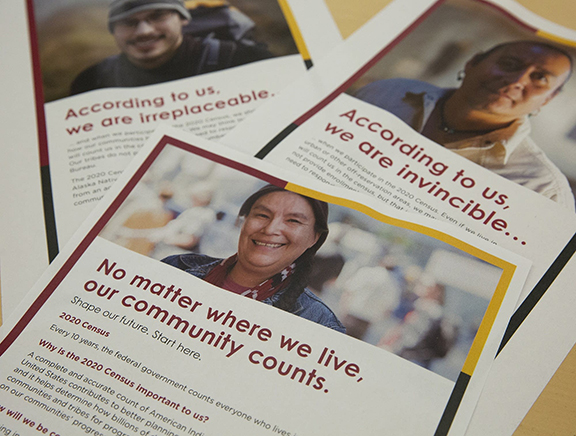
Much of tribes’ government funding is dependent on census numbers, so an accurate count is crucial. With potentially billions of dollars at stake, tribal officials and other community leaders are taking outreach into their own hands. NACDI and several other organizations throughout Minnesota are hoping to address the apprehension among many Native Americans by putting a community face on the census.
A tribal coalition
“Trailblazing” is the word Shelly Diaz uses to describe the committees working to reach hard-to-count communities in the state.
Diaz is a member of the Mille Lacs Band of Ojibwe and coordinator for the Tribal Hub, a new Complete Count Committee made up of 10 tribes in the state. The Tribal Hub is focused on training representatives of individual tribes to talk about the census with members on the reservations.
“A single person is worth $2,800 and that is $28,000 in federal funding forfeited over a course of ten years,” reads a public statement by The Red Lake Nation Complete Count Committee to its members. “Please keep in mind, the census is not about you, it’s about our tribe. It is our responsibility to fill out the census to benefit the tribe, our people and our families.”
And yet many in Indigenous communities remain wary of the federal government. Diaz said some residents are concerned with how the census will use their data. The confidentiality of census data is protected by federal law, according to the Census Bureau.
To chip away at that mistrust, the Tribal Hub is looking to recruit census workers who live on reservations.
In those situations, “that trust is established,” Diaz said. “I think any community, you know, you’d rather work with your community members rather than some strangers.”
The committee receives funding from the Minnesota Council on Foundations and the Native Governance Center, a nonprofit which advises tribal governments. Their total budget is about $130,000 to reach across all 11 tribal nations in the state, so Diaz said they’re relying on grassroots efforts.
NACDI, which serves Native American residents living off-reservation in the metro area, is also enlisting neighbors to reach as many people as they can. Day said in light of community feedback, the organization is recruiting people the community does trust: elders and heads of households.
“There are a few people who understand the importance of fully participating in the census and demonstrating what is at stake: education for our kids, health care, roads, all the wonderful thing access things that comes with being counted and having everybody count,” Day said.
‘Just check Native American’
As they prepare for next year, leaders like Diaz are worried about another issue: how mixed-race Native Americans will be counted in the funding calculus for government programs.
She said her concern is that individuals who indicate they are American Indian and one or more other races will be put into a non-Native, multirace category. This, Diaz said, could diminish the number of Native Americans represented, possibly resulting in less government funding for programs that rely on census numbers.
“We are definitely encouraging people to just check ‘Native American,’” she said.
Minnesota state demographer Susan Brower, a partner of the tribal hub, said Diaz brings up an important point for policymakers. Brower emphasized that it’s up to the various government programs to distribute billions of dollars of funding to the tribes, not the Census Bureau.
Still, she hopes individuals will fill out the census to best reflect their identity. The impact of mixed-race Native Americans solely identifying as Native American on the census could lead to a decrease in some populations.
“I see the origin of that line of thinking. And I also see that the impact is that it will kind of reduce the detail and the data that comes out of the other side after the census is over,” Brower said.
Wayne Ducheneaux, executive director of the nonprofit Native Governance Center, said he wants to work toward a day where the task of counting all of Indian Country accurately lies with the tribes themselves rather than using the Census Bureau’s numbers alone.
“I would argue probably 90 percent of the tribes out there have a very good idea of how many citizens they have,” said Ducheneaux. “We track people from birth to death.”
Minnesota Public Radio News can be heard on MPR’s statewide radio network or online.