

By Lee Egerstrom
Back a few years, when Christina Valtierra was cooking meals at the Little Earth neighborhood in Minneapolis, some residents would see her in the kitchen and go, “Oh, no. Healthy food again.”
As time went on these same reluctant consumers would see her, break into a smile, and comment on how glad they were to see her cooking indigenous foods for them.
“There were so many people at Little Earth who were victimized by ‘colonialized food’ they didn’t want to eat what I prepared,” she said in an interview. “They wouldn’t believe that healthy food could taste good.”
That changed over time. She is now greeted with excitement when former Little Earth people run into her cooking at some event.
Pat Thalhuber, semi-retired with the Sisters of Charity of the Blessed Virgin Mary in St. Paul, knows why that transformation occurred. “Christina is a first-class chef. When you eat her food, you just feel good.”
That’s the only easy part of explaining what Valtierra is doing, and so far, at least, why she is succeeding.
She started Native Food Perspective as a Minneapolis-based food catering business two years ago. Like all other entrepreneurs with a startup enterprise, she needs to make it profitable and self-sustaining. But that’s only one part of her business plan.
Valtierra’s business is a classic example of what has become known globally since the 1970s as a “social enterprise.” Investopedia.com, an online business dictionary, describes it like this, “Social enterprises exist at the intersection of the private and volunteer sectors. They seek to balance activities that provide financial benefits with social goals, such as providing housing to low-income families or job training. Funding is obtained primarily by selling goods and services to consumers, although some funding is obtained through grants. Because profit-maximization is not the primary goal, a social enterprise operates differently than a standard company.”
In other words, social enterprises are formed by people to support a cause and who can use their profits or expertise to give back to a community.
That sums up Valtierra and her Native Food Perspectives. The giving back comes from personal experiences.
“I’ve had to fight my own battles with health,” she said. Beyond that, she said, “I’ve lost too many of my relatives too early from health and nutrition-related causes.”
Valtierra grew up in the Twin Cities but is a Red Lake Nation descendant. Heart disease, obesity, cancer, alcoholism and diabetes are problems both “up north” and in the metro area, she said. Food choices and lifestyles play huge roles in those health problems.
That is a big part but only one aspect of her life journeys that brought her to starting her catering business and her admitted desire “to give something back.”
In other roles, she plays “mom” to two daughters and a niece. She has been a social worker in various capacities with American Indian Community Development Corp., Spectrum Mental Health Services, St. Stephen’s Home Services and Simpson Housing Services.
While working with these groups, community ties brought her in contact with Minneapolis Public Schools officials and that led to her working on programs for students on health, food and their Native culture.
More community ties developed. These led to her working with Dream of Wild Health (DWH), the Minneapolis-based nonprofit that seeks to reconnect the Twin Cities’ Native American community with traditional plants for culinary, medicinal and spiritual use. This educational group also operates a 10-acre farm used in training near Hugo.
Valtierra considers Diane Wilson (Dakota), the DWH executive director, to be a mentor. “When we started a program and called on Native people to come and look for ways to become chefs using indigenous foods, Christina was one of those who responded,” Wilson recalls. “She quickly said, “Hey, I want to do this!’”
Though DWH is a nonprofit, Wilson sees her groups and Valtierra’s businesses as having “parallel, compatible” social enterprise goals.
Native Food Perspectives is definitely a “small business” by U.S. Small Business Administration definitions. The SBA uses that name for enterprises making less than $7.5 million in annual revenue, and for manufacturers with fewer than 500 employees. Mostly a one-woman show, Valtierra is in no immediate threat to losing that identify.
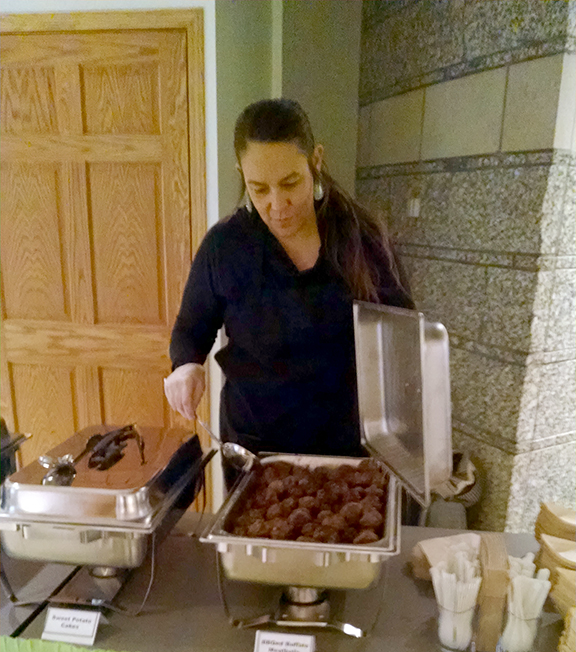
Menus are worked out with clients for her special events. “I try my hardest to source local, seasonal, healthy and indigenous foods,” she said. For instance, at a recent reception at the Minnesota History Center in St. Paul, she served bison meatballs and sweet potato cakes (dumpling) that were local; cedar with cranberry tea, and a fruit salad that could not be locally sourced this time of year.
Most of the events calling for her catering services include weddings, graduations, powwows, ceremonies and events like at the History Center, and a number of private parties and board meetings. An educational element to her business is helping people with meal planning and fitness planning.
At an earlier gathering of elders that Sister Thalhuber helped organize, Valtierra served bison stew with a wild rice side dish and vegetables. “Two women told me they felt so good afterwards and one took leftovers home. She was going to start her next day with those foods for breakfast,” Thalhuber said.
Valtierra’s business card uses her Ojibwe name, Aandakii Gweki-biimaadazi, which doesn’t translate directly but can mean “repairing one’s life” or “restoring the broken places.” Her website also notes that she is known in old family and friend circles as Christina White.
Her website explains how she likes good food and cooking, and sharing information about healthy indigenous food just as much . While she experiments with elk and bison, among other indigenous food ingredients, “she can filet a fresh caught fish while talking to you about diabetes and heart disease prevention.”
The dual purposes of her social enterprise business is always there. Valtierra puts her food where her mouth is, and the other way around.
For more info, see: www.nativefoodperspectives.com.