

Review by Deborah Locke
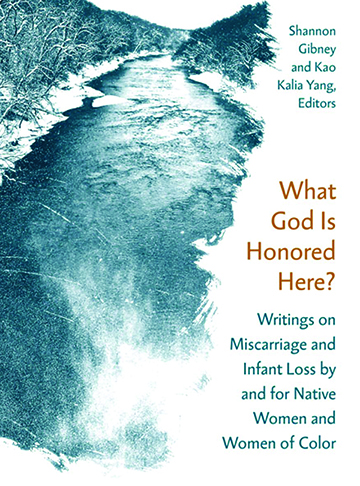
“What God Is Honored Here?” features stories from women of color who experienced miscarriage and the death of their infants. To say the book is heartfelt and heartbreaking is an understatement. Strength and love prevail in these essays of life and death. After so many accounts of pregnancies gone wrong, the fact that any babies are born full-term and healthy seems miraculous.
Which takes me to this warning. In my view, if you are in the early stage of a risky pregnancy, do not read this book. (But do read it later, after your healthy baby arrives.) If you have ever miscarried, the book will rain down a million poignant memories that you may or may not be ready for. If you and your partner sailed through healthy pregnancies to produce thriving infants, the book will give you reason to thank God repeatedly for those blessings.
Editors Shannon Gibney and Kao Kalia Yang each contributed essays to the book which contains contributions from 24 women. Through poetry and prose, the women reveal harrowing and traumatic accounts of life-threatening ectopic pregnancies, misdiagnoses, late-term stillbirths and sudden infant death syndrome. Ultrasound machines serve as a central symbol in the book, offering definitive proof that something is amiss by way of the furrowed brows of medical professionals who must then deliver alarming news.
Central also are the women’s partners and family members whose lives go on hold during the pregnancies, and the medical providers who work in earnest toward a good outcome. You’d have to be made of stone not to react to these fundamental and moving stories of the depletion of hope and the growth of sorrow. Yes, the book is hard to read and on occasion, I had to put it down, wipe my eyes and take the dog for a walk. Still, a few of the finest essays you will ever read in your life live between these two book covers.
Here’s one of them. In the brilliant “Tilted Uterus: When Jesus Is Your Baby Daddy” Taijon Coleman describes institutionalized racism delivered by a nurse who relegates Coleman to a public waiting room rather than a patient room. In addition to her skin color she has another distinguishing feature, a tilted uterus, and writes “once doctors discovered that my uterus was retroverted, they treated me like a specimen in a cage.” During routine pregnancy exams, doctors and medical students gathered around Coleman and her uterus for a “live and direct” glimpse of the phenomena. With wonderful wit and style,
Coleman weaves her growing-up years through the essay, writing this: “Having grown up the second oldest of five kids and raised by a single mother, I experienced one of the best forms of birth control that exist. I was a mother of three kids by the age of eight.”
In “The Ritual” by Rona Fernandez, we follow a healthy pregnancy to the birth of Naima, a sweet infant with almond shaped eyes. Naima is normal in every way, and then one day Fernandez gets a call from day care that the four-month old baby stopped breathing. Her parents race to day care from their jobs only to see emergency vehicles parked in the street. During her afternoon nap, the baby stopped breathing.
In this short, lovely essay we see the way Fernandez keeps her daughter’s memory alive with a weekly bouquet of pink and purple flowers placed near an urn that holds the baby’s ashes. She writes “It’s not easy being the mother of a dead child. In fact, it may be the hardest kind of mothering there is.”
At times reading this book is the hardest kind of reading there is. That makes it also the most important kind of reading there is.
“What God Is Honored Here: Writings on Miscarriage and Infant Loss by and for Native Women and Women of Color” will be available for sale on Oct. 15, which is also National Pregnancy and Infant Loss Awareness Day. You can meet the authors on that day at 6 p.m. at the Open Book, 1011 Washington Ave. S., Minneapolis. A book signing will follow the program and reception. Other programs and signings will occur at 6 p.m. on Oct. 18 at St. Catherine University, Our Lady of Victory Chapel, (2004 Randolph Ave, St. Paul); 7 p.m. Nov. 7 at SubText Books (6 W. 5th St., St. Paul); 7 p.m. Nov. 12 at ModernWell (2909 S. Wayzata Blvd., Minneapolis); and 7 p.m. Nov. 18, Next Chapter Booksellers (38 Snelling Ave. S., St. Paul).