


By Dan Ninham
“Niizhogabo indizhnakaaz, Gaa-zagashkwajimikaag indoonjiba. I am known as ‘Two Men Standing by the Spirits’ from the village of Chachabawning (Inger),” said Gerald White. White is a Leech Lake member of the Pillager Band and descended from people from Leech Lake, Mille Lacs and had relatives from other areas of Anishinaabe-aki.
“I’ve lived here my whole life here in Cha-cha except for my tour of duty in the US Army and four years of college,” said White. “I served with 82nd Airborne Division, 21 and 26 Recon Company (NBC). I am a 50% service connected disabled vet.”
“After the military I went to college and got a degree in the sciences and also have an education background,” said White. “I was a licensed teacher for 18 years.”
White was also the Indian Education Director at Deer River Public Schools for many years and has been retired.
“I have five amazing sons and two daughters, seven amazing grandchildren and one treasure, my Anikaaboojigan, little Ode’ my great grandchild,” said White. “I live in Chachabawning with my two sons and grandchild.”
“I am a hunter, fisher and gatherer, an award winning painter mainly watercolor,” said White. “I am a traditional Anishinaabe style dancer which is currently called the woodland dance. I belong to a big drum.”
The indigenous ways of being creative began by being in the forest and influenced by family elders.
“I started being creative at an early age,” said White. “I started drawing art and carving my own bows and arrows and other items that I saw were being used by our people. My great grandfathers on both sides were people who made their own items.”
“My great grandfather on my dad’s side had a frame in our backyard for making canoes,” said White. “He traveled all over to make canoes for different communities. I remember I used to use his handmade cedar floats for swords and never told me to leave any of his items alone.”
“The great grandfathers were the big influence on my creativity. I’m very interested in our traditional methods of creating our own items we use. I carve paddles, wooden utensils, and curly pipe stems. I think if it was made in the past by our people I can recreate it even if I wasn’t taught how to make a specific piece,” added White.
“I take great pride in being Anishinaabe, the teachings I’ve received over the years from many people have been my guide for living,” said White. “Generosity and love for our people and traditions is very important.”
“When I was a young man about 12-13 a man from Mille Lacs saw me dancing at a cultural camp I attended,” said White. “He asked me to put on a black velvet beaded dance outfit and dance on behalf of his brother who was deceased from a car accident. He told me the story and said I dance just like his brother did.”
“I never forget that and I’ve been interested in our Anishinaabe dance style ever since. This also happened up in Canada a number of years ago. This woman came up to me with tears in her eyes saying she hasn’t seen our style of dance for many years which is now called the woodland style. She said I reminded of her dad who was deceased and told me he danced just like I do and he had a similar outfit. Then she asked if I could dance with her son into the area so it reinforced my commitment to our dance style,” White added.
“I enjoy going to other territories to see their style of dance,” said White. “So I tend to make things that our people have made in the past. I will not make anything not specific to our people unless asked by someone to make them a personal item.”
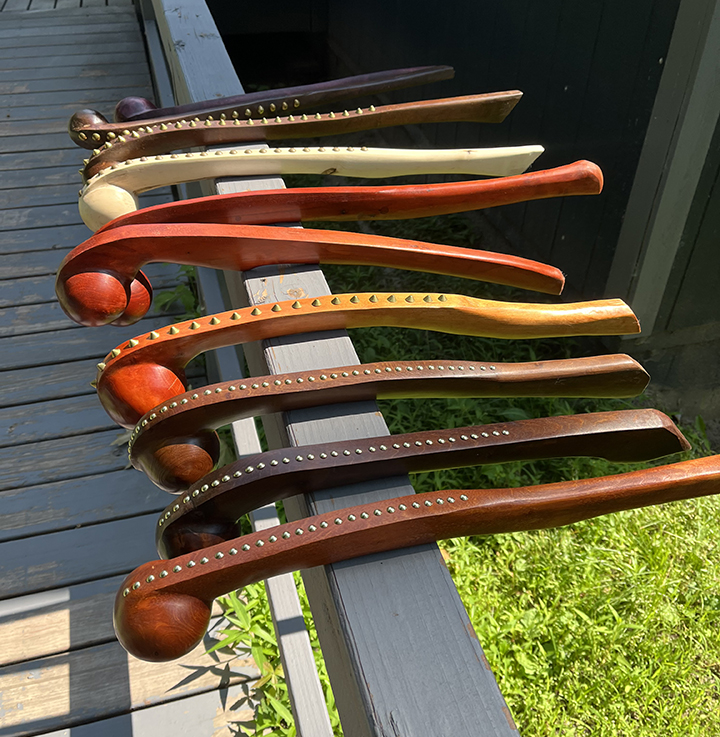
“When I go into the forest with something in mind I have to find the right piece of wood,” said White. “Sometimes it takes a while whether it’s for paddles, clubs or bowls. When I find a tree for a bagaamagan (club) I dig out the tree and chop all the roots off. It’s very hard work and time consuming. It has to meet my guidelines otherwise it’ll not turn out right which is something I think is very important.”
“The old people always made beautiful things and took great care in their work,” said White. “The intricacies of creating are learned by crafting these items and I’ve learned from experience what will work.”
“You look at the bark to see if it’s straight wood, or the roots or any number of things that affect the final product. I use wood dye mixed with alcohol because water will raise the grain which creates more work. You can’t let your wood dry fast either when doing green woodwork. So there are many things to consider.”
“My most popular item to create is the war club, biikwakadoo-bagaamagan,” said White. “This item was almost gone from many of our communities and there are other things as well that we don’t make by hand anymore. They are all important and keep us aware of our past. They become heirlooms if you pass them on to relatives. For example, I make my sons and daughters items they use in ceremony, spoons and pipe stems or implements used in hunting and gathering.”
“Our Anishinaabe style of dance has come to us from a couple ways, the way I dance was likely born for the lodge and big drum societies,” said White. “It’s very distinctive and when I see our people dance I know they’re from the woodlands. We all have our style but in many ways it is similar.”
“It’s a very strenuous dance style, the drum chiefs always tell us to dance as hard as we can because it brings in the spirits. I danced for many miles sometimes and I don’t get too tired when we dance for our people,” added White.