

By Natasha Rausch
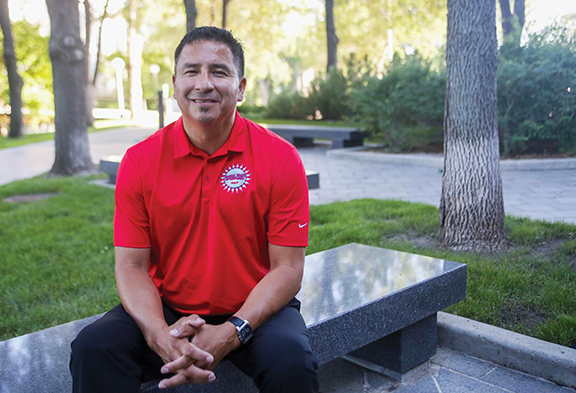
Jamie Azure said the numbers were off. When he saw the results from the 2010 census, he said they didn’t look right for his tribe, the Turtle Mountain Band of Chippewa in northern North Dakota.
“I hold our own tribe responsible, along with the Census (Bureau),” he said. “There was no communication.”
That’s why this time around, Chairman Azure is working to create a committee and appoint a tribal liaison to make sure “there are no blurred numbers.”
But getting the numbers right won’t be a simple task. Indigenous people are the most undercounted and one of the hardest to count populations in the U.S. The threat of an undercount puts North Dakota, South Dakota and Minnesota at risk of missing out on federal funding for health care, roads and schools, and tribal nations within the states at risk of missing out on dollars for housing and employment programs.
To boot, the upcoming census is considered “at risk,” according to the Government Accountability Office, as it faces a lack of funding and preparedness. Now with the official count less than a year away, tribes across the Dakotas and Minnesota have started organizing efforts in the hopes of being tallied.
“This is hugely important for the state to make sure we get the tribes counted,” said North Dakota Census Office Manager Kevin Iverson. “You will live or die with the results of this for an entire decade.
“We’ve got to get this right.”
In the last decennial census, the indigenous population on reservations was the most undercounted of any group in the U.S., with 4.9% not being tallied, according to the Census Bureau.
Part of that is a result of a third of the 5.3 million indigenous people in the U.S. being in the “hard-to-count” category because of characteristics such as high poverty rates, a younger-than-average population and largely rural reservations. The Dakotas are above the curve, though, as about half of South Dakota’s Native American population and 41% of North Dakota’s live in hard-to-count areas. For Minnesota, it’s 10%.
A Census Bureau spokeswoman said a tribal affairs team is dedicated to addressing hard-to-count issues and noted that more than half of households on tribal lands have unmailable addresses and about a quarter don’t have internet access.
“In these circumstances, we work with tribes to determine the best way to count people living on their lands,” the spokeswoman said, adding that the bureau requested each tribe appoint a census liaison and conducted a series of tribal consultations, among other measures. Though the census is aiming to do most of the survey online, those without internet access “have the option of responding by mail, by phone or when a census taker comes to their door.”
Census numbers are used to apportion the seats of the U.S. House of Representatives, and to distribute more than $800 billion in federal dollars for about 300 programs, such as Medicaid and the Children’s Health Insurance Program, according to a 2018 George Washington University report.
“The more accurate a state’s census count, the more equitable its share of federal funds,” the report said. “A substantial undercount in any one state could lead to the diversion of funds away from that state to other states and uses.”
For indigenous communities alone, “Census data is the basis for over $1 billion that annually flows into Indian Country to build tribal housing, and make improvements, maintain and construct roads, and provide employment and training programs,” according to a report by the Census Bureau and the National Congress on American Indians.
For tribal communities, being hard-to-count also stems from a more complicated issue.
“It’s just the general distrust and history with the U.S. government,” said Shelly Diaz, the urban liaison and project coordinator for the Mille Lacs Band of Ojibwe in Minnesota.
But her message to those wary of the census is that being counted is an act of exercising tribal sovereignty.
“If they’re not counting us, how are they going to live up to their treaty obligations?” she said. “If we’re undercounted, our numbers go down, and their obligation goes down.”
Scott Davis, executive director of the North Dakota Indian Affairs Commission, said some of the hesitance among indigenous nations to reply to the census also stems from a fear of being removed from government-subsidized housing, which often restricts the number of people who can live in a unit. For many reservation families, multiple generations may be in one household, he said.
Much of the focus for tribes has been telling those in subsidized housing that information provided to the census can’t be used against them, as the Census Bureau is required by law to maintain confidentiality, and the records are locked for 72 years.
Another focus has been on finding locals to go house-to-house to ask people to fill out the survey.
“Human nature says when someone knocks on your door and you don’t know who they are, you’re kind of like, ‘What do you need?’” Davis said.
The U.S. Constitution mandates a count of the country’s population once a decade. Indigenous people generally weren’t counted as part of the population until 1890, according to a report from the National Congress of American Indians.
It wasn’t until 1980 that the bureau began working with individual tribes to get complete counts – almost 200 years after the country’s first census. And it wasn’t until that year that all respondents self-identified their race, instead of a census enumerator marking someone’s race simply by looking at the person.
In March 2018, the NAACP sued the Census Bureau for being ill-prepared for the 2020 survey, citing canceled field tests and a lack of funding that could lead to a “dramatic undercount” of racial and ethnic minorities. The lawsuit, which is still pending in U.S.
District Court in Maryland, said the Census Bureau has been operating “on the cheap.”
The lawsuit notes the bureau was set to execute a practice census in 2017 on the Standing Rock Sioux Reservation, which straddles North and South Dakota, in order to test areas with a high Native American population. But the practice was canceled because of funding issues, the bureau said.
Now at Standing Rock, Cheryl Keepseagle, the census liaison, and Ira Taken Alive, the vice chairman of the tribe and head of the Complete Count Committee, have kick-started their own efforts to get a correct count.
Keepseagle, a member of the tribe, said she’s going to use newspaper, radio and TV ads as well as posters and word-of-mouth to inform people of the upcoming survey. In each of the districts across the 2.3 million acre reservation, she plans on having a set location where people can fill out the census and enter to win door prizes if they attend. Plus, she said the tribe will hire trusted local people to be door-to-door census takers when the time comes.
At the North Dakota state level, Scott Davis is conducting an economic impact survey of the census that he plans to publish by the end of 2019. He said he hopes it shows the importance of the census for the state’s indigenous population and urges them to be counted.
The 2020 census, he said, “is an economic impact to your tribe – if you get counted or you don’t get counted.”
Reprinted with permission of the Forum News Service.