
 When
When
Gavino Limon was 14 months-old, he began his professional career as a champion Grass Dancer, a mere five months after he began walking. Limon is now six years-old and continues his love for dancing as a member of the world famous Native Pride Dance Troop. His parents, Douglas and Rachel Limon believe that having him in a cradleboard during his infancy had a tremendous influence on his advanced large motor skills
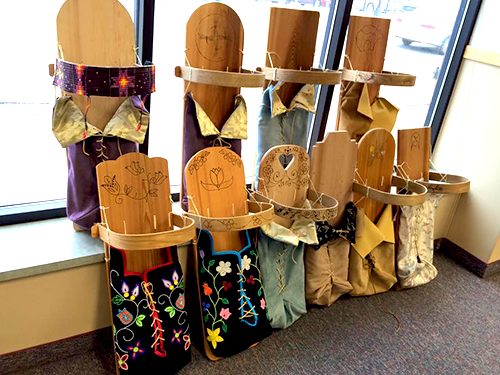
Traditionally, tribal people in Minnesota, Wisconsin and the Dakotas used cradleboards for hundreds of years to carry their children. Using whatever materials within the environment, cradleboards were assembled with much care. Depending on the community, cradleboards can be constructed with cedar, oak, cattail, buckskin, animal fur and moss. In essence, a flat wooden board is the base, a frame and a headpiece, sometimes to attach toys. The baby is wrapped tightly to the board, allowing them to feel secure and also sit upright to interact with their world. In this way, babies became accustomed to the daily activities of their tribe. The cradleboard was the first step in traditional Indigenous education.
Cradleboard advocates assert that
children who have been in a cradleboard have a developmental advantage. Babies
are able to observe their families and socially interact with their relatives.
Parents will often claim that a baby’s leg and neck muscles are strengthened
earlier than an infant who has not been placed in a cradleboard.
These benefits prompted the
Limons to have their baby in a cradleboard. Before their son was born, Doug and
Rachel Limon wanted to have their new baby in a cradleboard, but had difficulty
finding anyone in the community that could help teach them to make one. After
finding an elder in Leech Lake to help them, they had Gavino in the cradleboard.
This
sparked collective memories within the Native community in Minneapolis. “People
began to share their stories with me when they saw the cradleboard,” Doug Limon
said. “Seeing the cradleboard reminded our people of traditional values and I
thought this was a perfect way to bring our ways back.” This was the birth of
the Cradleboard Project. 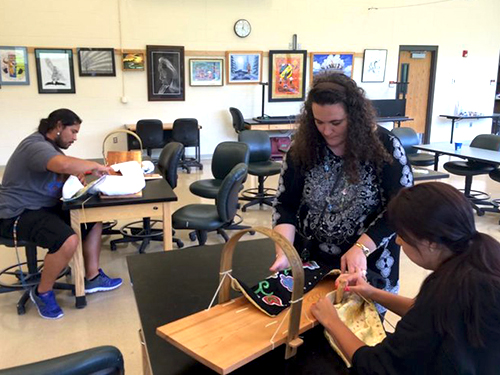
Since that time, husband and wife
team, Doug and Rachel Limon have been sharing this knowledge with the Twin
Cities Native American community. With financial assistance from the Minnesota
State Arts Board, the Limons have been able to offer workshops to actually make
cradleboards to the community for a very minimal price. Rachel Limon, a
professional photographer and artist says, “We want to share this knowledge
with the community, so in return, we ask that those who participate share what
they’ve learned with others as well.”
The materials alone for these
workshops cost well beyond what is asked of participants. To keep this
tradition alive, the Limon’s have created a Kickstarter campaign to cover the
costs of offering cradleboard making workshops for community members. Pledges
are important to this work and will be accepted until Monday, April 20, 2015. Pledges
are accepted at: www.kickstarter.com/projects/limon/cradleboards-to-preserve-our-past-and-protect-our
The next workshop will be offered
on a first come first served basis. Workshop dates are Saturday, May 30 and
June 20. Participants can reserve their place by contacting Rachel Limon at rachellimon5@gmail.com.
PHOTOS: Cradleboards made during one of the cradleboard workshops (top).
Rachel Limon helps a student with her cradleboard (above).
(PHOTOS COURTESY OF THE LIMONS)