


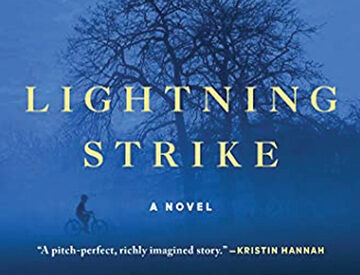
Review by Deborah Locke
The reading of “Lightning Strike” by Minnesota writer William Kent Krueger came about randomly. An acquaintance emailed that I just had to read the book, with a plot and characters set in northern Minnesota. He said this book was even better than Krueger’s highly acclaimed “This Tender Land.” Then he mailed it to my home.
Dear readers: my nightstand is six books high with recommended reading for Circle reviews. All were shoved to the side. “Lightning Strike,” which has an equal number of Ojibwe and non-Indian characters, touches you in a way that lasts. It’s mostly a thriller who-done-it, which means the plot assumes the most importance, yet it’s also character-driven, introducing people who you will not forget. It is a story I needed to hear right now, a story ripe with wisdom, touched by sorrow, and hopeful.
The book opens in 1989, but backtracks to 1963 where all the action takes place. Protagonist, Cork O’Connor, part Ojibwe, is the new sheriff in Tamarack County in northern Minnesota, located close to the Boundary Waters Canoe Area. He had barely settled into his new office before the reader is whisked back in time to when Cork’s father, Liam, served as sheriff. At that point, Cork is 12, lives with his parents in the small town of Aurora, and gets around mostly on his bike.
One day he and a friend bike to a place in the Superior National Forest called
“Lightning Strike.” The remote meadow is the site of a former logging camp. There they find the body of Big John Manydeeds, a well-liked community member who appears to have committed suicide.
An investigation leads the sheriff and his deputies to presume that Big John died by his own hand. But the nearby Ojibwe community begs to differ. At the same time, young Cork finds a clue that suggests more complexity to the case, and a broader cast of involved characters. Sheriff Liam gets caught in conflict between the Ojibwe who rail against a quick open-and-shut assessment of the Big John’s death, and his own deputies and townspeople who assume this was just another Indian suicide.
The investigation widens, and Liam begins to suspect foul play in Big John’s death. It’s fascinating the way Krueger builds the intrigue while at the same time, exploring the growing relationship between father and son. The weight of truth falls squarely on Liam whose every move in the investigation is suspect by both the Ojibwe and non-Indians.
One group is determined that the death of Big John not be swept under the rug as a stereotypical occurrence, while the other group is determined to do just that. Strains of racism run through this 1960s northern Minnesota community. Natives are viewed by many non-Indians as invisible or subordinate.
Krueger’s primary traditional Ojibwe character is Grandma Dilsey, a spunky elder who happily takes on Liam and anyone else who disrespects Big John. Like all Indian communities in Minnesota, everyone knows each other’s business. And the Iron Lake Reservation members know that Big John, though not perfect, was neither abusing alcohol at the end of his life, nor was he suffering from untreated depression.
In addition to memorable, believable characters, Krueger also gets the smaller details right, like the satisfaction one gains at a campfire. Krueger wrote:
“All his life, Cork would love the magnetism of a campfire, as did anyone who’s spent nights outside the glare of a city’s light. There was something elemental in fire, which warmed the heart as well as the body, mesmerized the eyes, cleared the brain of worry, let in a healing peace…Grandma Dilsey had told Cork that Nanaboozhoo, the trickster, had stolen fire and given it as a gift to human beings. Cork thought it was a generous gift.”
Along with a familiar setting in Minnesota, and insights into conflict and father/son relationships, there’s another reason for reading this book. About two-thirds of the way in, it becomes a classic page-turner. Surprises abound through clever twists. After a lifetime of reading mysteries and thrillers, I’ve always figured out who-done-it long before the last chapter, but not here. Krueger is as masterful at forging a plot as he is at extrapolating universal truths from large and small events. A couple of his characters comment about the bigness of life and death in ways that catch in your throat.
In short, you leave this book with a deeper understanding than when you arrived. That understanding must be at least one of the points my generous, insistent colleague wanted to make.
“Lightning Strike” is published by Atria Books (Simon & Schuster), 2021.