


By Lee Egerstrom
Mary Anne Quiroz, a co-founder of the Indigenous Roots Cultural Arts Center in St. Paul, and Victoria Marie, who has an Indigenous wellness program housed at the center, spent a few moments recently laughing and commenting on how similar and interconnected Indigenous cultures are from around the world.
Quiroz is originally from the Philippines. Her family moved to Minnesota in the midst of a civil war. That experience fits the definition of refugees.
Victoria Marie, an enrolled member of the Sisseton-Wahpeton Oyate, grew up in the Little Earth housing development in Minneapolis. Like many of the 78 percent of Native Americans living off reservations in urban areas today, she recognizes stresses that come from living in unnatural habitats and works to help others cope with pressures.
Marie, or Wachinhin Maza Winyan (Iron Plume Woman), is founder of Indigenous Lotus, a wellness program that combines yoga classes and tribal dance, exercise programs and meditation for coping with life’s s stresses. This includes posttraumatic stress disorder (PTSD) problems within Indigenous populations, often from homelessness, poverty, sexual exploitation and other experiences that weaken a person’s mind and body.
Beyond this wellness effort, Indigenous Lotus also sells Native-designed yoga clothing.
At a chance meeting at the Roots Café, Quiroz and Marie talked about how art interconnects across Indigenous cultures. Dance makes cultural connections, they said. And Marie said one other artistry connection is common throughout the cultures. “Drums!” They are important within all cultures, she said.
Such interconnections make the Indigenous Roots Cultural Arts Center, at 788 E 7th St. in St. Paul, an unusual place. Quiroz and her husband Sergio Cenoch Quiroz cofounded the center in 2017 as a place to support Indigenous arts, culture and tradition.
“We say that, and add ‘Plus’,” she said. That is because the center becomes a community meeting place, a hangout place for East Side students after school, for health and wellness programs, and a good number of art promotion and development programs.
The center described itself when it opened as “an incubator space for artists, cultural groups and organizations dedicated to building, supporting and cultivating opportunities for Native, Black, Brown and Indigenous peoples.”
Groups using Indigenous Roots facilities include the Yes Dance Academy that encourages cultural exchange and healthy living through traditional Hmong dancing arts; Away Runakuna that teaches and preserves tribal traditions from Ecuador; Kalpulli Yaocenoxtli, a Mexica-Hahua (Aztec) group sharing dance, song and philosophy from Nahua culture; and an oh-so-modern urban America dance group, the Cyber Side Dance School.
The latter describes itself this way: “We are a hub for youth dance culture that focuses on Break Dance, Choreography, Hip Hop Dance and KPop Dance.” It states its mission is to “welcome and inspire young dancers into a healthy and diverse community.”
Other groups operating from the center include language and culture programs for Latin-language influenced Indigenous people (Conferencia Alianza Latinx); Filipinx, and, again focused on next generation young people, the International Indigenous Youth Council (IIYC) for the Twin Cities.
The youth group clearly shows its Native American roots. It explains its work through the Native American exhortation: “Though action and ceremony, the IIYC commits to building a sustainable future for the next seven generations.”
Several groups preserving Mexican and Central American tribal cultures use center facilities. Their programs interconnect with groups working on urban youth needs and issues, including the Ain Dah Yung Center in St. Paul, St. Paul Public Schools, and Little Earth in Minneapolis.
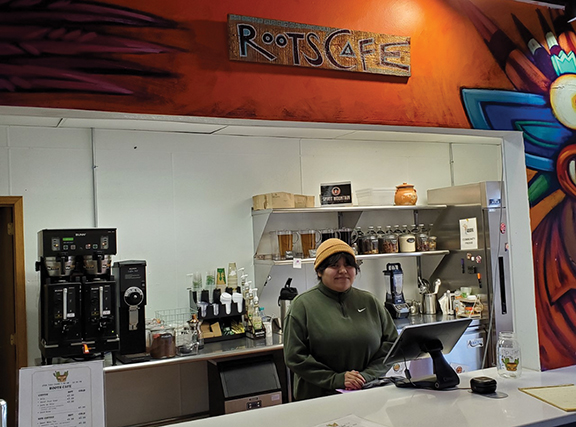
Roots Café becomes a neighborhood coffee house for diverse East Siders. It is described as a youth led economic development program started by Indigenous Roots and the IIYC.
It has after school café hours for students. On one recent day, a large group of art students from nearby Harding High School descended on the café where they met with local artists.
Art, culture, traditions are important components for healthy living everywhere around the world. That hasn’t changed over time. What the Indigenous Roots Cultural Arts Center is doing is building on those components for healthy communities now.
That may be even more important in the future. Some studies show a global rural-to-urban migration underway involving from 1.1 billion to 1.4 billion people. That means populations of either the size of India or China are being uprooted and moving into ever increasing large urban centers.
This global migration closely resembles North American Native experience.
While most of the migration is internal, or within countries, the UN’s International Organization for Migration (IOM) reported in 2020 that 272 million people were international migrants – people now living somewhere other than their country of origin.
Of these, 31 percent are residing somewhere in Asia, 30 percent in Europe, 26 percent in the Americas, 10 percent in Africa and 3 percent in Oceania (Australia and the islands between Asia and the Americas). This helps explain why political movements around the globe, including here in America, turn to racism, bigotry, sexism in all its forms, and xenophobia to resist change and gain political power through hate. Yale University historian Timothy Snyder is an international expert on that.
Shifting demographics are apparent on St. Paul’s East Side and around the American Indian Cultural Corridor in Minneapolis. Native Americans have banded together in neighborhoods they now share with Somalis and others refugees.
Mary Anne and Sergio Cenoch Quiroz are examples of that. Both families came to Minnesota in 1989. While she came from Manila, he came from Torreon, Coahuila, Mexico. They met as students at Battle Creek Middle School and worked together on cultural projects as students at St. Paul’s Johnson High School.
Neighborhood demographics show that 69 percent of area residents around the Indigenous Roots Cultural Arts Center are themselves or are children of immigrants, refugees and “involuntary migrants” – Black descendants from slaves, she said.
The Quiroz couple, now a family with five children, has been involved with cultural traditions and the arts from their early childhood. She began dancing ballet and Polynesian dances as a child in the Philippines. He has promoted dance, art and his Mexica Aztec tribal culture from his St. Paul school days.
While Mexica Aztec is essentially a grouping, or confederation of tribal cultures similar to the Iroquois Confederation in northeastern North America, Quiroz more narrowly promotes his family’s own Mexico Nahua tribal culture.
The center is now being supported by the McKnight Foundation in establishing a McKnight Culture Bearers support system. Artists who may be interested can find information at https://iroots-mcknight-culturebearers.org.