


By Lee Egerstrom
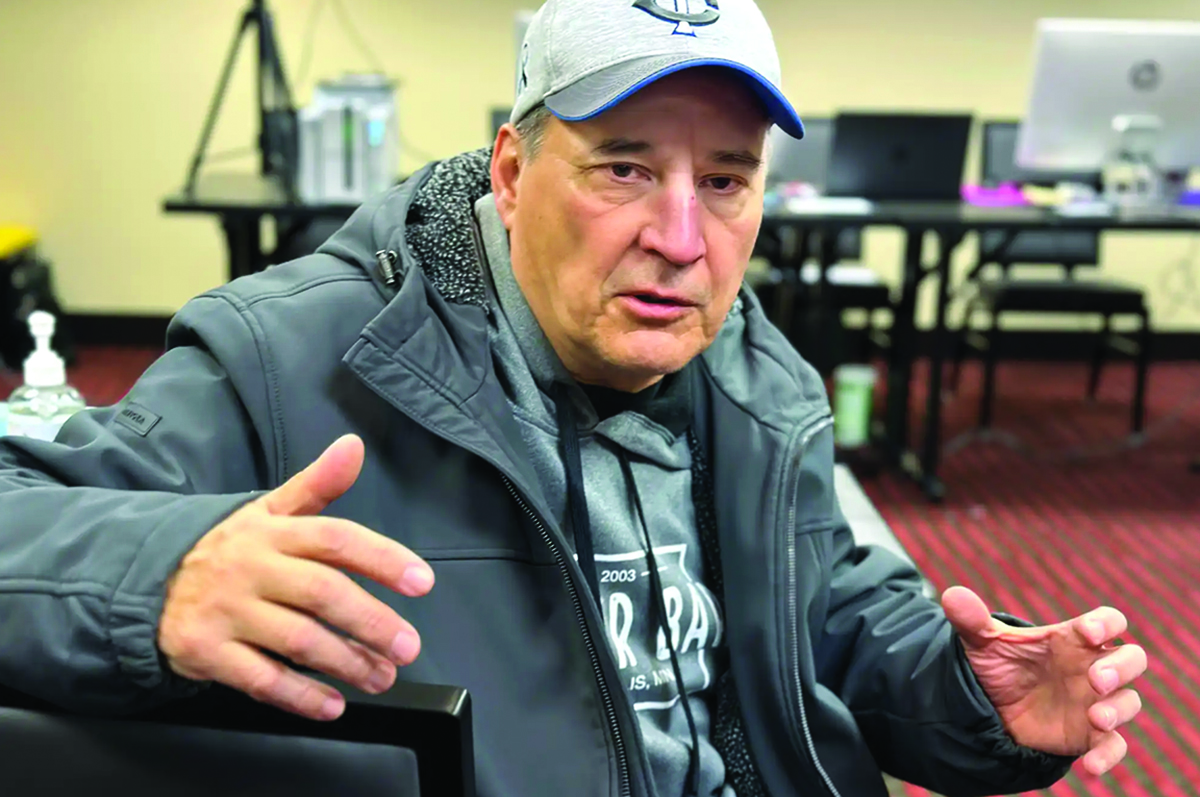
For at least 60 years, John Poupart of the Lac du Flambeau Band of Lake Superior Chippewa has helped municipal governments, state and federal agencies, tribal governments, Indigenous organizations, families, and others try to cope and understand one another.
That makes him a “consultant,” the now West St. Paul resident said in an interview. He has that title printed on what most would call his “personal,” or “business” card.
He would be considered an “Elder” within Indigenous societies all around the world. That is an honorific title prompting us to use the capital “E.” Whenever it is used, most people would recognize the word and understand it has more to do with knowledge and service rather than age.
Poupart, 85, doesn’t use the word. “That isn’t something you would claim for yourself,” he said. “That is something others put on you.”
As a case in point, a few years back a person commenting on the passing of an important Ojibwe woman in Northern Minnesota said “losing such an Elder is like having your community library burn down.”
Indigenous Elders are identified as “teachers, healers, advisors, and cultural ambassadors” in Internet references leading to academic and medical research. Canadian research explains that the role of Elder varies community to community and can be based on experiences, spirituality and community service.
Poupart represents all that. But his modest term ‘consultant’ suffices. The honorable title of “Elder” doesn’t conveniently fit into the language of Western European culture that dominates life in North America, he said.
The basic living situation for most if not all Native Americans, he said, is to travel through the two worlds of their Native culture and the dominant Western European culture common to both the United States and Canada.
U.S. medical sites on the Internet direct researchers on Elders to research work done in Canada with First Nation communities. In a major study referenced below, researchers in Quebec said Indigenous Elders “participate in intergenerational solidarity by transmitting knowledge, values and culture in a holistic approach.” Their study sought to explain how Elders’ social participation assists individual and community wellness.
This helps define how the life and career of John Poupart makes him a consultant, in his eyes, and an Elder in the eyes of nearly everyone else.
Poupart armed himself for the task with extensive educational training. Some of it, he admits, came from the “school of hard knocks.”
He has a bachelors’ degree in Criminal Justice Administration (1977) from the University of Minnesota and a Master’s Degree in Public Administration (1980) from Harvard University. He did additional graduate work in programs at the University of Minnesota’s Humphrey Institute of Public Affairs and at University of St. Thomas Center for Non-profit Leadership.
This came, he said, after being a seventh grade school dropout at the Lac du Flambeau reservation in Wisconsin, serving three stints at the Red Wing State Training School in Red Wing, and after serving as an inmate at the Stillwater Prison.
Other unsavory learning experiences came from being “a homeless bum hitch-hiking across the nation and working short-term on circus and carnivals.”
“Skid Row was sometimes my home,” he said.
Poupart has put the good and the bad experiences to work. Let’s use the Canadian researchers’ definition of Elders to show how.
Teachers: Going back to 1985, Poupart began work as an adjunct faculty member in political science at Inver Hills Community College, and from 1987 to 1999 he was on the Community Faculty for Indian Communities at Metropolitan State University.
In 1997 and 1998, he was a co-instructor of Sovereign Status of Indian Tribes and Color of Public Policy courses at the University of Minnesota. With some overlapping, he worked in 1997 to 2002 as instructors for Color of Public Policy and for Research in Communities of Color courses at Metropolitan State University.
Healers
Poupart held numerous research and evaluation positions with groups exploring chemical dependency and various tobacco cessation programs within American Indian communities in Minnesota. Some of this work was carried out with the School of Public Health at the University of Minnesota, with Twin Cities-based American Indian groups, and with Minnesota tribal organizations.
He served as co-principal investigator with Dr. Jean Foster at the University of Minnesota on a Community Tribal Tobacco Use Project that developed the first Minnesota data on American Indian smoking rates. And he was co-principal again on a Circle of Tobacco Wisdom project, 2009-2012, that helped Indian Elders coach young Indian on cautious regard for tobacco.
He collaborated with others on chemical dependency studies and with most Minnesota-based reservations on projects from 2006 through 2013.
Advisors
The 1960s and President Lyndon Johnson’s Great Society programs brought fundamental change to the U.S. government’s roles and programs in dealings with urban and reservation Indian groups, Poupart said. That led to changes in how Indian communities were organized, and how he because involved in advisory positions with some of the groups as well.
Over the years, he held positions with a variety of groups including the Division of Indian Work in Minneapolis, Minneapolis Civil Rights Department, the American Indian Movement in Minneapolis and as head of the St. Paul AIM.
He also helped special organizations that were built around recognized Indian issues. Some of them include the Dakota Ojibwe Language Revitalization Alliance (DOLRA), a co-chair of St. Paul Indians in Action, was a field investigator for the Minneapolis Civil Rights Department, and he founded a policy research center.
Cultural Ambassadors
Canadian researchers see this role as extremely important although observers of Indigenous life in Minnesota might quibble over who specifically it fits. Some easily recognized “Elders” primarily serve future generations with preserving a culture. Others, like Poupart, have added a dual need of explaining Indigenous cultures to with outsiders, such as government bodies, also essential for coexistence and cultural preservation.
Poupart defines his ‘consultant’ work as trying to help “mainstream society improve its understanding of American Indian ways, such as tribal sovereignty; American Indian oral history, cultural distinctions and research in the community.” And, he adds, on “how these topics interface with state and local government, the private sector and non-profit organizations for improved public policy.”
Putting those goals to work, he servicd as the Minnesota Governor’s Ombudsman for Corrections from 1983-1991. He was a program and policy manager at the Minnesota Department of Corrections in 1991-1994, and was founder of the department’s Anishinabe Longhouse program (1972) that helped the department with the cultural needs of American Indian offenders in Minnesota correctional institutions.
He also served Ramsey County on a project to reduce infant mortality, helped the Minnesota House of Representatives appoint members of the MNSCU Board of Trustees, and served Minnesota Department of Human Services on its Children of Color Advisory Committee.
In preparation for this diverse career, Poupart described his education this way. “I graduated to the Western world, not the cultural world.” Filling the void between the two shaped his life career.
This genuine “Elder” has been helping both worlds understand and respect each other ever since.
The Canadian study on the importance of Indigenous Elders can be found at https://pubmed.ncbi.nlm.nih.gov/32109314.