
By Eddie Chuculate
The Prairie Island Indian Community, with headquarters near Welch, Minn., will soon be the recipient of an 18th century-style replica dugout canoe, under a partnership with Wakan Tipi Awanyankapi and Great Lakes Lifeways Institute.
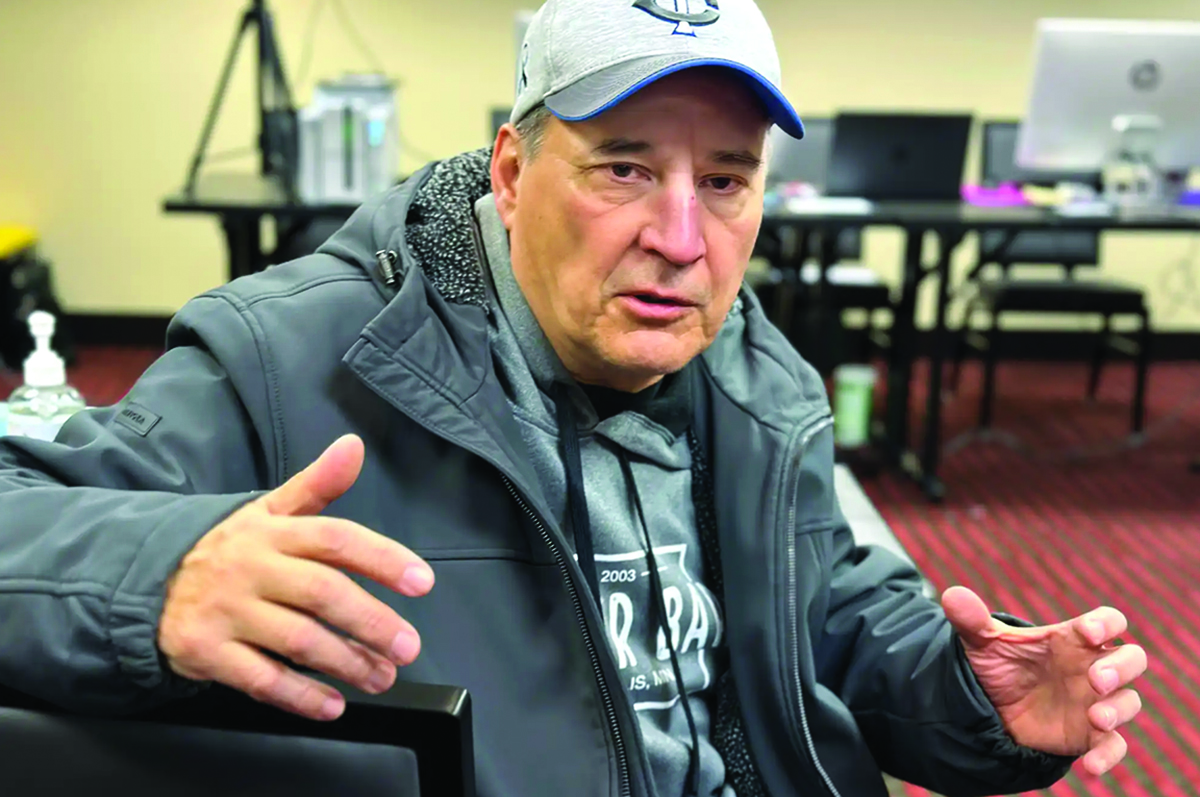
The Twin Cities-based nonprofits sponsored the canoe-building effort, held at the Minneapolis American Indian Center over three weeks in February and March, to show appreciation to the Dakota tribes for protecting the sacred Wakan Tipi site, said Kevin Finney, founder/director of Great Lakes Lifeways Institute (GLLI.)
The Wakan Tipi site, formerly called the Lower Phalen Creek Project, extends from Lake Phalen to the Mississippi River and throughout the East Side River District, a sacred area to the Dakota tribes.
The previous builder (of three canoes that were sent to the Shakopee Mdewakanton Sioux, Upper Sioux and Lower Sioux communities) experienced health issues that prevented them from building the fourth and final canoe, so Wakan Tipi approached GLLI, Finney said.
“One of the things our organization has been doing for a number of years is traditional watercraft work within Indigenous communities,” Finney said. “We help revitalize the knowledge and connect the communities with the tradition of building, and with the waterways as well.”
The 38-foot cottonwood was cut down from a roadside by the city of St. Paul for Wakan Tipi, which used a 6,000-pound, 20-foot section for the build, conducted mainly in the rear outdoor space at the Minneapolis American Indian Center (MAIC).
Finney said 263 people in total helped carve and hollow out the log at MAIC, which culminated in a “community boil” at the Indian Center on March 10, where the hollowed-out structure was filled with water and brought to an instant roiling boil by dropping in six large rocks (“grandfather stones”) that were heated in a nearby fire.
In a revolving process, participants used pitchforks to replace the cooled stones with hot ones, which kept the water boiling and allowed builders to shape and bend the pliable cottonwood to a final shape with the help of braces and clamps.
“You could just see the (16-foot) canoe start to shimmer” when the water was boiling, Finney said.
In total, 5,900 of the 6,000 pounds of wood was removed by volunteers wielding tools Dakota craftsmen and builders would have utilized in the early 1700s when access to steel became available through the fur trade and implements like broadaxes, pickaxes, gouges and adzes became available, Finney said.
“It’s a huge amount of physical work to do the carving,” said Finney, who has built canoes for over 20 years. “But it’s a very grounding experience to be working with your hands, to be carving, to be working with community.”

Native schools and youth organizations around the Twin Cities including the Nawayee Center School, MIGIZI and an arts group from Little Earth participated in the build as well as members of recovery organizations.
“They (Relatives in recovery) came out at first, then came back every day to carve because they said it was really, really good for them and they felt it was a key part of them helping with their sobriety,” Finney said.
Communal projects are the aim of Great Lakes Lifeways Institute, said Kaesha Baloch, co-director.
“The old ways are good enough,” Baloch said. “When contracting with Indigenous communities, we don’t build for, we build with. The more we get to know, the more we get to share. Indigeneity is not all about self, but about community. Our wealth is our relationship to one another, and connecting.”
Previous generations used a combination of stone and shell devices and fire to fell trees and hollow out logs in a time-consuming process. In a nod to time constraints and modernity, Finney used a chainsaw for some initial roughing-out work and sanders and grinders to finish, but the majority of work was accomplished with short- and long-handled adzes, he said.
“This style of dugout really hasn’t been made in this area since the 1920s or ‘30s, with the last one at Prairie Island,” Finney said. “The dugout (vs. birchbark canoes) was more common in the Dakota communities and the Anishinaabe in northern Minnesota.
“The dugout tended to be community canoes rather than individual. Historically, tribes kept dugouts as communal property on waterways. If you went to an inland lake, for example, there might be one or two dugouts which would always be there in the same spot for pretty much anyone to use. They’re incredibly durable.”
Indigenous people had an ingenious method of storing the watercraft under water for the winter by sinking them with rocks, Finney said.
“That’s what preserved them,” he said. “As long as you’re below the ice line, there’s no oxygen in those environments. It goes straight to the bottom and preserves just fine. You can bring it up in the spring. I’ve done it and it works just fine. You can leave it down there five years in an inland lake. … People are always finding dugout canoes buried in muck that predate the arrival of European settlers.”
After the final three ash-carved “thwarts,” or short cross-piece poles, are applied, Finney will slather the vessel with a mix of pine gum, bear grease and linseed oil to seal it.
“The idea is to make it as traditional as possible,” he said. “Some of them (dugouts) had carvings, but it’s very rare. Some of the Anishinaabe canoes were typically painted green or red on the outside of the canoe, either all red with green on it, or all green with red. This one won’t be painted, we’ll just put the finish on it, which protects the canoe.”
Finney said Upper Midwest tribes historically used white pine for their canoes, or basswood, but farther west as the deciduous forests trickled out into the plains, cottonwood was utilized.
“These dugouts were being made by all Great Lakes people,” Finney said. “Dakotas, Anish, Menominee, Ho-Chunk, Ottawas, Potawatomi, Ojibwes. The other most common were bark canoes, including birchbark — they’re incredibly lightweight. The difference is the dugout is very durable where the birchbark is fragile.”
When complete, the fully functional, sleek canoe can be used as a centerpiece of learning for tribal members and the general public, to educate them on tribal history or to just get out on the water.
“These canoes were a huge part of connecting people to the waterways all across the region,” Finney said. “Those (lakes and rivers) were the highways for many thousands of years to connect people to trade, travel, hunting, ricing and everything else.”