
 In January the staff from Senator Al Franken's (D-MN) office came to the Minneapolis American Indian Center (MAIC) to ask Native American elders about the problems they face in their senior years and gather information that will be used in the Senate this upcoming year to reauthorize the Older Americans Act, an act passed in 1965 in response to a lack of community-based social services for older Americans.
Senator Franken serves on the Senate Special Committee on Aging as well as the Subcommittee on Retirement and Aging in Health, Education, Labor, and Pensions.
The Older Americans Act has funded community services for the elderly such as Aging and Disability Resource Centers, the Aging Services Network and the Native American Caregiver Support Program.
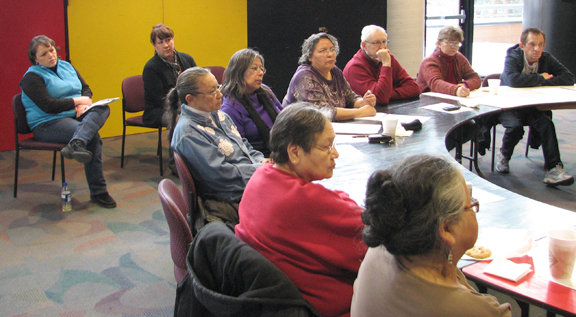
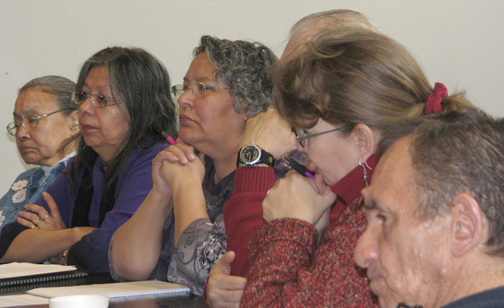 The meeting itself took place at a large round table, where staff, elders, and health care providers all talked about the challenges older Native Americans face in Minneapolis. Everyone was invited; interested parties and elders trickled into the meeting until there was a full table.
The subjects discussed were wide ranging, from funding disparities between reservation and off-reservation Natives, disability housing problems, need for dental and total health care, to transportation issues and elder's safety while going to work in the city.
Although Senator Franken was unable to attend the meeting, his staff listened and took notes to relay with the Senator. Daniel Fanning, Deputy Director to Senator Franken's Office, said, "This is one of over 20 listening sessions we've done around the state. The good thing is that what's come out of these sessions is a common theme; housing, transportation, a lot of these issues are the same concerns we've heard throughout the state. It's helpful because these are the issues Senator Franken will be working on. All of these listening sessions are going to give us a stronger voice when the time comes to vote. It's great that [the elders] have shared their stories and it's going to make us a more powerful advocate on their behalf."
After the meeting, elders and health care professionals had words to say to both The Circle and to Franken:
o Bill Munnell, elder: "The session was pretty good. I liked it; you know, I live in a handicapped building, and I have seizures so I can't work that much. People don't want to hire you because they think you'll have a seizure or something. I hope something comes out of this so it isn't so hard for me to get a job."
o Carol Hill, elder: "I really feel they could've scheduled Senator Franken on a weekend and a lot more Natives may have come. A lot of people were hoping to see him here today; maybe next time he can."
o Shirley Kane, elder: "I've been to other sessions where Al Franken attended and it was great. Sometimes it's hard, you know, for us elders to speak out and use our voices; so this was a really good opportunity. [These elders] have such a wealth of information; they're just such wonderful resources for our communities. Even though they have so many issues to deal with, they are resilient, and they are proud."
o Willard Jay Malebear, Standing Rock Lakota elder: "I've lived here since 1972 and I worked for 14 years as a Minneapolis Public Safety Official. A lot of elders that should have been here were not here; in order to make it really something that accomplishes what [Native Americans] need we need more people here."
o Jacque Wilson, the Bois Forte Urban Office Coordinator: "The housing issue I think is important; people should have an established background check before they're allowed to live in elderly apartments. There are people who can get in an apartment without having these necessary checks, and I think they should be treated like everyone else. Our elders are left in line for housing."
o Sheri L. Riemers, MAIC Program Director: "This [meeting] is to validate our elders who are raising their grandchildren, and how difficult it is, because with roughly 13% to 14% of our caseload the children are with grandparents. It's a rushed process; grandparents aren't receiving services, there's a lack of funding there. Our elders are our largest growing population [in the U.S.]. Our elders are one of the most important things we have; they're the ones that teach our children, and it's disheartening to see the lack of services."