

 A federal judge has ordered that
endangered species protection for gray wolves must immediately be
restored in Minnesota, Wisconsin and Michigan. The decision puts an
end to controversial hunts in Minnesota and Wisconsin.
U.S. District Court Judge Beryl A.
Howell returned management of wolves in the western Great Lakes
states to the federal government, overturning a 2012 decision by the
U.S. Fish and Wildlife Service.
"The D.C. Circuit has noted that,
at times, a court ‘must lean forward from the bench to let an agency
know, in no uncertain terms, that enough is enough,’" Judge
Howell wrote in her 111 page decision. "This case is one of
those times."
The Humane Society of the United
States and other animal welfare groups filed the suit last February.
They argued Fish and Wildlife’s decision to remove the wolf from
endangered species protection threatens the animals’ recovery in the
Great Lakes region.
More than 1,500 wolves have been
killed since Minnesota and Wisconsin authorized hunting seasons in
2011, said Jonathan Lovvorn, senior vice president and chief counsel
at the Human Society. "We are pleased that the court has
recognized that the basis for the de-listing decision was flawed, and
would stop wolf recovery in its tracks," he added in a
statement.
The other plaintiffs in the suit
include Born Free USA, Help Our Wolves Live and Friends of Animals
and Their Environment.
The decision restores wolves to
"threatened" status in Minnesota, and "endangered"
in Wisconsin and Michigan. People may kill wolves in self-defense,
but not to protect livestock or pets, said Minnesota DNR spokesman
Chris Niskanen. Federal workers must be enlisted to kill wolves when
there is proof they are threatening animals.
Niskanen said the agency received the
decision late in the day, and hadn’t had time to digest the lengthy
ruling or determine what it means for the state in the long term, and
whether there is basis for appeal.
It’s been more than 40 years since the
federal government imposed protections to prevent wolves from going
extinct in the lower 48 states.
Since 2003 the federal government has
tried four times to "de-list" the wolf from the Endangered
Species List in the Great Lakes region, arguing the wolf had
recovered to sustainable levels. The first three attempts were
blocked by lawsuits.
"We’ve been in this sort of
netherworld where it’s gone from state management to federal
protections back to state management," said Niskanen.
The fourth attempt to remove the wolf
from the Endangered Species List in January 2012 succeeded. That’s
when Minnesota and the other states assumed management of their wolf
populations.
Minnesota and Wisconsin have since
held three wolf hunts. Michigan authorized a hunt, but voters
overturned that decision in a referendum vote in November.
Wisconsin’s Department of Natural
Resources said in a statement Friday night that it is reviewing the
decision, but that hunting and killing wolves to protect pets and
livestock is now illegal in the state. The statement noted while the
"department is disappointed by this decision, we will continue
to support USFWS and their original decision to de-list and remain
confident in the State of Wisconsin’s ability to manage our wolf
population."
Minnesota’s third hunting and trapping
season just ended last week with the killing of 272 wolves, 22 more
than the target amount. That prompted protests outside DNR
headquarters in St. Paul, led by Howling for Wolves, which has
opposed the hunt.
Founder Maureen Hackett said the
ruling is "good news for the future of Minnesota wolves. The
vast majority of Minnesotans do want to protect wolves for future
generations," she said. "So we have to come up with a
smart, rational way of allowing wolves to exist."
The latest DNR population survey
estimated Minnesota’s wolf population at 470 packs and 2,423
individuals. That’s 212 more wolves than estimated last year, but
about 500 fewer than the last estimate before hunting began.
DNR officials have argued the state
can have a regulated hunting and trapping season and still assure the
iconic predator continues to thrive.
"We’re highly invested in making
sure that the wolf is protected in Minnesota," said agency
spokesman Niskanen. "There’s no desire by the DNR to endanger
the long term future of wolves in Minnesota. They’re an important
part of the ecosystem."
Minnesota Public Radio News can be heard on MPR’s statewide radio network or online at mprnews.org.
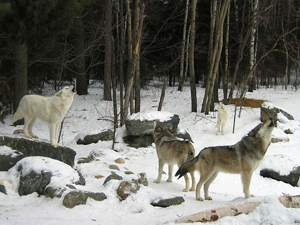
PHOTO: In this February 2008 photo,
gray wolves howl at an exhibit area at the International Wolf Center
in Ely, Minn. (AP Photo/John Flesher)