
BY DEBORAH LOCKE
(To see the article in this issue about Julie’s exhibit see: https://thecirclenews.org/the-arts/julie-buffaloheads-art-gives-no-answers-to-the-viewer/
When did you know that you wanted to be an artist?
I didn’t have a realization; I just did it. I took art classes in junior high and learned how to do art at the Minneapolis College of Art and Design. When I got to college, I knew I would do something in arts for the rest of my life.
Did teachers encourage you to pursue art?
No, I didn’t have a strong mentor (in school). My parents encouraged me to do whatever I wanted to do. They were college professors and as teachers, had experience with encouraging students. My father was brought to the University of Minnesota as Director of American Indian Studies; my parents knew Native artists like George Morrison. I grew up surrounded by writers and poets and artists.
What were the first objects you drew?
I drew horses and other animals and I kept drawing until they looked more like an animal. I studied pictures of them. I have a daughter who is nine and the thing I recognize in her is that she’s an extrovert who likes social situations. For me when I was younger, drawing and being bookish was a way to gain energy. My daughter gets pleasure in engaging with people and she talks a lot. She has some art ability, but isn’t self-motivated. When I was five, I tried to draw animals.
When was your first art show?
It was at Cornell University. There is a large Native population in New York but I wasn’t near my own community which was hard. New York is different from the Midwest. I was really on my own and lonely.
Why do you do what you do?
If you don’t take opportunities as a serious artist, you miss out. My work received attention when I was in college and I met new people and forged relationships which led to other opportunities. When you are young you may start by showing your work in a coffee shop and that leads to bigger things. I’m not terribly driven, I’m shy and probably could be more successful.
You’ve had a lot of shows, and received good reviews. How do you keep building on that?
I’ve had opportunities to do shows in major institutions and can now choose where I want to exhibit. Right now I’m working toward a major exhibit at the Denver Art Museum which opens in July. It’s the first time I’ve done a show there.
How do you prepare for a show?
Preparation depends on the size of the space. Then you decide on whether you’re doing paintings or sculptures. Or sometimes a curator will come to my studio and choose what they want. So what is in the show is now always up to you. I have a studio at home and one a few blocks from my home. I do the larger pieces in the warehouse studio.
Now does your American Indian heritage inform your art work?
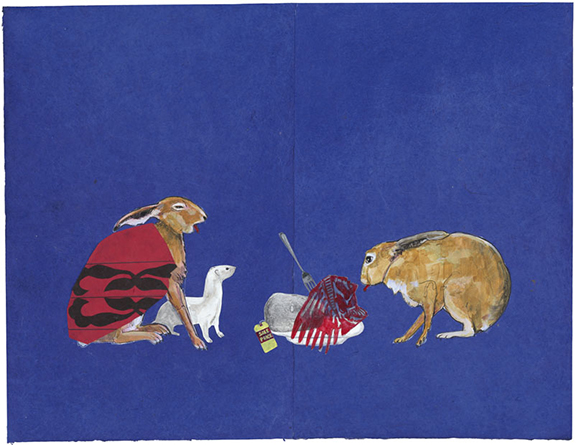
A lot of my work is based on Native American storytelling. I think of characters from the stories I heard and spin my own stories. I tend to use a lot of certain trickster characters like coyote and rabbit. I grew up in that culture and it is a natural part of my life. The work can be fun but because I’m a perfectionist, I have this battle in my brain about what I’m making and translating and how it looks aesthetically. Being an artist is like being a writer. You prewrite and write and edit and edit again. I know when a piece is done when I run out of time. Deadlines can be good things.
How long does the average work take?
If the drawing is experimental, one part of it may take a month or longer. By experimental I mean working with themes that are more political and less personal. In the past I was more emotional and ambiguous; now I’m getting into the politics of our time and am making statements about issues in my own life. Jimmie Durham who claims an Indian identity had a big exhibit at the Walker Art Museum but the Walker hasn’t done that for any other contemporary American Indian artist. (Durham “self Identifies” as Cherokee, according to the Walker Art Museum website, but none of the three Cherokee nations recognize him as Cherokee.)
Do you think viewers understand your work?
I don’t make images so they can be understood by everybody. If people derive their own interpretation, I’m happy with that. Art is like poetry: you may not understand what is meant by the poet, but the flow of words could still have an effect if you speak them out loud.
How do you compose your artwork?
I see something in my mind like a photo image, and sketch it out. Or I may start with something that interests me and draw it on paper and canvas and see a narrative developing of a place or objects, or an interaction.
Your newer works contain elements of current events. Wouldn’t it be easier just to do still life all the time, or scenery?
Many Native artists bring current events to our work – like the Walker scaffold story – and that has to continue. Institutions sometimes view Native artists differently from other contemporary artists. It’s not discrimination, but when they put on a show, they will leave out Native art. If a Native person were a part of the review in the decision-making process at the Walker, the scaffold may not have used. These dialogues need to continue.
What are the best and worse parts of being an artist?
As an introvert, I’d rather just sit in a hammock for hours. Creation is the most rewarding part of being an artist. Creation is powerful, not just to stand back and look at what you did, but to go through the process. I want viewers who see my art to feel an emotional connection and feel a reaction.
You’ve been criticized for not being “Indian” enough. Why?
My dad is Ponca and my brother looks like my father. My mother is white and I look more like her. Some people in my life have not been receptive of me because I look like my mother. But I go by what my father taught: accept everybody.