

By Brad Hagen
Language revitalization is widely recognized as an essential aspect of strengthening Native nations across Turtle Island. For some, there are more immediate matters like health care and housing to worry about while for others, language is central to healing our communities. For Randy Gresczyk, language revitalization is both his passion and profession.
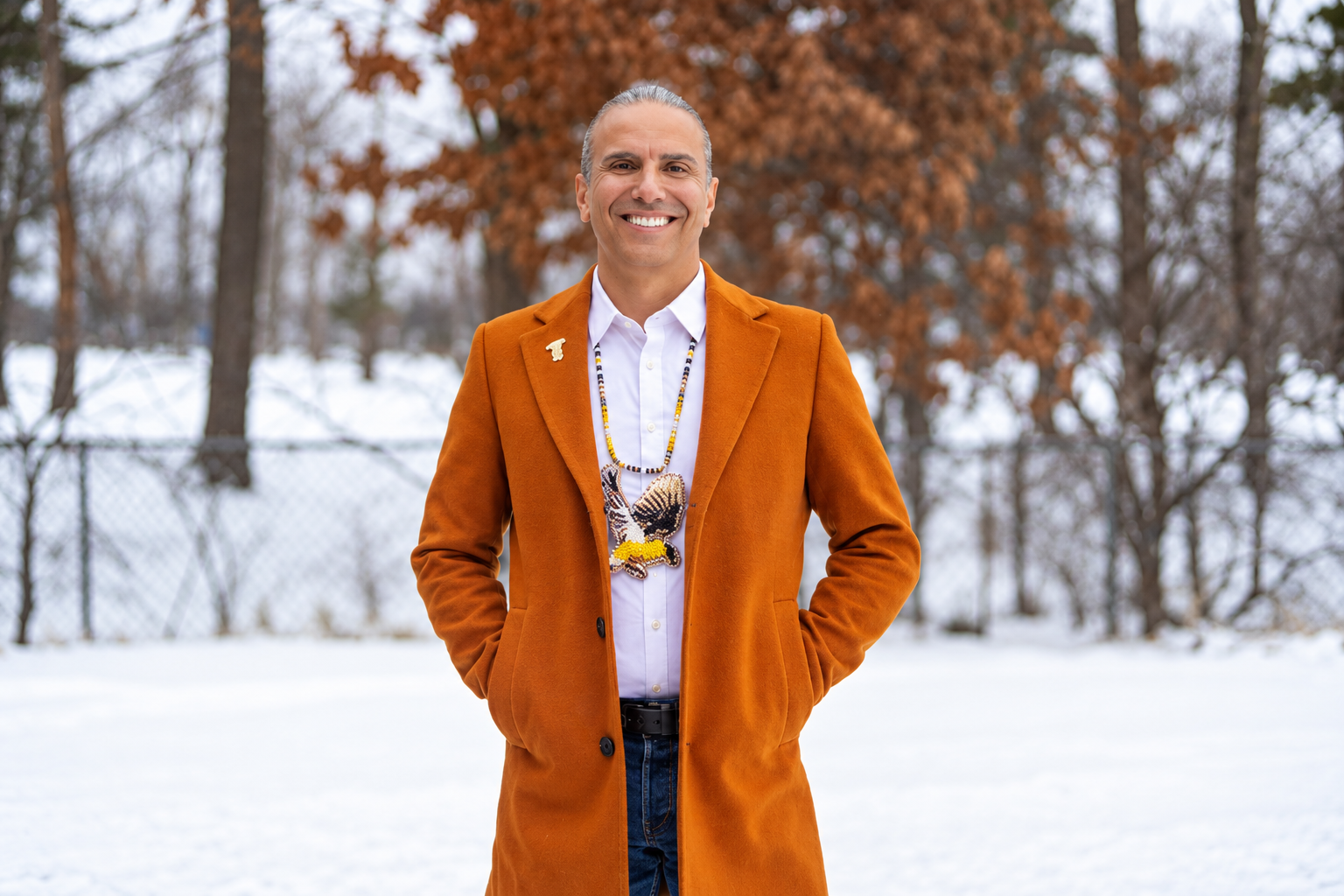
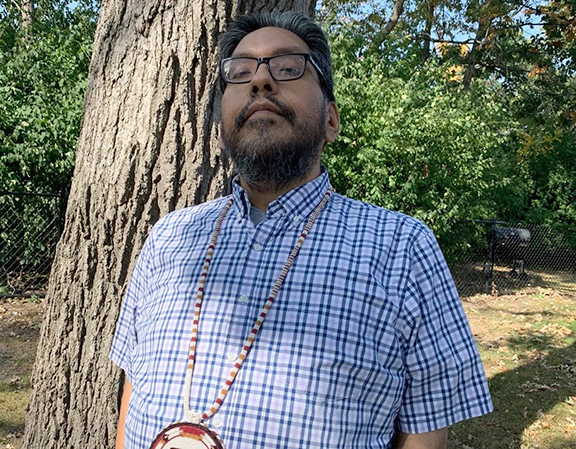
Gresczyk is the Indian Education coordinator as well as an Ojibwe language instructor for the Robbinsdale school district, where he’s worked for six years. His school district is the home of one of the only high schools that offers an Ojibwemowin class for college credit.
In addition to this work, he is also an adjunct faculty member at MCTC and Augsburg University, and is one of the founders of the Kiwenz Language Immersion Camp in Sawyer, Minnesota. He has done much for the Ojibwe people throughout his career and continues to provide excellence through his work.
Because of the pandemic, Randy and I are conversing via Zoom. “What up, niij?” I say as he joins the meeting. We spend some time catching up, given that we haven’t talked in almost a year, but the conversation quickly turns toward the current state of language revitalization.
“How do you think the pandemic has affected language classes?” I say.
“People definitely have had to do more of an online approach, so for people who aren’t used to doing that kind of instruction, that was a challenge. I know I’d take in person instruction over online. In person, you can have better conversations and instructors have more things that they can do versus ‘here, let me pull up this document for you, let me share this resource.’”
Despite the negative aspects of distance learning when learning a language, Gresczyk is quick to highlight some of the positives, as well.
“I think this could also be a positive in that it could reach a broader audience, like the Indian Center has a[n Ojibwe] class with almost 200 people in the Zoom session. There can be more instances of languages being recorded online so I think this is going to help get a lot more material out there.”
In Gresczyk’s eyes, this mode of instruction could also increase grant opportunities for language classes by making it easier to monitor the spaces that language revitalization occurs, which could make it easier to see all the good work occurring and how important this work is.
“For you personally, why does language revitalization matter?”
“It’s just part of who I am as an Ojibwe person and being fortunate enough to be in a situation where I had elders growing up around me, first language speakers growing up around me. My dad’s an [Ojibwe] language teacher.
“When I was going to go to college, I had no interest in teaching or Indian Studies for that matter, but I think that as I got a little more mature and saw the need and necessity that there was going to be for people to carry on the language, I figured I could help pass on what I know and carry on the legacy of elders that were kind enough to share teachings with me. Being around them growing up, as well as my grandma who was a first language speaker, meant I was always around the language and this put me in a good position to be able to become a teacher and be helpful in the language revitalization movement.”
Despite this connection between Native peoples and their languages, there are still some that question the benefit of learning them, especially considering that many are endangered or close to extinction.
In regard to the importance of learning our languages, Gresczyk says, “It’s a part of who we are as Indigenous people. It’s part of our identity and for those of us who are still lucky enough to have the ability to learn what we can, we should take advantage of that. There are some languages that are completely dead and some of them are well on their way towards dying, while others are considered endangered, like the Ojibwe language. So some might ask, what’s the point?
“It brings diversity to the world and it’s a part of who you are as a person and your worldview, right? Coming from a Western mindset, English is noun based so you’re thinking about materials all the time. Ojibwe is a verb based language, so you’re thinking about actions, so it’s a different way of seeing and interacting with the world. Consider animacy in Ojibwe – things have power, like a feather or a drum. You get all kinds of culture that’s in that language, as well.”
Under the best of circumstances, learning a new language is difficult. Throw in historical trauma and a relative lack of resources compared to more common languages like French and German, and you’re left fighting an uphill battle. The most recent addition thrown into this hodgepodge is the COVID-19 pandemic. What use is learning and/or speaking a language that doesn’t have many speakers when the world as a whole is struggling to hold on?
To this question, Gresczyk offers the following insights, “Depending on who you talk to and your own personal beliefs are, language does a lot for a person. For some people, speaking Ojibwe is even a prayer, like saying ‘I’m Ojibwe’ can be a prayer that fosters a healthy state of mind and can create a sense of emotional wellbeing. I’m not saying there’s anything that can be done physically by speaking the language, but it definitely helps the other senses, your spirit, emotions.”
When asked if there was any advice he could give to those who are still on their language journey, Gresczyk replies, “Don’t give up. Try. There’s a lot more resources out there. Learn as much as you can. Take advantage of the internet. Not everybody has access to first language speakers, fluent speakers, or even the internet, but I think some libraries are still operational under pandemic guidlines. If you’re not going outside a lot during this time, maybe that’s [learning a language] a new skill you could work on.”
Being productive during the pandemic is a good mindset to have. The fact that our languages survive today after the onslaught of English during the boarding school era speaks to the resilience of Native people. Both strength and suffering went into this act.
We owe it to those who kept warm the embers of our languages during those tough times to now stoke the flames. If they could do it, why not us?
For info on Native lauguages, see:
• CLAN (Culture Language and Art Network): http://www.maicnet.org/project/culture-language-and-arts-network.
• GLFWC (Great Lakes Fish/Wildlife Commission): http://www.glifwc-inwe.com/index.html.
• The Ojibwe People’s Dictionary: https://ojibwe.lib.umn.edu.
• Waking Up Ojibwe: http://www.wakingupojibwe.ca/pathways/families.