

By Lee Egerstrom
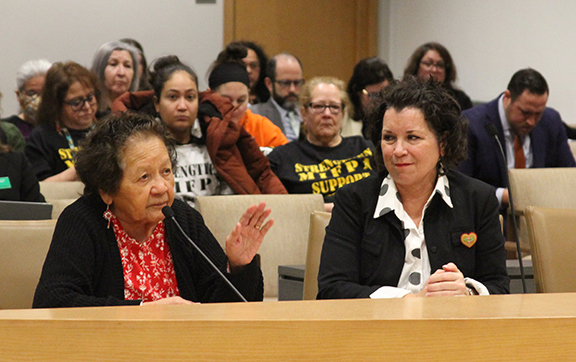
Several bills for Native American Minnesotans, their families and communities are gaining momentum early in the Minnesota Legislature with high chances of becoming law. One big jump occurred Feb. 27 when the Minnesota Senate voted 66-1to approve Senate File 667, which seeks to add children protection measures in the federal Indian Child Welfare Act (ICWA) to the existing Minnesota Indian Family Preservation Act (MIFPA).
The federal act is being challenged before the U.S. Supreme Court and it could be declared unconstitutional, thus void, later this year.
Sen. Mary Kunesh (DFL-New Brighton) is convinced her bill that sailed through the Senate will also win broad support in the House and will land on Gov. Tim Walz’s desk to become law. While the future of the federal law is cloudy, its best protections for preventing removal and disconnecting children from their families and tribal culture will become Minnesota law.
Kunesh, a Standing Rock Sioux Tribe descendant and the lead author of the Senate bill, recalled the painful past for Native people when the bill was passed.
“Every Native family has been affected by the history of U.S. and Minnesotan family separations, which were weaponized as tools for genocide and jeopardized, rather than protected, Native children,” she said.
The companion bill is also making progress in the House. It has had a few hearings. But it has a powerful list of co-authors of that looks like an ad hoc committee at large.
Rep. Heather Keeler (DFL-Moorhead), an enrolled member of the Yankton Sioux Tribe, is the lead author for the House bill (H.F. 1071). Co-authors include House Speaker Melissa Hartman, Brooklyn Park; Assistant Majority Leader Brad Tabke, Shakopee; and Native American lawmakers Alicia Kozlowki, Duluth; and Jamie Becker-Finn, Roseville.
Other co-authors include Reps. Dave Pinto, St. Paul; Mike Freiberg, Golden Valley, Zack Stephenson, Coon Rapids, Emma Greenman, Minneapolis; and Amanda Hemmingsen-Jaeger, Woodbury, plus two Republicans who make this a bipartisan bill, Reps. Walter Hudson, of Albertville, and Matt Bliss, from the unincorporated village of Pennington, also called Cass River, on the Leech Lake Indian Reservation.
The urgency for this legislative action comes from the challenge to the federal law.
The state of Texas and some non-Native families have a case before the U.S. Supreme Court (Haaland v. Brackeen) seeking to have the ICWA declared unconstitutional. If that is done, perhaps in June, state laws regarding adoption and placement of indigenous children in non-Native homes would guide future child welfare practices.
Native and allied groups defending the ICWA before the court see this as a challenge to tribal sovereignty. Kunesh told The Circle the legislation was shaped by lawmakers working with a tribal MIFPA working group. It included tribal officials and attorneys, the Minnesota Department of Human Services, the Minnesota Association of County Social Services Administrators and other social welfare groups. They seek to avoid what could become almost endless litigation if the federal law is voided, Kunesh said. Minnesota law would continue current federal protections afforded Indigenous children, their families and the tribes no matter how the Supreme Court rules. Her co-authors of the Senate bill are Sens. Jim Abeler, R-Anoka; Melissa Wiklund, DFL-Bloomington; Grant Hauschild, DFL-Hermantown; and Clare Oumou Verbetem, DFL-St. Paul.
At a Senate Health and Human Services Committee meeting on Feb. 7, Kunesh reminded senators of the long and painful history American Indians have experienced with children being removed for their homes and sent to boarding schools or to live with non-Native families. This was an intentional effort to destroy Native cultures, she said.
Tribal leaders from across the state and other Native community leaders told of personal, family and tribal experiences backing up the senator’s call for urgent action.
Among them were Robert Larsen, president of the Lower Sioux Community; Laurie York, executive director at the White Earth Nation; and Bobbi Jo Potter, manager of Ramsey County’s Indian Child Welfare program. She is a Bois Forte Band of Chippewa member and descendant of St. Croix Band of Chippewa.
Kevin Dupuis, Fond du Lac Band chairman, summed up the damage losing children causes the tribes. “No one man or group of people has the right to deny us the right to exist as who we are as a people,” he said. “Our children are our future, and that goes for any society.”
Gertrude Buckanaga (White Earth Nation), executive director of the Upper Midwest American Indian Center, told how she and her siblings were sent to boarding schools after their mother died in 1946. They were only allowed to go home a year later to visit with a baby sister and baby brother being raised by an uncle.
“We were kept from our dad, our grandparents, our aunts and uncles, cousins – family members that we grew up with when we were young.”
Another personal experience was told by Faron Jackson Sr., chairman of the Leech Lake Band of Ojibwe. Two younger brothers were removed from his home in the 1960s before the ICWA was passed (1978). “Even though they’re my biological brothers, they feel like strangers when we are together.”
Tribal leaders and elders don’t want to risk seeing those days come back if the ICWA is struck down by the Supreme Court, they told the committee.
That is but one of several pieces of legislation for Native communities that has a strong chance of passing in the current session, Kunesh said in an interview. Some others are supportive of emotional causes and others, naturally, involve providing funds for projects.
She is chief author of six such bills currently making progress through committees. One allows student data to be shared with tribal nations under certain circumstances, and another, Teachers of Color Act, that she described as a broad way to deal with racism in education that damages students and teachers. “We might fine tune this some, but I’m confident it will pass.”
Kunesh and Keeler have bills in their respective houses to create special auto license plates calling attention to Missing and Murdered Indigenous Relatives. Kunesh is confident that will pass, and she also thinks a bill she is sponsoring in the Senate that is also part of Gov. Tim Walz’s agenda will become law. It would prohibit school districts from prohibiting students from wearing regalia or objects of cultural significance at graduation ceremonies.
She also is chief author of a routine bill providing operating funds for the Minnesota Indian Affairs Council. And, she is co-author of a bill to appropriate $3 million for tribal colleges. “They are historically underfunded,” she said.
On other issues before the Legislature, there does seem to be momentum for a bill allowing sports betting in Minnesota. The bill making headway for passage would keep betting in the hands of tribal gaming enterprises.
There was also strong possibility that funding for projects sought by the Metropolitan Urban Indian Directors (MUID) and its related Urban Indigenous Legacy Initiative (UILI) will be approved in a two-step process this year.
Sixteen non-profit Native organizations banded to form a joint effort in the past to seek state appropriations for buildings and selected other projects. Those efforts stalled in 2022 as some members feared who might get credit for legislative action.
Kunesh is involved in seeking funding for UILI projects. She also recently introduced a bill that would exempt the Office of Ombudsman for American Indian Families from paying court fees.
Many of these bills need perusal and approval by judiciary committees in the two legislative houses. That, too, is a reason for Kunesh to be optimistic about progress this session. Rep. Jamie Becker-Finn, DFL-Roseville and a Leech Lake Ojibwe descendant, is chair of the House Judiciary Finance and Civil Law Committee that will handle many of these bills. And she, like Kunesh, is a founding member of the People of Color & Indigenous (POCI) Caucus in the Legislature that formed on the theory there is strength in numbers.