


By Lee Egerstrom
Racial covenants on property have been illegal in Minnesota for more than 50 years but still remain on long-established mortgages and leasing contracts. Minneapolis wants to change that.
The city has launched a new program to help people wipe this blight clean from their legal documents.
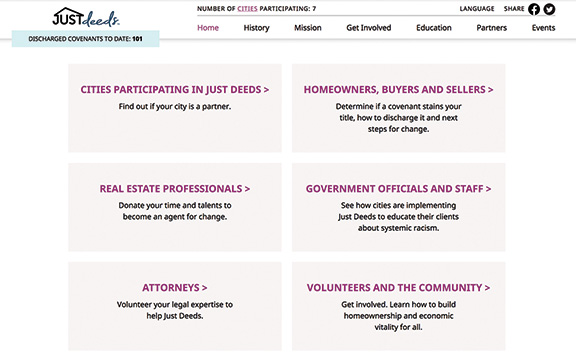
Minneapolis City Attorney’s Office began a program in early March, called the Just Deeds Project, to help people “discharge” the racial and religious covenants against their properties. The city and Hennepin County have waived fees for changing these property records.
“This is not to erase history,” said Amy Schutt, an assistant Minneapolis city attorney. “It’s really more for education. A lot of people don’t realize the covenants exist on their documents.”
In discovering the discrimination languages written into mortgages and leases, people do learn about the inequality in housing that still impact how, and where, people live today, she said.
Black, Indigenous and People of Color (BIPOC) members were forced to live in segregated communities in the Twin Cities and elsewhere in Minnesota starting more than a century ago. In the Twin Cities, and especially in Minneapolis and Hennepin County, these covenants also signaled out Jews who were not to buy or occupy property in neighborhoods that had covenants.
In announcing its Just Deeds Project, Minneapolis officials noted that University of Minnesota research found more than 8,000 properties in Minneapolis still had racial covenants on documents. University researchers used volunteers and others to review thousands of recorded documents in a 2016 to 2020 effort by a Mapping Prejudice team.
This affected and continues to affect where Native Americans and other BIPOC community members live.
Mapping Prejudice researchers found a common Minneapolis covenant stated “the said premises shall not at any time be sold, conveyed, leased, or sublet, or occupied by any person or persons who are not full bloods of the so-called Caucasian or White race.”
The first racially-restricted deed found in Minneapolis, dated in 1910, said the “premises shall not at any time be conveyed, mortgaged or leased to any person or persons of Chinese, Japanese, Moorish. Turkish, Negro, Mongolian or African blood or descent.”
A research team from the Minneapolis Federal Reserve Bank in February waded in on how these covenants impose restraints on Native American home ownership. Authors Ben Horowitz, Kim Eng Ky, Libby Startling and Alene Tchourumoff found:
“Explicitly and implicitly racist policies and practices barred many Native American families and families of color from the federal government’s massive investments in homeownership through the Twentieth Century.”
They noted that the Federal Housing Administration (FHA), started in 1934, encouraged racial covenants and used color coded maps to exclude Native and BIPOC families from access to credit. This was the start of the term “redlining,” they said, which told lenders that neighborhoods in “red” were considered “high risk.” “Not surprising, from 1934 to 1962, 98 percent of federally backed FHA loans nationally went to White home buyers,” they wrote.
The various studies show that these covenants and legal barriers to credit gradually became illegal after World War II. A U.S. Supreme Court ruling in 1948, Shelley vs Kramer, made the covenants unenforceable. The Minnesota Legislature prohibited them in 1953, but they remained commonplace in much of the nation until 1968 when Congress passed the Fair Housing Act that made them illegal.
While that is the law, lenders and realtors continued steering people away from neighborhoods long after, said Minneapolis attorney Schutt. As a result, she said, “discrimination in housing continued but only the impact was visible.”
The Minneapolis Fed researchers show how visible the lingering inaccessible credit and other factors remain. The disparity between the White homeownership rate with those for households of color and Native Americans in Minnesota is the fourth highest in the nation, they said.
With federal programs promoting homeownership, the White ownership rate in Minnesota went from 55 percent in 1940 to 77 percent in 2019. Homeownership for households of color and Native Americans in Minnesota actually decreased from 46 percent to 44 percent in those same years.
Faculty and students at St. Catherine University in St. Paul, in collaboration with the Mapping Prejudice project, has a related project – Welcoming the Dear Neighbor? – exploring similar racism and covenants in Ramsey County and in the area of St. Paul around St. Kate’s.
Information on the Minneapolis project and how to connect with the Minneapolis City Attorney’s Office can be found at JustDeedsProject@minneapolismn.gov. Substantial data on Minnesota housing discrimination and homeownership from the Minneapolis Fed can be found at https://www.minneapolisfed.org/article/2021/systemic-racism-haunts-homeownership-rates-in-minnesota.
Extensive University of Minnesota information on racial and ethnic covenants in Minnesota is available at https://mappingprejudice.umn.edu/; and information on the St. Kate’s project can be found at https://welcomingthedearneighbor.org/.