

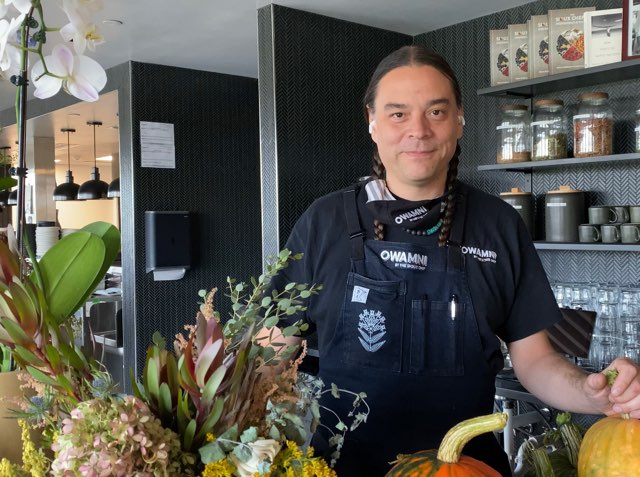
By Brad Hagen
I’m walking to Owamni again, though this time from the opposite direction. I was here a year ago to interview Sean Sherman (the Sioux Chef) before the grand opening, walking alongside the Mississippi from the north. I’m approaching the restaurant now from the south, having had to park all the way down the river at Augsburg University because participants in the Stone Arch Bridge festival took up all the available parking. I don’t mind, though – I’ve never been one to turn down a walk on a nice day, especially when the destination promises a great meal.
A year ago when I first came to meet Sherman (Oglala Lakota), the restaurant was gearing up to open its doors for the first time in order to provide Indigenous foods to their customers. They’re clearly excelling in this endeavor given that, just a year later, I’m back to discuss their most recent success: Owamni has won the James Beard award for Best New Restaurant.
The James Beard Foundation seeks to celebrate and support those excelling in America’s food culture, as well as promote equity in the food industry. The fact that Owamni has been recognized by them is no small feat, especially considering the nature of the food that Owamni serves. There has historically been little room for Indigenous-based dishes in American cuisine, despite the fact that the ingredients used in them have been present on this continent long before European contact. However, Owamni’s success seems to mark a shift in the tide, one that will hopefully usher in more Indigenous restaurants and chefs in the years to come.
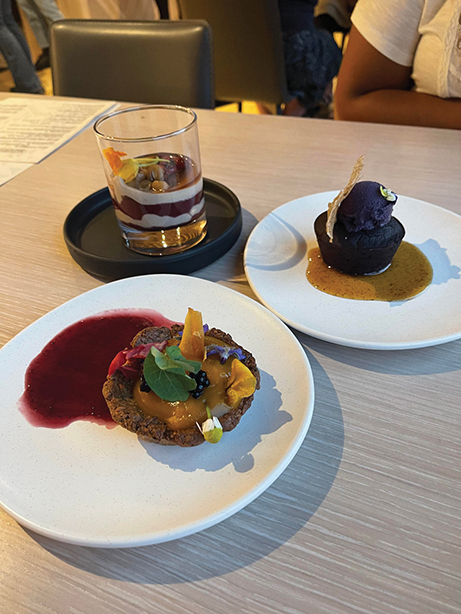
When I approach the restaurant, I see Sherman leaning against the rail on the rooftop balcony, looking, along with some of the other employees, at a demonstration occurring across the street. Two men hold picket signs with biblical phrases on them, while one speaks into a microphone, informing pedestrians of the fiery nature of Hell. It seems to be a coincidental location, to say the least.
After climbing the steps and finding my way through the crowd of customers milling about the rooftop, I find Sherman still leaned against the railing and we shake hands. I motion over to the demonstrators across the street and say, “Do you think they picked that spot on purpose?”
“Who knows,” Sherman responds.
We spend some time catching up before I address the elephant in the room. “So I hear you won some big award or something,” I say, teasing him.
“Yeah, that was big,” he said. “I was shocked because I was up for two awards, Best Chef of the Midwest and Best New Restaurant, and when I didn’t win the first one, I thought there was no way we were gonna win that restaurant one. So I was preparing myself to have the mindset of ‘We were just lucky to be nominated’, but then they called us up.”
“Did you have a little speech prepared or anything?”
“Dana [Dana Thompson is co-owner of Owamni, and is a descendant of the Wahpeton-Sisseton and Mdewakanton Dakota] had prepared a speech, but I didn’t have anything prepared. I kinda just said whatever felt right and basically told that crowd that we’ve been through 200 years of white supremacy and that we’ve got a lot of work to do, and that this was only the beginning.”
As we continue talking, I look down to see the traditional plants Sherman was planning on having planted along Water Works Park, bright and full of life with insects buzzing around them. “How is the garden coming in, anyway?”
“Oh, they’re coming in great. And you can see that they have the Dakhota names on there, so if you walk around, you can see the original names of the plants that were originally on this land.” The goal behind this was to increase awareness around Indigenous presence.
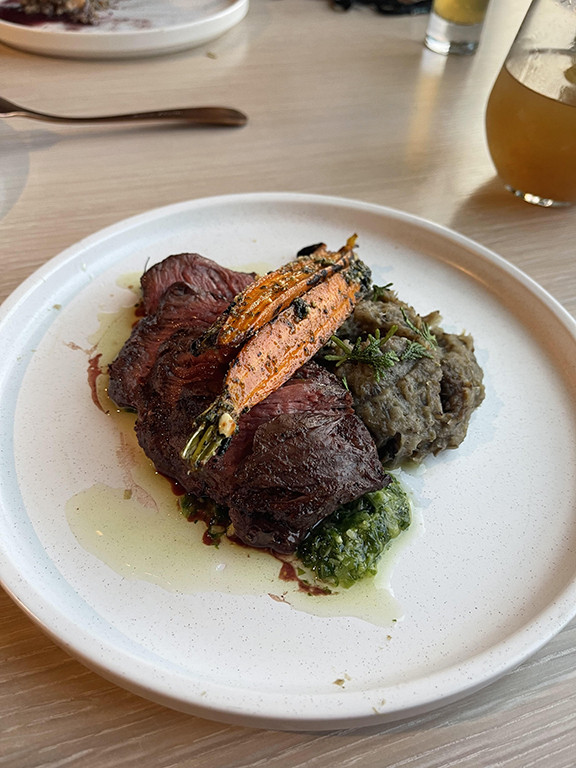
(File photos by Brad Hagen taken in 2021.)
Despite the many successes that Owamni has experienced this past year – reservations booked out for months, media coverage, and the winning of their latest award – they’ve hit the occasional roadblock.
“There’s always the occasional person who just doesn’t get it,” Sherman said, referring to the food that Owamni offers and the reasoning behind using the ingredients that they do. “If you read some of the online reviews, you can just tell, but we’re just showcasing what’s possible in modern Indigenous foods. Nobody has to do it like us if they don’t want to. We’re trying to modernize and normalize Indigenous foods.”
Looking ahead, Owamni is set to open up an Indigenous ingredients-focused market in Midtown Global Market in August. “It’s part of our non-profit NATIFS [North American Traditional Indigenous Food Systems], and its goal will be to provide Native foods.”
Sherman mentioned that he’s hoping to provide some staple ingredients like wild rice and maple sugar/syrup products, as well as some other harder to find items. “People need access to these traditional foods, and we’re hoping to provide that.
“The other side of the market will be a classroom studio where we can teach about Indigenous food ways and create a lot of curriculum, so that people can take classes on language or cooking food, nixtamalizing corn at home – we’re just looking to come up with all sorts of curriculum. Because there are two pillars to NATIFS: Creating access to Indigenous education and creating access to Indigenous foods. It all ties together.”
For Sherman, one essential component of providing this kind of education is that it be accessible. “There will be a price on these classes, but it’ll be a “pay what you can” sort of thing, so we hope to eliminate any kind of financial barriers that may be in place. And all of these classes will be recorded, so people can go onto our website and access them anyways, or join a live class that’s being streamed.”
We chat for a little while longer before I get back to the rest of the Stone Arch Bridge Festival. Just in time too, because someone needed some help inside the restaurant. I walk back down the steps and get in line at the Tatanka Truck, Owamni’s food truck. While standing there, I see my friend and former classmate Ziz from across the crowd. We stand in line together, catching up, reminiscing about college. I’m reminded of the power that these places can hold, the community building that can occur at them, and reconnecting that’s possible. And with all the plans that Owamni has for the future, this is clearly only the beginning.
Owamni is located inside the Water Works Pavilion in Mill Ruins Park, between 3rd Avenue South and 5th Avenue South, in Minneapolis. For more information, see: https://owamni.com.