

By Dan Gunderson/MPR News
Minnesota Senate District 2 boundaries were redrawn this year, shifting to the east to encompass the Leech Lake Band of Ojibwe. The district now includes Red Lake, Leech Lake and White Earth, the three largest tribal nations located in Minnesota.
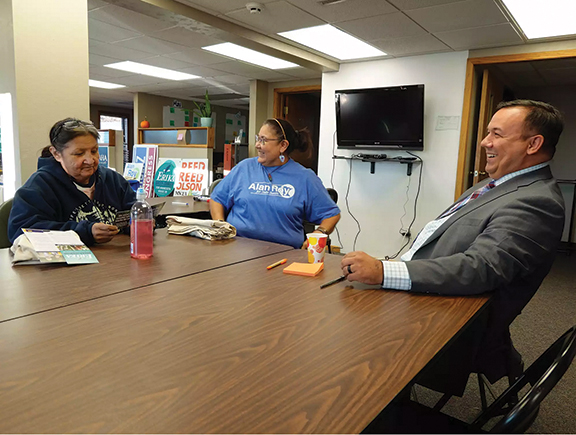
DFL candidate Alan Roy expects to get strong support from Native voters.
“Red Lake specifically, they’ve decided some races. They primarily vote over 95 percent DFL consistently, and White Earth and Leech Lake, I think with the groundwork that we’re putting in will make a difference,” said Roy. He grew up on the White Earth reservation before leaving to attend college and serve in the military. After returning, he was elected to the tribal council.
Roy was defeated in a 2020 run in the old Senate District 2, receiving about 35 percent of the vote.
He believes the new district elevates the importance of tribal governments.
“That collaboration with the tribes is important. They’re economic drivers for the area, some of the largest employers in the area, and being able to work with them not only on economic issues but on law enforcement issues as well,” he said.
Republican candidate Steve Green did not respond to multiple requests for an interview.
During a debate broadcast on Lakeland Public Television – sponsored by Lakeland PBS, The Bemidji Pioneer, The Brainerd Dispatch and KAXE Northern Community Radio – Green said he would work with tribal governments if elected.
“Because I’m a member at White Earth as well as Alan is” Green said. “But the main thing to remember is that the issues that are affecting all of this district are the same whether you’re a tribal member or not.”
Green has represented House District 2B since 2012, a district that covered a portion of the new senate district. As a result, he has broad name recognition there.
Bemidji State University Political Science professor Patrick Donnay said the Republican candidate is still favored, despite the expanded Native voter representation.
“Even doing that, putting the three together, I think that makes them something about 21-22 percent of the district, of the voting age population,” he said. “It’s a long way still from any kind of majority-minority district.”
And the Native vote is not homogenous, even though Donnay said it’s likely to skew Democratic in most areas.
During their televised debate, the two candidates appeared to agree on many issues, even pausing once to shake hands.
Green returned often to what’s been a major focus for him, government regulation.
“And so there’s a huge backup of bureaucracy in Minnesota. And there again, like my reoccurring theme, that comes through the agencies. And as of yet, the legislature has been unwilling to go after the agencies and rein them in,” Green said.
Roy agreed many businesses are over-regulated. The two also agreed on the need to cut taxes.
Green said key issues he hears about from voters are inflation, parental rights in schools, and public safety.
Roy said he hears most about inflation, abortion rights and adequate funding for schools.
Roy said abortion is the issue that most clearly separates the candidates. He supports abortion rights. Abortion did not come up during the debate, but on social media, Green touts his endorsement by the anti-abortion group Minnesota Citizens Concerned for Life.
Political scientist Donnay says he doesn’t expect the abortion issue to drive a lot of voters to the polls in the largely rural district.
Roy is also trying to establish himself as the candidate who will work best with tribal governments, and collaborate across the aisle.
“I am a pragmatist before anything. I want to get things done,” said Roy.
“He’s a tribal elder and he has served honorably in the legislature. But his policy decisions to consistently vote no on just about anything is detrimental to the progress of the district.”
Green insisted during the debate his efforts to work across the aisle are routinely rebuffed by DFL legislators at the capitol.
Donnay said so far, he’s seen little outside money spent in the race, leading him to believe the landscape of the new district gives Republicans a decided edge.
But he said there are unknowns: will Republican voters turn out in a referendum on President Joe Biden, or are Democrats more energized by key issues?
“What is turnout going to be? I don’t think anybody really has a good idea. It doesn’t feel like it’s a typical midterm,” he said.
Whatever the outcome of this race, it could result in a stronger voice for Tribal Nations in northern Minnesota at the legislature.
Minnesota Public Radio News can be heard on MPR’s statewide radio network or online at https://www.mprnews.org.