
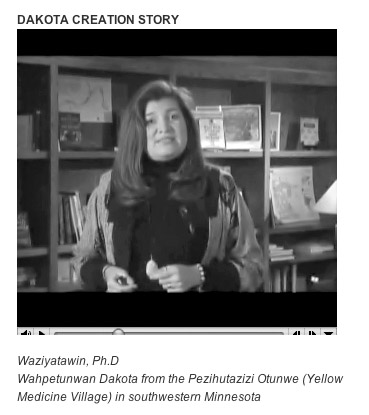
 Waziyatawin (Angela Wilson), Ph.D., a Dakota scholar and activist,
and the Minnesota Humanities Center in Saint Paul have collaborated to
create Responses to Statehood, an online video project that showcases
Dakota and Ojibwe perspectives on Minnesota statehood and the
sesquicentennial. The project began airing in November when the
Humanities Center began luanching new videos weekly.
New videos
will be uploaded through December. Waziyatawin (Wahpetunwan Dakota)
hosts each chapter, providing video commentary on such topics as: the
forced removal, ethnic cleansing and
genocide, boarding schools, allotment, and the seizure of Native lands.
All videos and support material can be found under "Special Projects"
on the center’s main website. Several introductory videos
guide viewers into the larger presentation. The first video explains
the connection between the Humanities Center and Minnesota statehood.
Waziyatawin (Angela Wilson), Ph.D., a Dakota scholar and activist,
and the Minnesota Humanities Center in Saint Paul have collaborated to
create Responses to Statehood, an online video project that showcases
Dakota and Ojibwe perspectives on Minnesota statehood and the
sesquicentennial. The project began airing in November when the
Humanities Center began luanching new videos weekly.
New videos
will be uploaded through December. Waziyatawin (Wahpetunwan Dakota)
hosts each chapter, providing video commentary on such topics as: the
forced removal, ethnic cleansing and
genocide, boarding schools, allotment, and the seizure of Native lands.
All videos and support material can be found under "Special Projects"
on the center’s main website. Several introductory videos
guide viewers into the larger presentation. The first video explains
the connection between the Humanities Center and Minnesota statehood.
Stanley Romanstein, President and CEO, says
the humanities encourage people to examine complex issues like the
sesquicentennial from interconnected specialties such as philosophy,
history, ethics, culture, and civics.
Waziyatawin then provides Dakota and English greetings before
discussing the Dakota creation story and its profound connection to the
geography of the Twin Cities area. She also presents her values
assumptions: genocide is a crime against humanity, might is not right,
white is not right, and a good society is a just society. From there,
the "Statehood Video Library" links to several Native introductions and
the topic chapters. As support material, the "Statehood Resources
Library" provides links to a variety of articles, and "Statehood
Voices" describes the many Native people who have
contributed to the project, such as Joe Bendickson, Neil Cantemaza
McKay, and Lillian Rice.
Support material also includes a list of
questions to consider. "My goal with the Responses to Statehood project
is to bring in critical perspectives you won’t find anywhere in the
mainstream," said Waziyatawin. "These are perspectives ignored by the
Sesquicentennial Commission, mainstream media, and textbooks."
The project began as an outgrowth of the Humanity Center’s ongoing
teacher-training workshops that present Dakota and Ojibwe perspectives.
The workshops received positive feedback, spurring the
center to seek other ways to share with a broader audience. "We have
worked with state teachers for over eight years under the philosophy
that all speakers, presenters, and planners of workshops
will be from the Dakota or Ojibwe community," said Matthew Brandt, Vice
President of the Humanities Center. "This has made for powerful and
life-changing experiences for those who attend." After learning of the
Sesquicentennial Commission’s limited opportunities for Native
perspectives, the center hired Mona Smith (Sisseton-Wahpeton Dakota) to
film some of the teacher-training workshops. The project eventually
expanded to include interviews with Native people from throughout the
state. Smith is currently producing the online videos. She is a
filmmaker and co-founder of Allies: media/art, an award-winning,
Dakota-owned media production company. "The work I do is focused on
expanding the listening range of Native, and especially Dakota,
voices," she said.
"So I was happy to producethe video for the site. Being part of providing resources from Native
points of view for teachers and learners is an honor." Smith
interpreted Waziyatawin’s presentation for a web-based format bybreaking it into small pieces and illustrating the resulting sections
in a way that was true to the speaker and compelling to the viewer. The
Humanities Center says it is committed to this project for the
long run, beyond the sesquicentennial. It has enlarged the scope of
outreach beyond state teachers to attract viewers from as many regions
and backgrounds as possible. A blog was also added to allow community
members a space to comment.
The collaboration between Waziyatawin and the Humanities Center has its
roots in a spring 2007 meeting with the Sesquicentennial Commission.
Secretary of State Mark Ritchie and Commission Director Jane Leonard
invited Dr. Waziyatawin and Matthew Brandt to a meeting with other
community members. The commission said it wanted to get the Dakota
perspective on the sesquicentennial. Waziyatawin presented her ideas,
assuming the commission members would change their plans and include
Native points of view. However, she says the members ignored her after
the meeting.
One man even asked another member about playing golf. "I had just
finished giving a presentation about genocide and land theft," she
said, "and he was talking about golf." After the meeting, Brandt asked
to speak with Waziyatawin and said the Humanities Center wanted to
provide opportunities to share Dakota and Ojibwe perspectives. "They
are essential if Minnesotans are going to truly understand the history,
culture, and living experience of Native people in the state," said
Brandt. "The videos highlight many untold aspects of our state history
from uncompromising, indigenous points of view. We are hopeful people
will leave with a desire to learn more, even if the material might be
difficult to listen to." In addition to the teacher workshops and web
videos, Waziyatawin has also written a book, What Does Justice Look
Like. It examines the price the Dakota paid for Minnesota statehood and
the ossibility of embarking on a path of transformation to respectful
coexistence. To see the videos and blog, go to:
www.minnesotahumanities.org.