
 World champion
jingle dress dancer Willow Abramson (Shoshone-Bannock) faced
difficult challenges in her life. In 2005, she and her family were
involved in a car crash; her baby daughter and husband did not
survive. She found healing in dancing.
She believes the
energy and life on the powwow circuit helped her find strength to
raise her son. She encourages her fellow dancers, “Some of us dance
to forget, some of us dance to remember, some of us dance to heal,
but whatever the reason, just dance with your heart and your spirit:
we see it shine when you dance.”
It’s officially
Powwow Season in Indian Country! The anticipation and excitement
dancers and singers built up throughout the winter months will be
unleashed within many traditional and contest powwows throughout the
country this year. Indigenous people have always gathered to
celebrate and heal through song and dance. What has evolved is our
contemporary powwow, the opportunity to share culture across various
tribes.
Taking part in the
powwow circuit can create connections for lifelong friendships, as
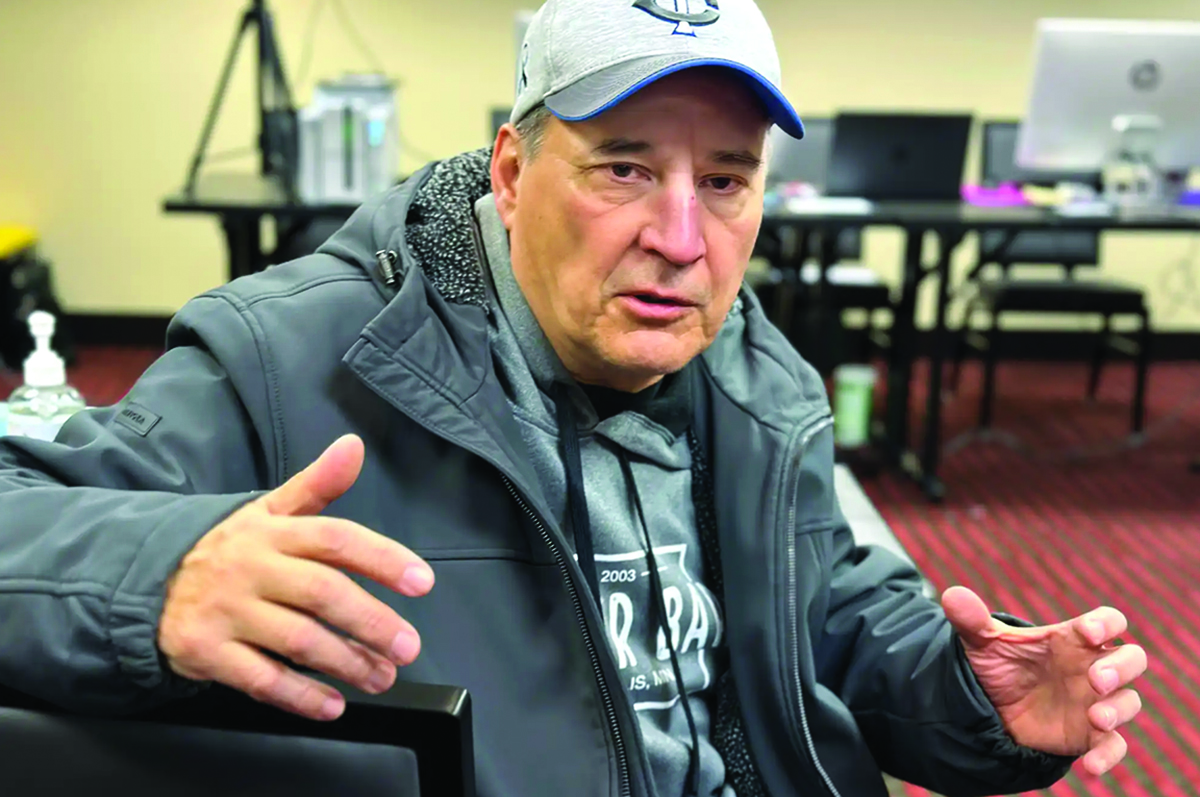
dancers and singers alike. Frankie Graves (Leech Lake Ojibwe) has
been involved with powwows since he was a young child. Graves has
been a Grass Dancer, singer, Arena Director and even a master of
ceremonies at various powwows across the Midwest. He shares his
experience with the powwow culture, “So many beautiful Nations come
together in the summertime, almost creating one large nation, like a
big family.”
There are hundreds
of different tribal nations, all with very unique dances including
the Hoop Dance from the Southwest region, the Chicken Dance from the
western tribes, or the Smoke Dances from the East Coast. Although
only the primary dance styles are highlighted here, it is important
to keep in mind these dances all originated with teachings and
stories.
Women
 Fancy Shawl
The Fancy Shawl
dance is the most recent edition to the powwow scene, which appeared
around the 1950s. Women used their shawls, which looks similar to how
a butterfly moves about. The fancy shawl dance is a hybrid adaption
of various tribal dances. Their moves are often large and the
footwork is a complicated bounce, as women move lightly across the
arena.
Northern
Traditional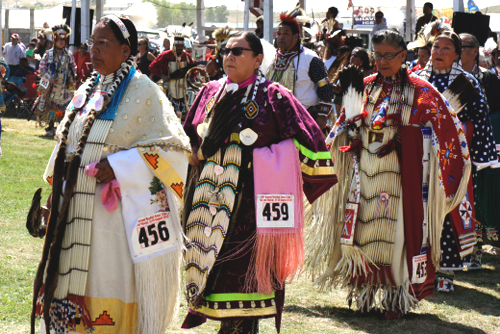
Women’s
traditional is one of the oldest dances. Historically, this dance is
in honor of warriors returning home from battle. Northern style
traditional dancers stay on the perimeter of the arena and Northern
women’s traditional dancers often dressed in elaborate beadwork and
buckskin. Their regalia include intricate designs, beautiful fans and
amazing uses of color.
Southern
Traditional
Like Northern
Traditional, Southern style has buckskin, velvet or other cloth
dresses. However, beadwork is only used as an accent. Southern style
Women’s Traditional dancers do not stay along the perimeter, but
gracefully step throughout the arena.
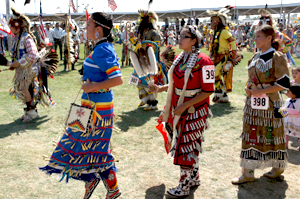 Jingle Dress
The Jingle Dress
dance is considered a newer dance. There are different stories that
come with its creation. In one story, a young Ojibwe girl became very
ill. Her grandfather had a dream about a dress with these jingles all
around the dress, which gave the whooshing sound, like the sound of
the creation of the universe.
In the dream, the
young girl was to wear the dress and become healed. The story goes
that the young girl was too sick to dance, so she was carried around
the circle and was healed. The jingle dress since then was introduced
to other tribes and spread into the powwow circuit. The Jingle Dress
is considered to be a powerful medicine and women who take on the
dance style are to be very respectful.
Tin cones are sewn
around the dress, often 365 of them representing every day of the
year. Women often dance in small foot moves, in a zig-zag pattern,
creating a specific rhythmic sound with their jingles.
Mens
Fancy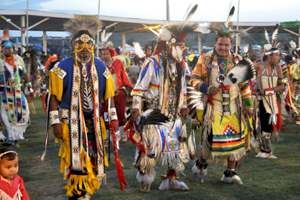
The newest edition
to the powwow, Men’s Fancy Dancers were at first considered clowns.
Like Women’s Fancy, this style of dance was an adaption of various
tribal dances. Men’s Fancy Dancers use incredible bright and bold
colors with their fast movements. Often using high jumps and fast
beats, fancy dancers wear two large bustles and two smaller ones on
their arms made of ribbon, yarn or hackle feathers creating a
streaming movement look to compliment dancing.
Northern
Traditional
One of the oldest
dance styles, Northern Traditional Dancers imitate a hunter searching
for their enemy. Originating from the Northern Plains tribes,
Northern Traditional Dancers have a bustle with about 28 eagle
feathers and colorful beadwork. They often carry a fan or an eagle
whistle.
Southern
Traditional
Also known as
Straight Dancing, Southern style Traditional Men’s Dancers do not
wear a bussel and their movements are more concentrated compared to
the Northern Men’s style.
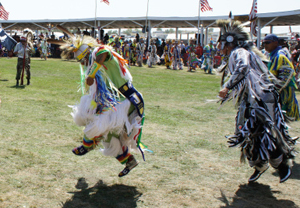 Grass Dance
Originating from
the Omaha Warrior Society, the Grass Dance began as a victory dance
and has since evolved. Outfits have ribbon or yarn fringes somewhat
resembling grasses flowing in the wind. Dance moves are symmetrical,
as dancers create movements in one direction to be duplicated with
the other side.
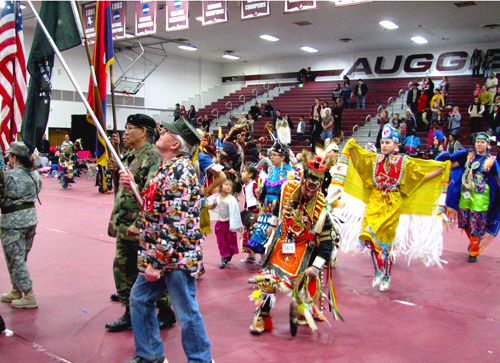
COVER PHOTO: The afternoon Grand Entry at the 7th Annual Augsburg Traditional Powwow in Minneapolis on March 28. Veterans hold a special place in Native American culture, often leading the Color Guard before the dancers. (Photo by Deanna StandingCloud)