
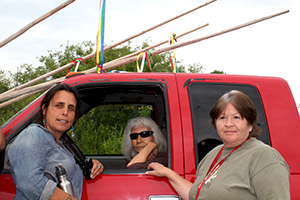
 On an overcast, and quiet midday
afternoon, 50 or so Anishinaabeg from ricing families and their
friends gathered at Big Bear Landing on the shore of Big Rice Lake.
It is 138 years to the day of the infamous Battle of the Little Big
Horn.
Some would say that the odds were not
great for the Lakota at that point and some might say the same now,
for the Anishinaabeg. The Ojibwe hold ricing poles, knockers and
carry their canoes to the lake, carefully placing them on the edge.
Michael Dahl, has called us together to talk about our manoomin, our
wild rice and this lake. This lake is the most bountiful wild rice
lake in Minnesota – four miles long and two miles wide. A solid bed
of wild rice on a good year. There is nothing like it. Really.
It’s an epic moment. The newest
version of the Indian Wars is coming towards Rice Lake. This Seventh
Cavalry incarnation is a set of fossil fuel and extractive mining
proposals, capped by some pipelines – big ones headed every which
way across the heart of Indian Country. Kinder Morgan and Enbridge
Gateway to the North in what is called British Columbia and into the
Salish Sea, Energy East projected to go from West to East to Miq’Mac
territory the Keystone XL, Alberta Clipper, Line 9 and the Sandpiper,
are all intended to move fossil fuels – fracked oil and tar sands
oil across some territories, which have no pipelines.
The companies, Kinder Morgan,
TransCanada and Enbridge, with the largest armament, are intent upon
reaching their ports: Superior, St. Johns, Kitimat and Vancouver.
They are, however, opposed.
June, or the “Strawberry Moon” in
Ojibwe country, has been good for the Enbridge Corporation. They
received the approval of Premier Steven Harper for the very
contentious Gateway Pipeline, despite a plebiscite in the city of
Kitimat opposing the pipeline, the opposition of 140 First Nations,
huge numbers of fisherman and a good percentage of British Columbia.
That was, however to be expected.
After all, Steven Harper has shown immense support for energy
companies, little support for the environment and none for Native
nations. On the heels of that victory, the Alberta Clipper line was
approved by the Public Utilities Commission of Minnesota, clearing
one more obstacle for the company, to proceed in doubling their tar
sands oil pipeline from 400 to 800,000 barrels per day.
Then, a bit of icing on the cake, the
North Dakota Public Utilities Commission approved the first 500 miles
of the Sandpiper Line, intended to carry 375,000 barrels per day of
Bakken oil across Minnesota in an entirely new route than the other
eight pipelines that cross the state. That is a lot of oil headed
across the Lake country, that’s for sure.
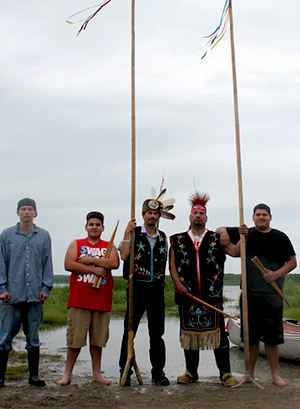
“There is nothing like this lake
anywhere,” Blaze Neeland, a ricer, told me. “This lake has rice
forever, we eat from this lake, fish at this lake and it is our
life.” Elder Joanne LaFriniere, remembers ricing since she was 16
years-old on this lake. It is the lake of the Anishinaabeg
prophecies. That tradition continues and today, she names the
pincherries, blueberries, raspberries, strawberries, chokecherries,
which all grown in the lands which surround the lake. “One oil
spill and it is gone, our whole life is gone.” Alfred Fox, Chief
Conservation Officer for the White Earth tribe came to the gathering,
he told stories about how the people used to gather, dance and then
work together to build up the landings and the access to the lake.
The lake is a national treasure for the Anishinaabeg and the proposed
Sandpiper line would go within the reservation boundary, within the
watershed which feeds the lake and, about a mile from the Rice Lake
shores.
“It stops here.” Michael Dahl
explains. Dahl prays for a long time in Anishinaabeg to the rice, the
lake, the beavers, the muskrats, the Thunderbeings and thanks all for
being there. Dahl has been to each of the Public Utilities Commission
hearings and does not seem convinced that the PUC or Enbridge has
taken seriously the unanimous opposition of the Ojibwe to the
Enbridge proposal. “I don’t expect them to come here,” he said
of the PUC, despite the formal request of the White Earth Tribal
government for PUC hearings on the reservation. Thus far, none have
been scheduled. “I am here for the rice, not for Enbridge,” he
tells us.
I can’t help thinking that the
Seventh Cavalry of 139 years ago had a lot of guns and was pretty
arrogant. I also can’t help thinking that the Indian Wars are not
over yet.