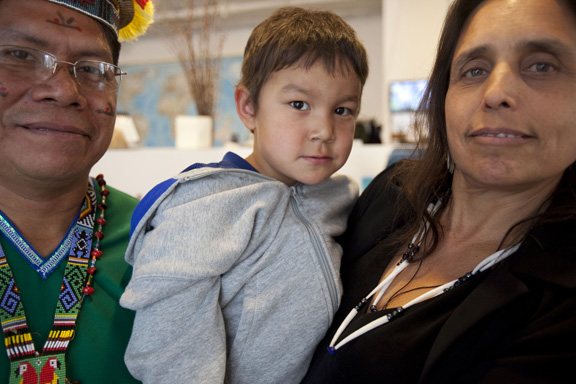
 In May, my grandson Giiwedin Buckanaga and I traveled to the United Nations in New York City for the UN Permanent Forum on the Rights of Indigenous Peoples (UNPFII). Testifying and attending the meeting were thousands of Indigenous delegates from African, American and Asian continents; all discussing the need for self determination, rights to a clean environment, rights to language and religious freedom, protection from foreign militaries, and hoping for some redress by multinational corporations who have contaminated their land.
Perhaps the most compelling case (with US origins) was that of the Ecuadorian Native and farming communities, who have been poisoned by American-based Chevron Oil. They are now seeking justice in the US courts, after having won justice in the courts of Ecuador.
After l7 years, the Indigenous people of the Amazon, represented by Ramiro Aguinda (Aguinda vs. Texaco), got justice. Or so they thought. Chevron-Texaco had dumped over 17 million gallons of pure crude oil and l6 billion gallons of toxins into their pristine ecosystem in Ecuador, leaving a wake of ecological and human destruction. Thousands of illnesses and cancer deaths, birth defects and a lost way of life, have impacted the last generation of people from the region (of at least 30,000).
In February, after a l7 year set of legal proceedings, an Ecuadorian court found Chevron liable for $18 billion in damages. The trial was conducted in Ecuador (Chevron had petitioned to move it from a more public US venue). But Chevron is now refusing to pay the judgment, and has sued the poor and indigenous plaintiffs in US courts to overturn the decision.
In the proceedings, Chevron admitted at trial that it deliberately discharged 16 billion gallons of toxic "produced water" directly into the environment, dwarfing the amount of oil spilled during the BP Gulf disaster. The company also abandoned more than 900 unlined waste pits, spilled more than 17 million gallons of pure crude oil, and continually "flared" contaminants without any environmental controls, according to evidence presented during the trial.
In a letter released by a delegation of five Ecuadorians, the plaintiffs said Chevron oil workers, "Told us that oil was good, that it would bring progress for the future. We remember the almost daily oil spills. How the crude oil would came down the rivers like black sheets. We remember the toxic waters they dumped in our rivers. We remember how the fish began to die, how they tasted of metal and gasoline. We remember how the men raped our women. We remember the pain our children felt after bathing in the rivers contaminated with oil. We remember the illnesses, the deformations, the cancer. We remember all of those who died."
Chevron became the second largest oil company three years ago, with the purchases of Unocal and Texaco, and posted $2l0 billion in sales and $l7B in profits in 2006. The company has publically stated that it will fight the fines till "hell freezes over".
Total court awards include $8.6B in damages, mostly to decontaminate polluted soil, $860,000 to plaintiffs and a further $8.6B in punitive damages. The legal ruling accounts to BP’s $20B compensation fund after the Gulf oil spill. Chevron’s earnings were $6.2B in the first quarter of 2011, up from $4.6B last year, indicating that one year of corporate profits could pay the legal settlement of the court.
More than 1,300 Indigenous delegates from around the world attended this 10th session of The UNPFII – an advisory body to the Economic and Social Council, with a mandate to discuss indigenous issues related to economic and social development, culture, the environment, education, health and human rights.
This year’s forum was especially significant, since it is a review year, which will focus on the implementation of forum recommendations on economic and social development, the environment and free, prior and informed consent.
Throughout this session Indigenous peoples have advanced their own development models and concepts and practices of living well, as well as organized around issues of self-determination and collective rights, organizing power and support for (as in the Aguinda case) challenging the environmental and cultural devastation and exploitation of land and people.
Editor’s note: Texaco started drilling in Ecuador’s Amazon rain forest when the country was run by a military dictatorship who profited from the wealthy US oil men. The Ecuadorian upper class grew rich from the oil extracted in the Indian homelands. With the new leader, Rafael Correa, now in place and a switch to a socialist government, Ecuadorian support has turned toward the indigenous people and the devistated rain forest.
Ecuador’s President Correa, elected in 2006, has called the environmental damage to the Amazon a crime against humanity. He has extended greater protection and rights to indigenous cultures, and has given "Pachamama" (Mother Earth) legal standing. Their new constitution gives nature the right to "exist, persist, maintain, and regenerate its vital cycles, structure, functions, and its processes in evolution." Ecuador is the only country in the world to have granted legal rights to the environment.