
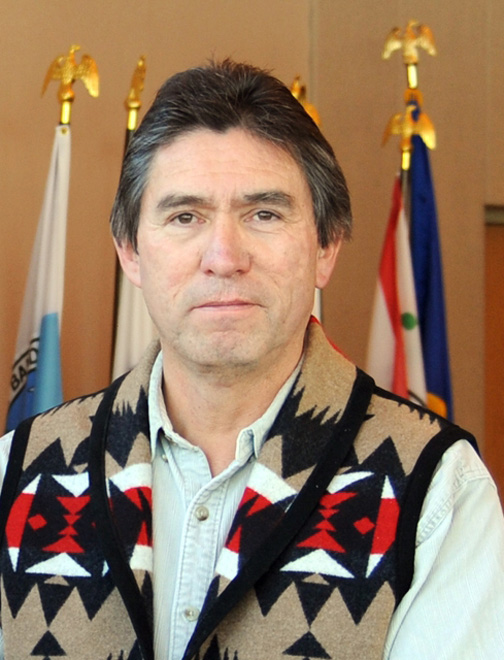
 Leech Lake Tribal College Names Dr. Donald Day President
The Board of Trustees of Leech Lake Tribal College has announced that Dr. Donald Day, Director of the American Indian Resource Center at Bemidji State University, has been selected as the next President of the College, effective August 13. He will succeed Dr. Ginny Carney, who is retiring in August after more than a decade of service at LLTC.
In announcing the appointment of Day, Rose Robinson, Chair of the Leech Lake Tribal College Board of Trustees, said, "On behalf of the LLTC Board of Trustees, I extend a warm welcome to Dr. Day. We are all looking forward to working with Don as he steps into this leadership role at an entity that is so important to our community."
Day’s career in education spans more than 35 years, and has covered a wide range of roles including academic counseling, teaching, research, student services, curriculum development, and administration, including a successful stint as president of Fond du Lac Tribal and Community College. Day mentioned that one of his proudest accomplishments was gaining approval from the Higher Learning Commission for FDLTCC to offer its first ever four-year degree program – a big leap forward for any community college.
"Leech Lake Tribal College is an awesome institution with strong academic programs that are grounded in Anishinaabeg values" Day said. "I look forward to working for my people again and expanding the already impressive services and outreach efforts in which the college faculty and staff are now engaged."
Dr. Carney will stay on board at LLTC until August 15, and then plans to return to southeast Tennessee to spend time with family and friends. "My 11 years at Leech Lake Tribal College have been some of the most rewarding and fulfilling years of my life, and I am confident that Dr. Day will be given the same warmth and respect that I have received," said Carney. "I offer my congratulations to Don and wish him all the best as he assumes his role as President of LLTC."
Founded in 1990, Leech Lake Tribal College is a public, 2-year college that provides higher education grounded in Anishinaabe values. For more information about the college, visit www.lltc.edu or call 218-335-4200.
Free colonoscopies for Indian men and women ages 50 – 64
The Sanford Health Bemidji has partnered with the Minnesota Department of Health Sage Scopes Program to provide free colonoscopies to American Indian men and women between the ages 50 – 64, and has committed to find ways of paying for treatment if cancer is found.
The screening can save your life by finding and removing polyps before they can turn into cancer. Northern Plains Indians have some of the highest colorectal cancer rates in Minnesota.
American Indians referred to the program through their tribal health system are exempt from income guidelines.
Sage Scopes is a free colorectal cancer screening program that provides free colonoscopies for eligible Minnesota men and women. Most people should get screened for colorectal cancer starting at age 50.
Sage Scopes will provide a number of services free of charge to eligible participants: Bowel prep kit, Screening colonoscopy, Follow-up tests for patients with abnormal screening results, Interpreters for patients who do not speak English, Pre-colonoscopy office visit if required.
If you are interested, call Sage Scopes at 1-888-643-2584 (mention code ScopesWeb) to see if you’re eligible. Receive a $20 gift card once screening is complete.
North Hennepin Com. College offers new American Indian course
A new course will be offered at North Hennepin Community College starting this fall. The "American Indian Culture – Indigenous Peoples of Minnesota" course will provide students with an overview, past and present, of the cultures of Indigenous Peoples of Minnesota, including music, dance, art, the oral story telling tradition and the American Indian connection with the environment and other non-human species. Students will also analyze how these vibrant cultures have survived oppression and genocide, and continue to thrive.
This 3 credit college level course meets goal areas 6 and 10 as part of the liberal education requirements needed for completing the Associate of Arts degree and also for meeting the goals of the Minnesota Transfer Curriculum.
The course was developed by Dr. Anton Treuer and will be taught by Dr. Brendon Fairbanks. For information about how to register, contact Melissa Lembeck, Director of Outreach and Admissions at 763-424-0945.