

By Winona LaDuke
In 1986, Congress passed the White Earth Land Settlement Act. Returning l0,000 acres of land to the White Earth Anishinaabe and $17 million in settlement funds to the White Earth Tribe. What was this for? How did this happen? Was it just?
The Giiwedinong Museum will be exploring the history of land loss on the White Earth reservation, and those who fought to protect our land- from the 1800s to the l980s. We’ve collected a lot of historical information and interviewed people involved with the 2415 investigation into land loss on the White Earth reservation. We want to talk to those who remember and participated in meetings, demonstrations and the formation of Anishinaabe Akeeng, a community organization, along with groups like White Earth Heirs and Allottees Association to seek justice.
The museum will be hosting a set of community meetings to record oral histories of land loss on the White Earth reservation and the contemporary struggles of those in the l980s and beyond who sought return of land. Those meetings will begin in January, and the museum will work with community people to prepare exhibits and materials from historic and present oral histories. We will hold meetings in White Earth village, and in Minneapolis.
How did this happen?
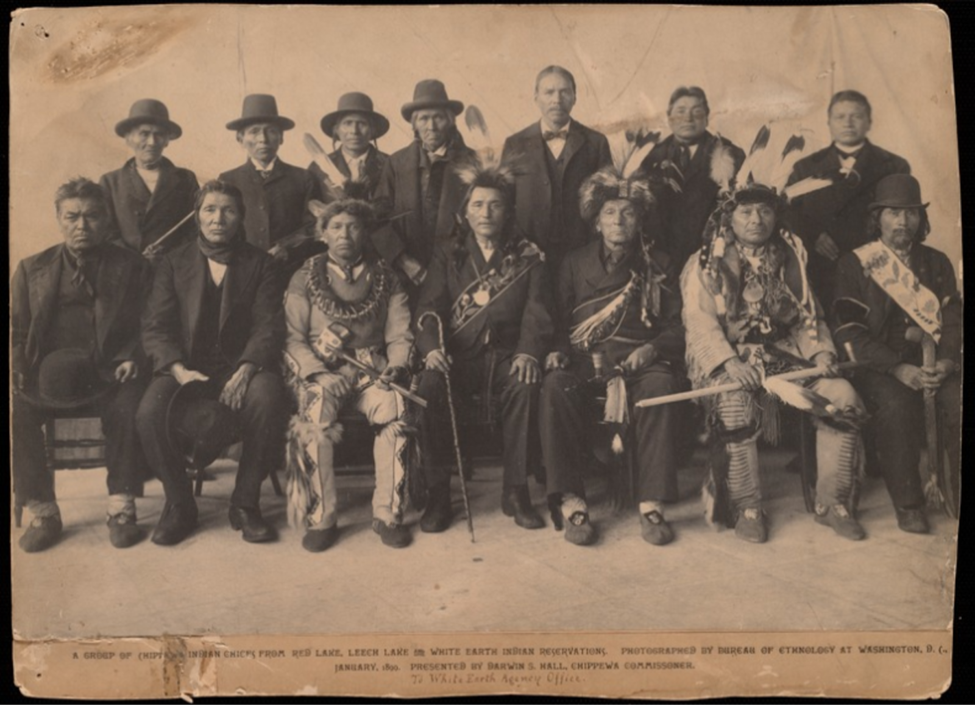
“… the lands so held by any Indian shall be exempt from taxation and sale for debt and shall not be alienated except with approval of the Secretary of Interior and in no case to any person not a member of the Chippewa…” Article 7 of the 1867 Treaty. That treaty was signed by President Andrew Johnson, and was the basis for many of the Anishinaabe Chiefs to move their people to the reservation, including Mezhukegiizhig, who moved to the Rice Lake area, Bad Boy ( Pine Point and Tamarac Refuge area), Wadena , whose family is today largely in Naytauwash, and of course Wabunoquod, or White Cloud who became one of the principle leaders of the Anishinaabe of White Earth.
The Problem
From an initial reservation area of 829,444 acres, in 1983 there were only 54,125 acres in tribal hands, and 1,953 under allotment on the White Earth Reservation. The Nelson Act, Clapp Act and Steenerson Act stripped land and trees from the Anishinaabe, followed by land takings like the Tamarac National Wildlife Refuge and the White Earth State Forest. It was devastating for our people, and illegal. That is how the urban Anishinaabe came to be- by the 1920s. three quarters of all tribal members had moved off reservation- refugees in our own land. The museum will explore this historic record, and the impacts on our people.
Then we will talk about resistance: A 1974 Minnesota Supreme Court decision and the actions of George Aubid the heir of ZayZah, opened a door for the beginning of land recovery by the White Earth band, underscoring what would become a national investigation.
The federal 2415 investigation began on White Earth in l979 and was intended to review the allotments and the land transactions which had resulted in the illegal transfer of lands. The investigation found that there were several ways in which land had been transferred illegally- tax forfeiture ( ZayZah case), forced fee patents, minor sales, full blood sales and more. The initial investigation by the 2415 found at least 99,350 acres of land were tied up in 947 disputes. The 2415 investigation was closed before completion, but many of the researchers concluded that if the 2415 study had been completed, two or three times as much real estate could have been claimed. Interviews with John Morrin, an initial researcher for 2415 Claims, and others helped reveal the injustices.
White Earth tribal members organized to inform others about the land rights and the 2415 investigation. Tribal members formed groups like Anishinaabe Akeeng, and the White Earth Coalition of Heirs and Allottees. They held meetings, met with the tribal council, and testified at state and federal hearings. Initial legislation proposed in 1983 would have “cleared land title”, in return for $3 million. This was opposed by the community and later the tribal council. There was a bitter battle, ending in the 1986 White Earth Land Settlement Act which was passed in Congress under a suspension or the rules, and very few legislators in the room, another theft of land.
The White Earth Land Settlement Act told a story of what had happened to our people, but much of the story was omitted, and there were clear denials of due process and just compensation. This law was opposed by many allottees and their descendants, who filed two federal cases- Manypenny V. US and Little Wolf V. US seeking return of land and due process. These cases, filed in Washington DC, were dismissed.
In l989, sone members of Anishinaabe Akeeng formed the White Earth Land Recovery Project and were able over the course of twenty years, to secure 1300 acres of land on which they farm, harvest maple syrup, hold ceremonies, and created a radio station- Niijii Radio or KKWE in one of the facilities, the former Callaway Elementary School. That’s the legacy and there is more
The quest for justice on White Earth continues. We hope to have a display commemorating the 40th Anniversary of WELSA, and what it means in these times, up for the summer.
Please email winona@giiwedinong.org if you’ve got stories to tell and want to help organize informational meetings.